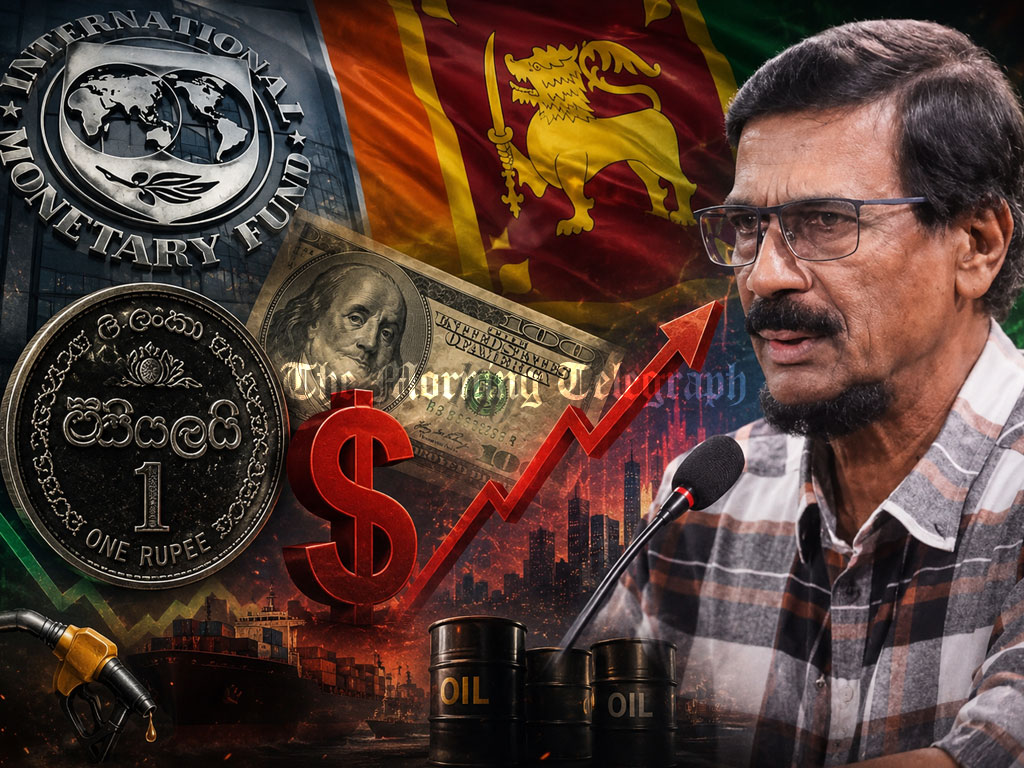
Dollar intervention by the government has raised IMF concerns after Tilvin Silva said authorities brought the rupee back from Rs.350 to Rs.330.
Dollar intervention by the government helped bring the rising US dollar under control in recent days, JVP General Secretary Tilvin Silva said.
He said the government had successfully intervened to control the rapidly rising dollar and maintain it at a stable level.
Commenting on current economic management, Silva pointed out that the cost of fuel imports had increased sharply due to the ongoing war situation.
He said the cost of importing oil stood at US$98 million in February.
By May, that expenditure had increased fivefold to US$520 million.
Silva said that, in the face of this situation, the value of the dollar exceeded Rs.350.
However, due to swift government intervention, he said it was possible to bring the dollar back down to the Rs.330 level.

The JVP General Secretary further emphasized that the government has the economic management capability needed to create a good country free from racism for future generations.
However, Sri Lanka is currently under an Extended Fund Facility agreement with the International Monetary Fund.
Under such an agreement, the way a central bank intervenes to control the dollar can become a sensitive issue.
A key condition of IMF programmes is that the exchange rate should be determined by market supply and demand.
If the Central Bank attempts to artificially maintain the dollar at a specific level, or control its value by excessively releasing dollar reserves into the market, that could amount to a clear violation of IMF conditions.
Under IMF agreements, a central bank is not completely banned from intervening in the foreign exchange market.
However, strict limits apply.
If the dollar appreciates or depreciates rapidly within a short period due to an external shock or speculative activity, the Central Bank may intervene to control excessive volatility and stabilize the market.
When dollar inflows increase and the rupee becomes excessively strong, the Central Bank may also buy dollars from the market to strengthen official foreign reserves.
That type of intervention is generally consistent with IMF conditions.
Under the IMF programme, countries such as Sri Lanka are given quantitative targets on the minimum level of official foreign reserves they must maintain.
If the Central Bank continuously releases dollar reserves into the market to artificially control the dollar, it may fail to meet those reserve targets.
Such a failure could become a major reason for IMF reviews to be delayed and future loan tranches to be held back.
To reach a proper conclusion on this matter, more information is needed on the technical method used for the government’s dollar “intervention.”