By Roy Denish
A single Bangkok raid has signaled the beginning of a new era in global law enforcement, where cybercriminals can no longer hide behind borders, bureaucracy, or jurisdictional loopholes as nations unite to hunt down digital fraud networks with unprecedented speed.
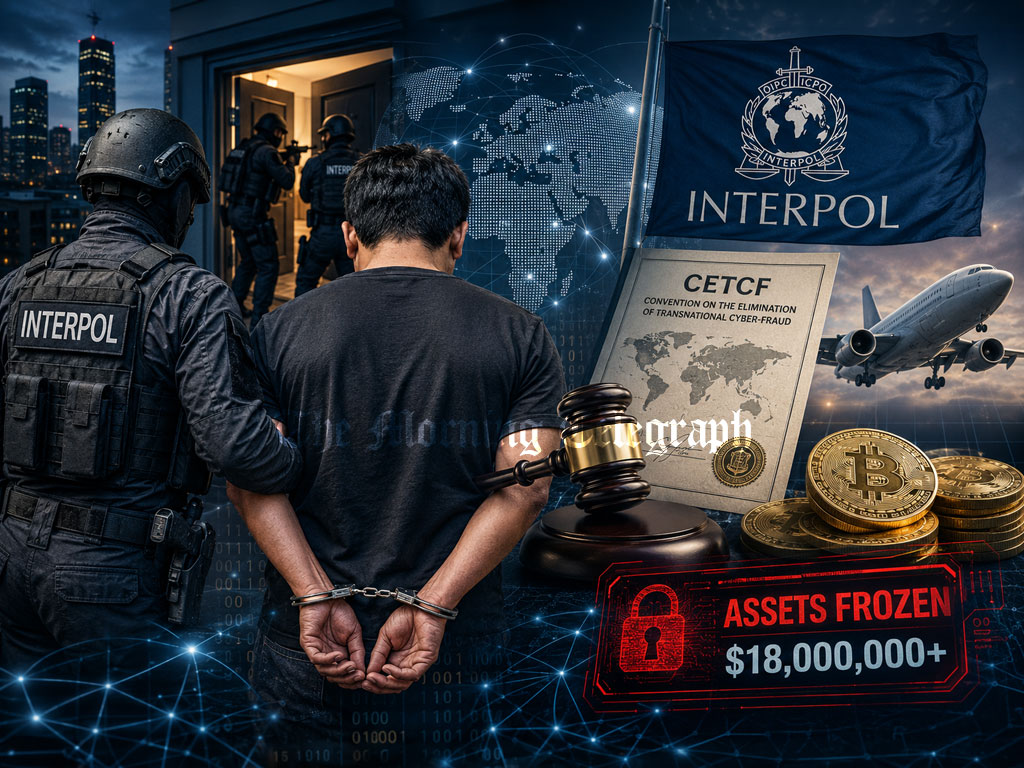
BANGKOK — A historic and hyper-aggressive international treaty aimed at eradicating global cyber-fraud has triggered its first high-stakes enforcement action, resulting in the rapid-fire arrest and near-instant extradition of a notorious scam syndicate leader.
The operations, executed under the newly ratified Convention on the Elimination of Transnational Cyber-Fraud (CETCF), mark a radical and controversial shift in global law enforcement, tearing down decades of traditional bureaucratic red tape to favor the victims of digital crime.

For years, international scammers operated with near-total impunity, shielded by slow-moving diplomatic channels and protective borders. Under old frameworks, extraditing a suspect could take years, if it happened at all.
That era ended at 3:00 a.m. local time on Thursday.
Acting on a “Category-Alpha Intervention” warrant issued by Interpol just hours prior, a heavily armed Thai tactical unit embedded with international Interpol observers, shattered the reinforced doors of a luxury high-rise penthouse in Bangkok’s Sukhumvit district.
Inside, authorities detained 34-year-old Chen Wei, the suspected mastermind behind a sophisticated “pig-butchering” cryptocurrency scam that allegedly defrauded thousands of elderly citizens across the United States out of an estimated $42 million.
Under the strict mandates of the CETCF, the clock immediately began ticking.
Previously, a foreign power attempting to arrest a suspect on sovereign soil would have been viewed as a violation of international law. Under the new treaty, however, Signatory States are legally compelled to act as Interpol’s immediate operational arm.
Within 24 hours of his arrest, well ahead of the treaty’s strict 48-hour deadline, Chen was escorted in handcuffs onto a chartered transport plane bound for Ohio, where he will face trial. In a revolutionary twist for international jurisprudence, Chen will not be tried under Thai law, but under the laws of the plaintiffs’ home jurisdiction.
Simultaneously, financial nodes flashed across the globe as banking institutions and cryptocurrency exchanges executed the treaty’s mandatory asset-freezing protocols. Over $18 million in digital assets tied to Chen’s network were frozen instantly. Under Article IV of the treaty, these funds bypass traditional civil forfeiture delays and are scheduled to be repatriated directly to the victims’ bank accounts within 30 days.
While proponents are hailing the operation as the dawn of true global accountability in the digital age, the treaty has sent shockwaves through international legal communities. Critics argue that forcing a nation to execute foreign warrants with virtually no judicial review compromises national sovereignty and sets a dangerous legal precedent.
“We are entering uncharted waters,” said Elena Rostova, an international law professor at the Geneva Graduate Institute. “By prioritizing the forum of the victim over local judicial oversight, we have essentially created a borderless enforcement mechanism. It is highly effective, but it severely tests the boundaries of sovereign law.”
Despite the friction, Interpol officials remained defiant, signaling that the Bangkok raid is merely the opening salvo in a global crackdown.
“For too long, fraudsters hid behind borders while their victims suffered in silence,” Interpol Enforcement Director Marcus Vance said in a brief statement from Lyon, France. “The message of this operation is clear: if you steal from a victim across the world, you have signed your own extradition papers. The shield of distance no longer exists.”