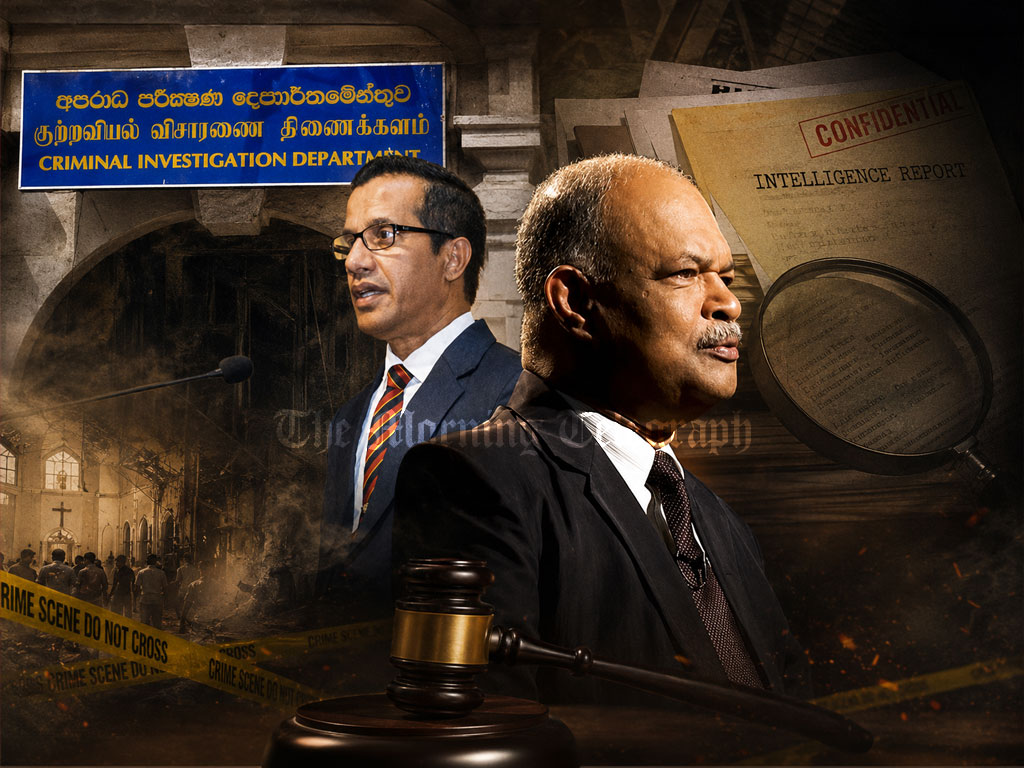
The Easter Attack case took a new turn as court proceedings revealed allegations of intelligence failures, ignored warnings, and CID lapses.
The Easter Attack investigation returned to the spotlight on Wednesday (11) after the Court of Appeal heard detailed submissions alleging serious failures by senior Criminal Investigation Department (CID) officials in the years leading up to the 2019 terrorist attacks.
The Court of Appeal ordered that the writ petition (CA Writ 232/2026) filed by former State Intelligence Service (SIS) Director Suresh Sallay against his arrest and detention under the Prevention of Terrorism Act be postponed for further consideration until July 10.
When the petition was taken up before a bench comprising Court of Appeal President Justice Rohantha Abeysooriya and Justice Priyantha Fernando, several significant matters relating to the conduct of senior CID officials and the handling of intelligence before the Easter Sunday attacks were placed before court.

Questions Raised Over ISIS Investigations and Mawanella Incident
President’s Counsel Sanjaya Jayewardene, appearing on behalf of petitioner Suresh Sallay, outlined before court how the ISIS terrorist network had operated within Sri Lanka. He reminded court that 39 Sri Lankan nationals had travelled to Syria and joined ISIS directly, and noted that former Justice Minister Wijayadasa Rajapaksa had previously made a statement in Parliament regarding the matter.
Referring to investigations into the destruction of Buddha statues in the Mawanella area, counsel argued that clear indications had emerged linking the incidents to an extremist foreign ideology. Despite this, a serious allegation was made that Shani Abeysekara, who served as Director of the CID at the time, had failed to pursue a sufficiently broad investigation.
It was further argued that opportunities existed to expand inquiries with Interpol assistance and that alleged negligence at the CID level contributed to circumstances that ultimately allowed the attacks to take place.
97 Intelligence Reports and 129 Suspects Allegedly Overlooked
Court was told that a sworn affidavit submitted before the Supreme Court confirmed that former SIS Director Nilantha Jayawardena had forwarded 97 intelligence reports concerning extremist activities, including those involving Zahran Hashim, to the Inspector General of Police between April 20, 2016, and April 30, 2019.
In addition, intelligence authorities had reportedly provided a list of 129 individuals linked to extremist activities. Allegations were raised before court that then CID Director Shani Abeysekara and Senior Deputy Inspector General of Police Ravi Seneviratne had failed to conduct adequate investigations based on those intelligence reports and information.
Focus Turns to Janaka de Silva Commission Findings
A major point of discussion during the hearing centred on findings contained in the Janaka de Silva Presidential Commission of Inquiry report into the Easter Sunday attacks.
Particular attention was drawn to observations appearing on pages 114 to 116 of the report. Counsel noted before court that these findings have not been challenged by Cardinal Malcolm Ranjith or the Catholic Church.
According to the Commission report, the CID’s position on January 29, 2019, that international police assistance could not be sought because there was insufficient information regarding the country or method involved in the conspiracy, was described as lacking foundation.
The report records that by January 25, 2019, approximately three months before the attacks, the SIS Director had already informed Senior Deputy Inspector General Ravi Seneviratne in writing that Zahran was an extremist preacher encouraging youth to carry out an ISIS-style attack in Sri Lanka and that he maintained links with foreign extremists.
Only Five Officers Assigned to a Major National Security Threat
The Commission report further states that the CID failed to assign adequate priority to what later became one of the gravest national security threats in Sri Lanka’s history.
Although the CID had more than 700 officers at its disposal, only five officers, including the chief investigator, had reportedly been assigned to the investigation. Evidence before the Commission showed that the lead investigator’s division was simultaneously handling nearly 400 routine investigations with a team of just 22 officers.
The report also highlighted findings connected to the Wanathawilluwa explosives camp investigation. During those inquiries, investigators had reportedly uncovered evidence suggesting plans aimed at establishing an Islamic state in Sri Lanka.
One suspect was alleged to have stated, “We will turn it into a lake of blood.” The Commission report further indicates that an attack originally intended for 2020 was accelerated after Zahran feared detection following the discovery of the Wanathawilluwa camp.
Investigators recovered nitric acid, urea, potassium nitrate and 99 Indian-manufactured non-electric detonators from the site.
Indian Intelligence Warnings Allegedly Ignored
The hearing also revisited warnings issued by Indian intelligence agencies shortly before the attacks.
Court heard that on April 4, 2019, Indian intelligence authorities formally alerted Sri Lankan officials that members of the National Thowheed Jamaath, including Zahran Hashim and his associates, were preparing suicide bomb attacks targeting churches, luxury hotels, and the Indian High Commission in Colombo and surrounding areas.
The warning reportedly included the names of individuals expected to participate in the attacks. Counsel argued that the relevant authorities failed to act with the urgency required despite the detailed nature of the intelligence received.
Legal Questions Surrounding Sallay’s Detention
The submissions also drew attention to findings contained in the report of the committee headed by former High Court Judge Jayakee de Alwis, which specifically recommended legal action against Shani Abeysekara and Ravi Seneviratne for alleged failures linked to preventing the Easter Sunday attacks.
Against that backdrop, counsel argued that the detention of former SIS Director Suresh Sallay under the Prevention of Terrorism Act raises significant legal and ethical questions, particularly since no investigative commission or inquiry report has directly implicated him in planning or facilitating the attacks.
While emphasizing the need to respect judicial independence and the ongoing proceedings, developments before the Court of Appeal suggest that the next hearing on July 10 could trigger an extensive legal debate surrounding accountability, intelligence failures, and what has been described as one of the most significant alleged derelictions of duty in Sri Lanka’s criminal investigative history.