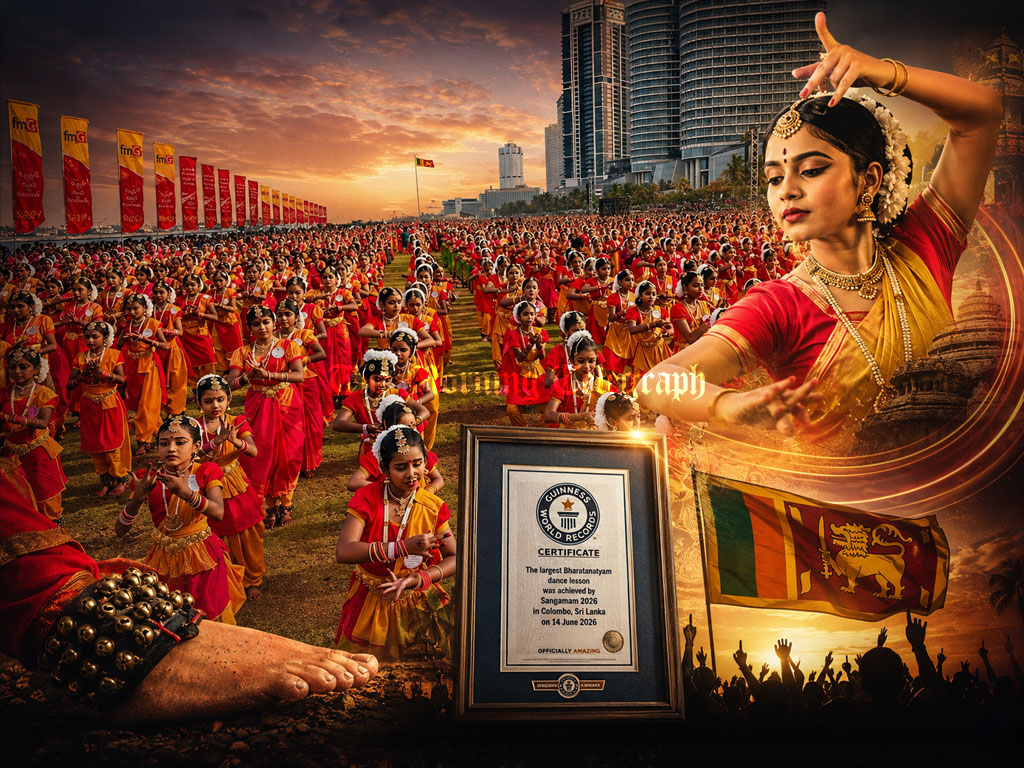
Nearly 5,000 Bharatanatyam dancers turned Colombo’s Galle Face Green into a spectacular display of culture and unity, breaking a Guinness World Record with 4,988 performers. The Sangamam 2026 festival showcased the timeless beauty of classical dance while strengthening cultural ties between Sri Lanka and India.
Roughly 5,000 dancers set the Galle Face Green ablaze when they shattered a world record by performing Bharatanatyam, a traditional South Indian dance. In a breathtaking display of synchronized geometry on June 14, 2026, the Colombo oceanfront promenade transformed into a sea of vibrant silk costumes, resonant ankle bells, and expressive storytelling.
The scale of this mass performance, titled the “Sangamam 2026” Bharatanatyam festival, completely obliterated the previous global standard. The official Guinness World Record for the largest Bharatanatyam dance lesson had been held since February 2020 by the Thyagayya Charitable Trust in Chennai, India, which brought together 416 participants. By scaling the lineup to 4,988 performers from Sri Lanka, India, and several other countries, the Colombo event magnified the record tenfold, setting a staggering new benchmark for classical arts.

To witness the feat was to see the ancient blueprint of the Natya Shastra executed on a monumental scale. The story of Bharatanatyam begins over two thousand years ago in the temples of Southern India, where it was originally known as Sadir Attam and kept alive by the Devadasis, women dedicated to temples who expressed devotion through exquisite movement. Though it faced severe social stigma and an outright ban during the British colonial era, a mid-twentieth-century renaissance rescued and restructured the art form, transitioning it from temple inner sanctums to the global stage.
That rich history came alive as the massive group relied on the flawless execution of adavus, the foundational physical steps combining distinct postures with rhythmic footwork. Dancers dropped into a deep araimandi, the characteristic half-squat position that forms the low, stable center of gravity for the dance, creating sharp geometric angles with their limbs against the backdrop of the Indian Ocean.


The performance seamlessly blended the three core pillars of the art form. The technical precision of nritta, or pure, abstract rhythm, was anchored by the sharp, synchronized slap of bare feet executing complex rhythmic patterns. This structural foundation shifted into nritya and natya, where the performers moved in perfect unison to convey theme and emotion through abhinaya, the art of expression. Thousands of pairs of eyes moved in absolute synchronization, guided by intricate mudras, hand gestures that translated ancient mythology into a shared visual syntax.
The event was jointly organized by the Sangamam Global Academy of India and Samgamizh Liya of Sri Lanka to showcase the timeless tradition of the classical art form and strengthen cultural and people-to-people ties across borders. Following an official adjudication process on-site by Guinness World Records adjudicator Rishi Nath, the world record certificate was formally presented. Indian High Commissioner to Sri Lanka, Santosh Jha, accepted the certificate on behalf of the organizers and the thousands of triumphant performers who proved that a centuries-old tradition can possess a deeply modern, electrifying energy.