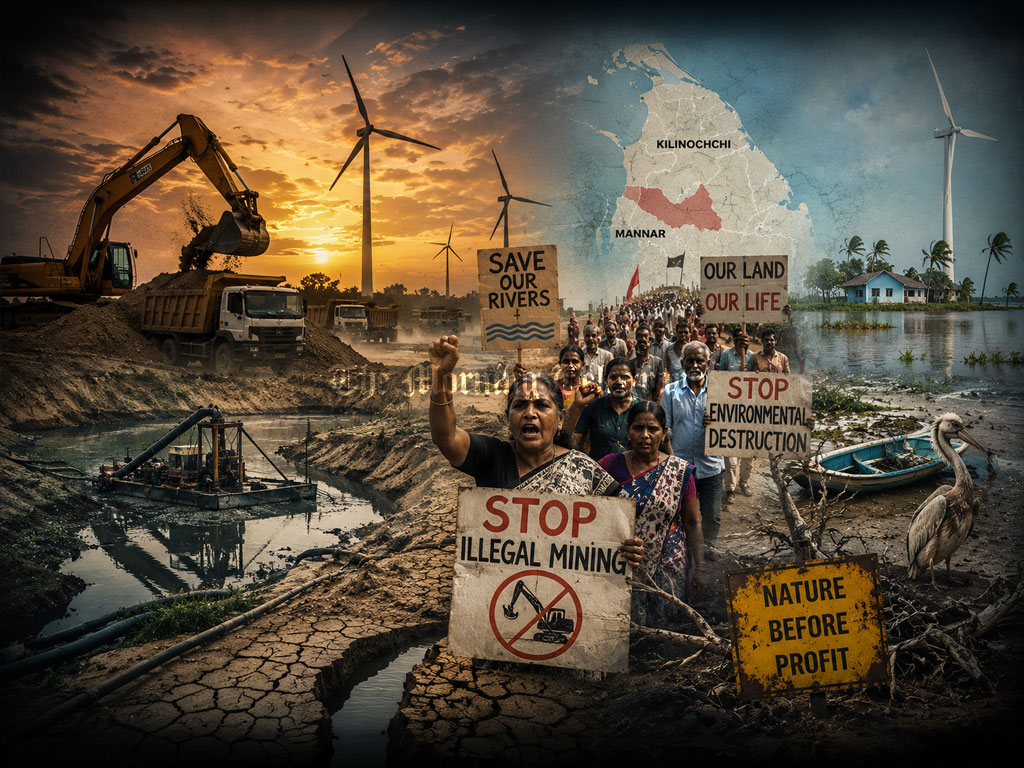
Northern Sri Lanka is witnessing growing resistance as communities in Kilinochchi and Mannar accuse powerful mining syndicates and corporate interests of destroying rivers, coastlines, farmland, and livelihoods through illegal sand mining, limestone excavation, and large-scale development projects. Despite government crackdowns and new regulations, residents fear the battle to protect the North’s fragile environment is far from over.
The sun sets heavily over the Vanni landscape, casting long shadows across the dry riverbeds of Kilinochchi and the coastal plains of Mannar. In these northern stretches of Sri Lanka, the quiet of the night is increasingly broken not by the sounds of nature, but by the dull roar of heavy machinery, the high-speed rattle of overloaded tipper trucks, and the rhythmic whir of wind turbines. This is the backdrop to an intensifying friction between state-driven development and the preservation of localized ecosystems, where a massive parallel network of resource extraction is pushing communities to the brink.

While the central government frames large-scale wind energy and mineral extraction as crucial pillars for national economic recovery, the communities directly affected see these initiatives as an existential threat. Driven by powerful cartels and corporate interests, these groups exploit the regulatory vacuum left in the wake of decades of conflict, using political patronage to extract millions of rupees worth of natural resources.
A major demonstration in the Poonakary division of Kilinochchi recently saw hundreds of residents march from Veravil Hospital to the Kiranchi Karpaga Pillaiyar Temple. Organized across several ancient villages, including Veravil, Valaipadu, Ponnaveli, and Kiranchi, the protest focused on local environmental exploitation. Residents and civil leaders raised strong objections to plans for limestone excavation, mineral sand mining, and a proposed wind power project, arguing that these decisions are being imposed by Colombo without local consultation.
In areas like the Kalmaadu, Iranamadu, and Kariyalai Nagapaduvan tank basins in Kilinochchi, legal excavation permits are often used as a front. While contractors might operate within legal parameters during daylight hours, the real devastation occurs under the cover of darkness. Armed with heavy dredging equipment, illegal miners dig deep into riverbeds and tank boundaries, far exceeding depth and volume limits.
Similar tensions have heavily impacted neighboring Mannar Island, where protests have historically persisted for months. The grievances here spotlight the unintended ecological consequences of poorly planned infrastructure and heavy mineral sand mining. Residents point out that existing and proposed wind turbine foundations obstruct natural water channels and streams. During monsoon seasons, this lack of proper drainage has led to severe, recurring flooding in residential areas like Pesalai, displacing families for months at a time. Local fishermen also report a sharp decline in fish populations near the coast, attributing it to the vibrations and ecological disruption caused by offshore and coastal turbine operations.
Heavy opposition faces companies like Titanium Sands Ltd, which have targeted Mannar for large-scale extraction of industrial minerals like ilmenite and thorium. Activists warn that dredging and vegetation clearance will destroy the local water table, ruining the area’s fragile agriculture and unique biodiversity, which serves as a critical habitat for migratory birds. Large-scale dredging destroys mature forests of satinwood and ebony, altering natural topography and leaving coastal villages vulnerable.
The human cost of this enterprise is rising. Villagers who voice objections face direct intimidation from the “sand mafias.” The danger is not limited to activists; the reckless speed of heavy transport trucks hurtling through narrow village roads, often bypassing authorized routes under night cover, has turned fatal for pedestrians and school children. The violence associated with the trade hit a flashpoint recently in Kodikamam, where a police officer lost his life during an attempt to intercept an illegal sand-smuggling operation.
While the government has occasionally offered temporary assurances or pauses to review environmental impact assessments, the continuous resumption of these projects—often under heavy police escort—has left northern communities deeply skeptical of state promises. The escalating crisis has forced a sharp reaction from both residents and provincial authorities. Widespread public protests from Poonakary to Pesalai have demanded an immediate end to the destruction, forcing the Northern Provincial Council and the central government to intervene. A series of high-level emergency summits resulted in the sweeping suspension of all sand mining permits across the Mannar District to root out widespread irregularities.
State investigators and the Criminal Investigation Department have launched extensive probes into the corrupt networks facilitating the trade, revealing deep coordination failures and complicity among local officials. In response, a massive regulatory restructuring is underway across the Northern Province. Authorities are moving to decentralize the trade, handing over the exclusive rights for sand identification and distribution to local government bodies and local authorities to break the monopoly of private syndicates.
To prevent the illicit night trade, a complete ban on transporting sand after dark has been implemented, alongside plans to introduce digitized, QR-code-based transport permits and GPS-tracked routes monitored by law enforcement. Yet, for the communities living along the damaged rivers and coastlines, skepticism remains high. They know that technological fixes are only as strong as the political will behind them, and until the entrenched networks of profit are completely dismantled, the battle for the north’s natural survival is far from over.