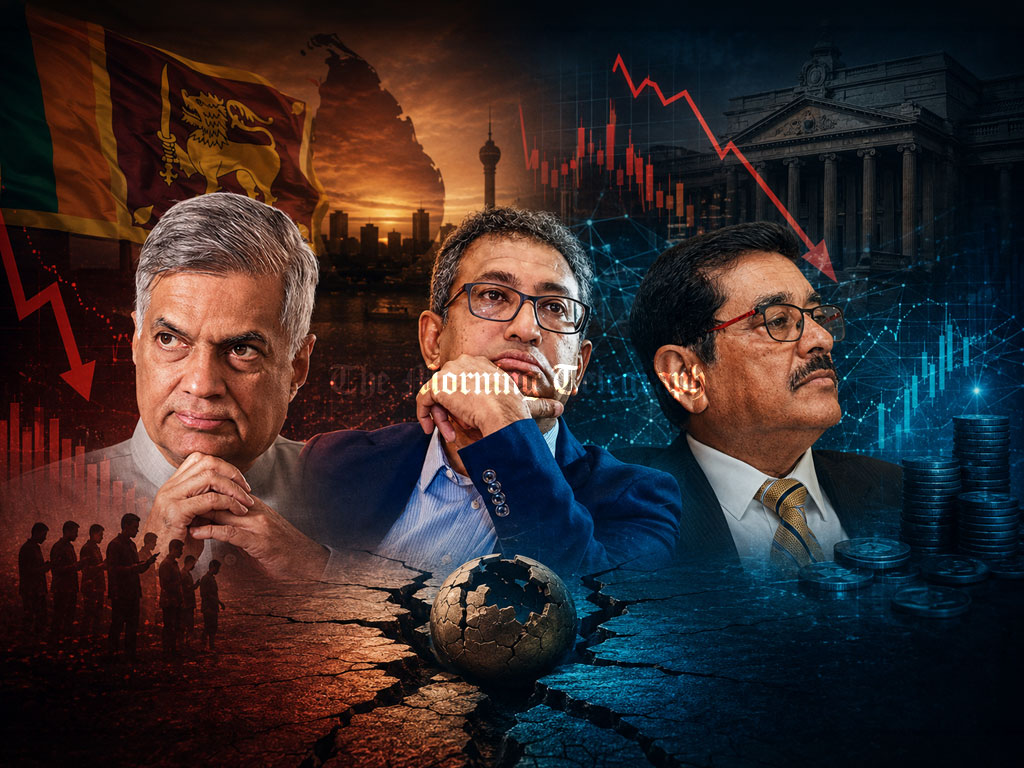
Sri Lanka economy fears deepen after Ranil Wickremesinghe warned of collapse, as rupee pressure and reserve concerns raise fresh risks.
Sri Lanka economy concerns have intensified after former President Ranil Wickremesinghe warned that the country could face a complete economic collapse within days.
He made the warning while addressing a meeting of the United National Party Working Committee at the party’s political office on Malalasekara Mawatha in Colombo.
Wickremesinghe also alleged that the current administration is carrying out what he described as a destructive programme targeting war heroes and the Maha Sangha.
Can this statement, made on a political platform, be dismissed as ordinary political rhetoric?
Or does it signal the beginning of a deeper macroeconomic crisis?
To understand the real risk, it is necessary to examine current financial market behaviour and official economic data.

Rupee Pressure And Central Bank Explanation
The former President’s warning comes as instability is already visible in the foreign exchange market.
Central Bank Governor Dr. Nandalal Weerasinghe informed Parliament on June 10 that during the first six months of 2026, from January 1 to June 9, the rupee had depreciated by 8 percent against the US dollar.
Currencies in regional economies have also weakened, with Indonesia recording 7.9 percent depreciation and India 6.2 percent.
However, given Sri Lanka’s debt burden and economic vulnerability, the situation carries risks beyond a normal regional currency movement.
According to the Central Bank Governor, several domestic market behaviours have contributed directly to the depreciation.
One reason is the import-export imbalance, with rising import costs including fuel and vehicles, while foreign exchange inflows from tourism have remained lower than expected.
Another factor is speculative behaviour.
Exporters are delaying the conversion of dollar earnings into rupees, expecting further depreciation, while importers are buying dollars early and increasing orders.
The Governor also pointed to capital outflows, including foreign investment moving out of government securities and the Colombo stock market.
Surface Stability, Structural Weakness
The deeper structural reasons behind these market movements have also been highlighted by Samagi Jana Balawegaya Parliamentarian Dr. Harsha de Silva.
Although macroeconomic stability may appear visible on the surface, Dr. de Silva has argued that the country is again moving along a dangerous path.
His analysis gives an economic basis to the warning issued by the former President.
The Reserve Illusion
While the Central Bank says foreign reserves stand at around US$7 billion, Dr. Harsha has pointed out that a large portion consists of Chinese yuan funds that are not freely usable.
He warns that if a real liquidity crisis emerges, Sri Lanka could again face the risk of bankruptcy.
Why Exporters Are Holding Dollars
Although the Central Bank has blamed exporters for delaying dollar conversions, Dr. Harsha argues that the real cause is arbitrary government policy.
He says investor confidence has been damaged by forced conversion laws requiring foreign exchange earnings to be converted into rupees.
According to him, this recreates conditions seen before the 2022 crisis.
Low Growth And Heavy Taxes
GDP growth has fallen to a low level of around 3 percent.
At the same time, small entrepreneurs and the middle class are facing severe pressure from harsh tax policies.
This combination, according to critics, is weakening the production economy and reducing confidence among businesses.
Budget Claims And The 2027 Risk
Dr. Harsha has also warned that some budget and economic plans presented as relief measures for political gain are unrealistic if IMF conditions are not properly managed.
He has emphasized that if the present path is not corrected, the public may face severe hardship from 2027 onward.
Beyond Political Rhetoric
Ranil Wickremesinghe’s claim that “the economy will collapse” may carry political motives.
However, when the explanations of Central Bank Governor Dr. Nandalal Weerasinghe and the analysis of Dr. Harsha de Silva are considered together, it becomes clear that the economy remains exposed to serious risk.
The weakening of business confidence through forced currency conversion rules, dependence on reserves that may not be fully usable, and slowing production growth all suggest that Sri Lanka may be moving toward another crisis similar to 2022.
Unless transparent and stable economic policies are introduced urgently, with clear protection for business freedom and investor confidence, the political and economic warnings now being issued may become impossible to ignore.