By Roy Denish
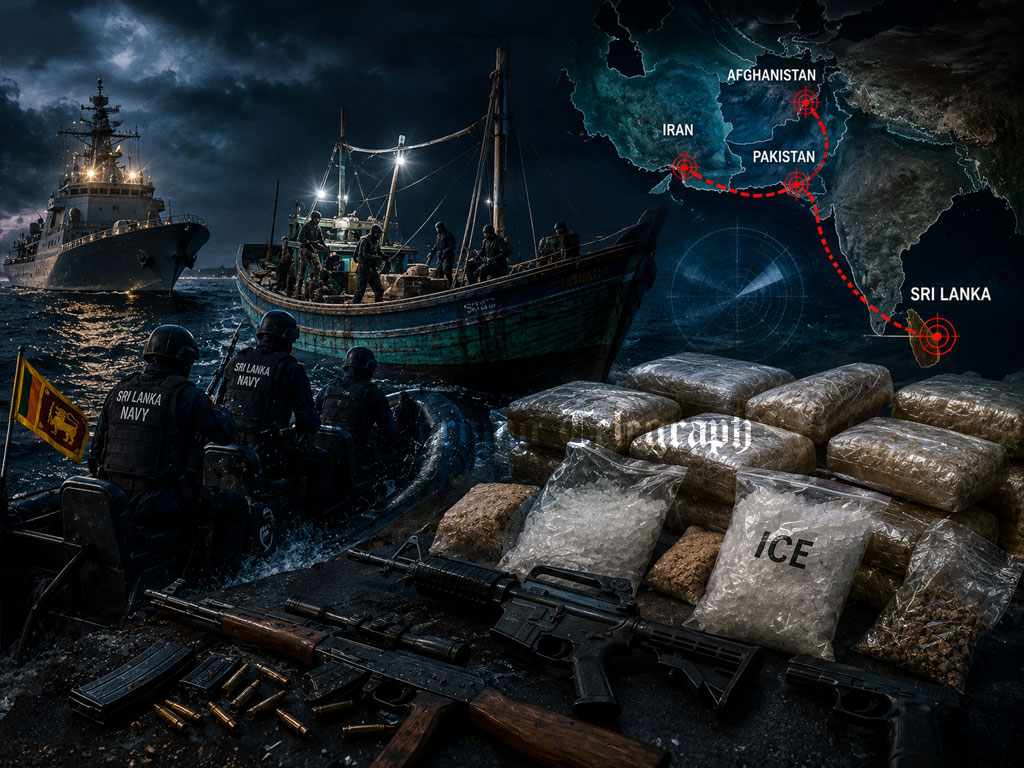
A secret high-seas pipeline is allegedly pushing heroin, ice, and weapons from the Iran-Pakistan-Afghanistan corridor straight into Sri Lanka’s streets. As naval forces seize billions in narcotics from deep-sea trawlers, Colombo’s neighborhoods are left facing the brutal end of a global cartel route.
The phrase coined as the Iranian connection represents a deep-sea logistical pipeline that directly ends by flooding the streets of Colombo with highly addictive and destructive narcotics.
What begins as a high-seas geopolitical supply chain rapidly destabilizes local urban neighborhoods, transforming the capital into a major consumer hub for transnational cartels.

A Dhow Waiting in the Darkness
The sea was black and flat under an equatorial night sky as a lone wooden dhow drifted in international waters, two hundred nautical miles off the southern coast of Sri Lanka.
On board, the air was thick with the scent of diesel and brine.
The foreign crew, operating in absolute darkness with their automated tracking systems completely disabled, waited at a precise set of global positioning coordinates.
They were a floating warehouse, an anonymous link in a pipeline running directly from the rugged Makran Coast where the borders of Iran and Pakistan meet.
Because Iran shares a highly porous land border with Afghanistan — the world’s capital for opium and an increasingly dominant source of synthetic crystal methamphetamine — this coastal strip acts as a massive oceanic launching pad to push these illicit substances into Sri Lankan markets.
Kudu, Ice and the Cartel Cargo
The specific narcotics carried in these hulls are high-purity brown and white heroin, known on the streets of Colombo as kudu, and massive quantities of crystal methamphetamine, universally referred to by its local street name, ice.
Synthetic drug trafficking has surged exponentially as cartels exploit the Iranian maritime pipeline to move massive volumes into the country, where the purity of ice makes it an exceptionally lucrative and devastating product for urban markets.
Mid-Sea Transfers and Armed Cargo
In the distance, the low hum of a diesel engine signaled the arrival of a local multi-day fishing trawler.
To any passing commercial tanker, it looked like just another vessel from the island’s massive fishing fleet.
But this rendezvous had nothing to do with a daily catch.
Within minutes, the crews began a rapid mid-sea transfer, shifting dozens of heavy, waterproof plastic sacks across the open decks.
Along with the kudu and ice, the shipment also included heavy crates of military-grade weapons, including T-56 assault rifles, M-16 rifles, and pistols, destined to arm underworld enforcement networks on land.
The Maritime Highway From Afghanistan to Colombo
This maritime highway serves as the main logistical artery for transnational cartels moving narcotics originating from the vast production fields of Afghanistan.
By bypassing coastal radar grids and using international waters for transshipment, these syndicates insulate themselves from local law enforcement.
The operations are funded and directed by high-level criminal masterminds who operate with near impunity from overseas safe havens, particularly Dubai, manipulating local fishermen with the promise of massive financial rewards to take the ultimate risk on the high seas.
How Drugs Move Into Colombo
Once these multi-day trawlers slip back into local waters, the distribution method morphs into a highly coordinated network to push the drugs into Colombo.
The massive bulk shipments are broken down into smaller parcels at coastal transit hubs and transported inland using private vehicles, three-wheelers, and public transport to evade roadside checkpoints.
Within Colombo, the syndicate structures rely on a cellular system of local dealers, often operating out of dense urban neighborhoods like Maligawatte, Grandpass, Maradana, and parts of Wellawatte.
Street-level distribution is highly digitized, utilizing encrypted messaging applications to coordinate dead-drops and mobile money transfers, ensuring that upper-level distributors rarely interact directly with consumers.
Smaller amounts are packed into tiny plastic packets or balloons, which are rapidly distributed to street-level users and a growing student demographic through a web of sub-dealers, three-wheeler drivers, and local gang enforcement networks.
Sri Lanka Navy Enters the Deep-Sea Fight
But as the local trawler turned back toward the island to blend in with returning fishing boats, a shadow materialized out of the dark.
The vanguard of the country’s deep-sea defense relies on Advanced Offshore Patrol Vessels, including premier capital ships like SLNS Vijayabahu, SLNS Gajabahu, SLNS Sayurala, SLNS Sindurala, and long-range fleet units like SLNS Samudura and SLNS Suranimala.
To execute these high-stakes interdictions, these offshore boats are heavily armed with stabilized weapon platforms, featuring automated Otobreda seventy-six millimeter naval artillery guns, CRN-ninety-one thirty millimeter automatic cannons, and a defensive perimeter of multiple M2HB twelve-point-seven millimeter heavy machine guns.
Radar, Intelligence and Ocean Surveillance
To detect and hunt down these dark-running gun and drug-trawlers across the vast expanse of the Indian Ocean, these naval capital ships utilize a complex multi-layered surveillance grid.
They rely on high-precision surface search radars equipped with Automatic Radar Plotting Aids to track unlit targets, long-range day and night optronic stabilized surveillance cameras, Electro-Optical fire control systems, and Global Maritime Distress and Safety System communication arrays.
This organic technology is paired with real-time satellite intelligence sharing, aerial surveillance feeds from international maritime task forces, and deep-sea coordinates provided directly by the State Intelligence Service.
High-Seas Boarding Operations
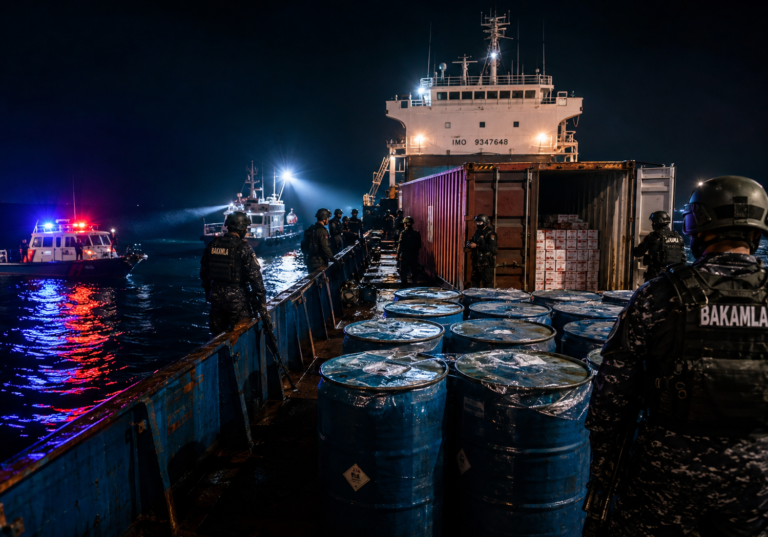
When a target is verified, the capital ships launch fast, quick-response Rigid-Hulled Inflatable Boats carrying heavily armed commandos from the Special Boat Squadron to perform tactical boardings on the high seas.
The crew on the smuggling trawler, realizing they are cornered, scramble to execute a frantic protocol to either dump the weighted cargo into the deep sea or scuttle the entire vessel to send the evidence to the ocean floor before the naval boarding party can secure the deck.
Clean Sri Lanka and the Anti-Drug Crackdown
Despite these desperate tactics, the push against the deep-sea pipeline has led to unprecedented confrontations and historic seizures.
These aggressive interdictions are coordinated under the umbrella of a massive, sweeping nationwide anti-drug enforcement campaign.
Initiated as the Clean Sri Lanka initiative to fortify the country’s maritime zones, the security apparatus has evolved into a highly synchronized crackdown.
This intensified campaign has mobilized the Navy alongside the Police Narcotic Bureau and the Special Task Force to execute continuous, aggressive deep-sea raids targeting global supply networks.
Billions in Narcotics Seized
The scale of this continuous crackdown has yielded massive results.
In 2024 alone, naval operations intercepted narcotics with an estimated street value exceeding twenty-eight billion rupees.
The momentum has intensified into 2026, with naval forces successfully tracking down and seizing ten local multi-day fishing trawlers involved in international trafficking within just the first three months of the year.
This aggressive first-quarter push alone has recovered more than one thousand eight hundred kilograms of illicit cargo, including heroin, cocaine, and crystal methamphetamine, valued at over forty-four billion rupees.
While these multi-agency operations continue to bring massive hauls into fisheries harbors like Dikkowita, the battle remains a high-stakes conflict fought wave by wave across the open ocean, as authorities actively pursue international channels to extradite nearly ninety organized criminal directors currently under Interpol Red Notices.
Sri Lanka Navy Drug Seizure
Sri Lanka Navy Drug Seizure demonstrates the intense maritime environment and the precise operational maneuvers executed by naval forces during deep-sea interceptions of multi-day smuggling trawlers.