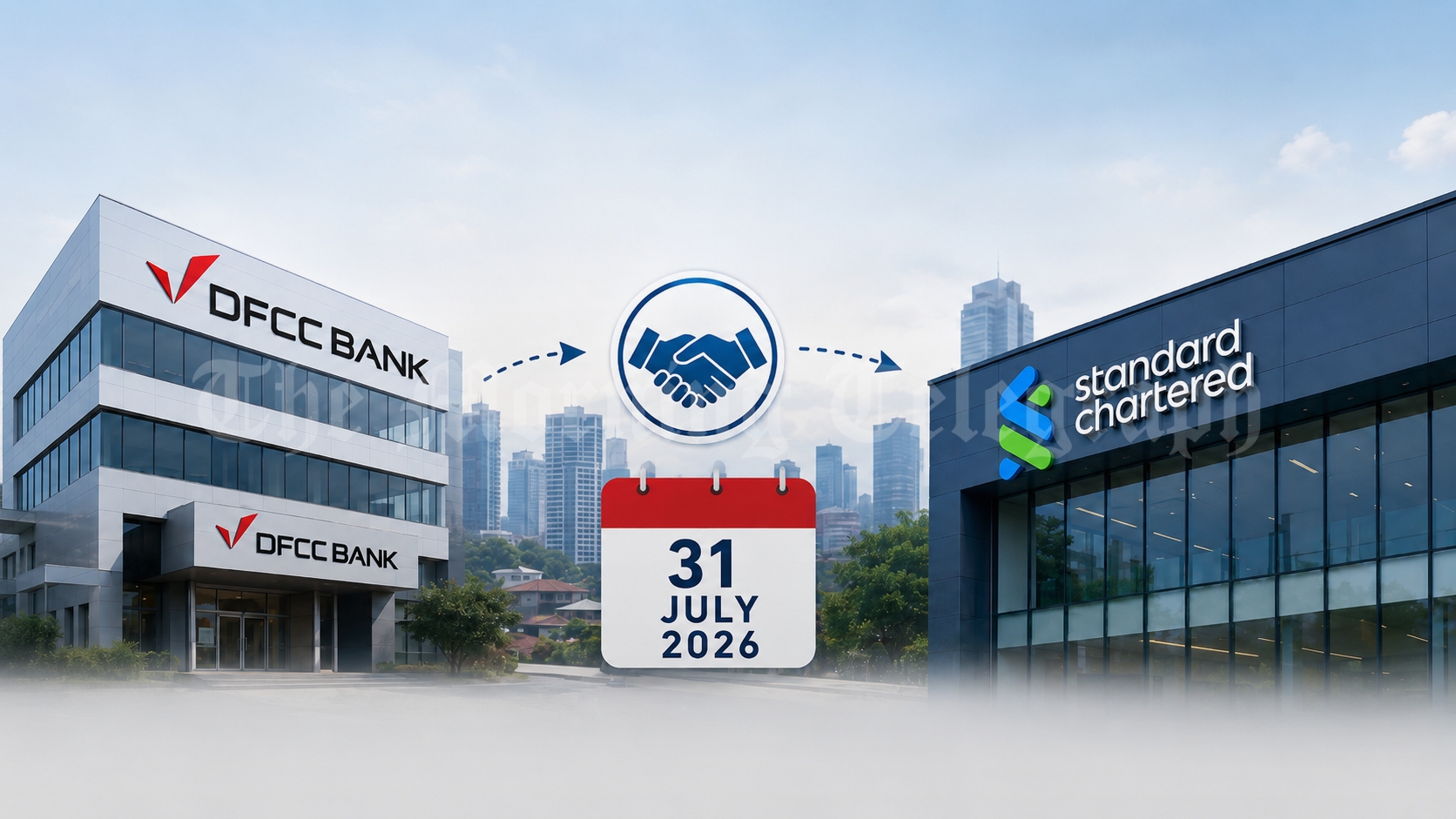
DFCC Bank’s acquisition of Standard Chartered Sri Lanka’s retail and wealth business nears completion, raising questions over cards, deposits and customer transition.
The DFCC Bank acquisition of Standard Chartered Sri Lanka’s wealth and retail banking business has returned to the spotlight as one of the most important banking transactions in Sri Lanka’s post-crisis financial sector moves closer to completion.
DFCC Bank is expected to complete the proposed acquisition by 31 July 2026, bringing a major international bank’s local consumer banking portfolio under a domestic banking group.

The transaction was first announced in November 2025, when DFCC Bank entered into a binding Business Sale Agreement with Standard Chartered Bank, United Kingdom, acting through its Sri Lankan branch, to acquire the wealth and retail banking business of Standard Chartered Sri Lanka.
The deal covers some of the most customer-facing areas of Standard Chartered’s local operations, including Priority Banking, credit cards, retail lending, customer deposits and SME portfolios.
That means the transaction is not just a corporate banking deal. It directly affects individuals, professionals, business owners, credit card holders, depositors, borrowers, high-net-worth clients and small and medium-sized enterprises that have maintained banking relationships with Standard Chartered Sri Lanka.
For DFCC Bank, the acquisition represents a major opportunity to expand its retail banking reach, strengthen its deposit base, grow its credit card and lending portfolios, and enter a more premium customer segment.
It also gives DFCC Bank a chance to reshape its public image. Traditionally known for development banking and commercial lending, the bank now has an opportunity to position itself more aggressively as a full-service financial institution with stronger wealth management and retail banking capabilities.
The transaction has also been reported as a Rs. 3.7 billion acquisition, subject to regulatory approvals and completion requirements. In the current economic climate, that makes the deal significant not only for the two banks involved, but also for Sri Lanka’s wider banking industry.
For Standard Chartered, the sale reflects a narrower strategic focus. The bank is not exiting Sri Lanka entirely, but it is stepping away from parts of local retail banking while concentrating on corporate, institutional, international and cross-border banking services.
This is part of a broader global pattern where some international banks are reassessing smaller retail banking markets and focusing their capital, technology and management attention on areas where they believe they have stronger competitive advantages.
In Sri Lanka, however, the most immediate question is customer transition.
Existing Standard Chartered retail customers will want clear answers on what happens to their bank accounts, credit cards, loans, fixed deposits, digital banking access, reward points, standing orders, relationship managers and premium banking benefits after the transfer is completed.
Priority Banking customers may be especially sensitive to the change. Premium banking is not only about account balances. It is also about personalised service, international access, investment support, faster response times, lifestyle benefits and relationship management.
Credit card customers will also be watching closely. Any migration of a credit card portfolio can raise practical questions about card numbers, outstanding balances, billing cycles, instalment plans, reward points, annual fees, merchant discounts, airport lounge access and existing promotional offers.
Depositors and loan customers will want reassurance that their interest rates, repayment schedules, salary remittances, fixed deposit terms, foreign currency accounts and standing instructions will not be disrupted by the transfer.
SME customers will have their own concerns. Smaller businesses depend heavily on continuity in working capital facilities, overdrafts, trade finance, business accounts and relationship banking. Any uncertainty during a banking migration can affect cash flow, supplier payments and customer confidence.
This is why communication will be critical. Customers will expect both banks to provide clear timelines, direct notices, transition instructions and practical guidance before, during and after the completion of the deal.
From a regulatory and industry perspective, the acquisition also raises a bigger question about banking consolidation in Sri Lanka.
On one hand, consolidation can create stronger banks with better scale, larger customer bases, more efficient systems and stronger capacity to absorb economic shocks. A larger DFCC retail franchise could improve competition against bigger domestic banks if the transition is handled properly.
On the other hand, the shrinking presence of international banks in retail banking could reduce customer choice, especially in premium banking, credit cards and internationally connected personal banking services.
Sri Lanka’s banking sector is still rebuilding after the economic crisis, debt restructuring, pressure on disposable incomes and tighter credit conditions. In that environment, any major banking acquisition carries public importance beyond the balance sheets of the institutions involved.
The success of this acquisition will not be judged only by whether the deal closes on time. It will be judged by how smoothly customers are moved, how clearly information is provided, and whether DFCC Bank can maintain or improve the service standards expected by Standard Chartered’s retail clients.
If handled well, the acquisition could strengthen DFCC Bank’s position in retail banking and give Standard Chartered customers a stable local platform for future banking services.
If handled poorly, it could create confusion among credit card users, depositors, borrowers, SMEs and premium clients who depend on reliable banking relationships.
The real question now is not simply whether the transaction will close by 31 July. The bigger question is whether this deal will become a model for orderly banking consolidation in Sri Lanka, or another test of how well financial institutions protect customers during major structural change.
#DFCCBankAcquisition #DFCCBank #StandardCharteredSriLanka #SriLankaBanking #SriLankaFinance #BankingConsolidation #RetailBanking #WealthManagement #CreditCards #SriLankaEconomy #SriLankaNews #TheMorningTelegraph