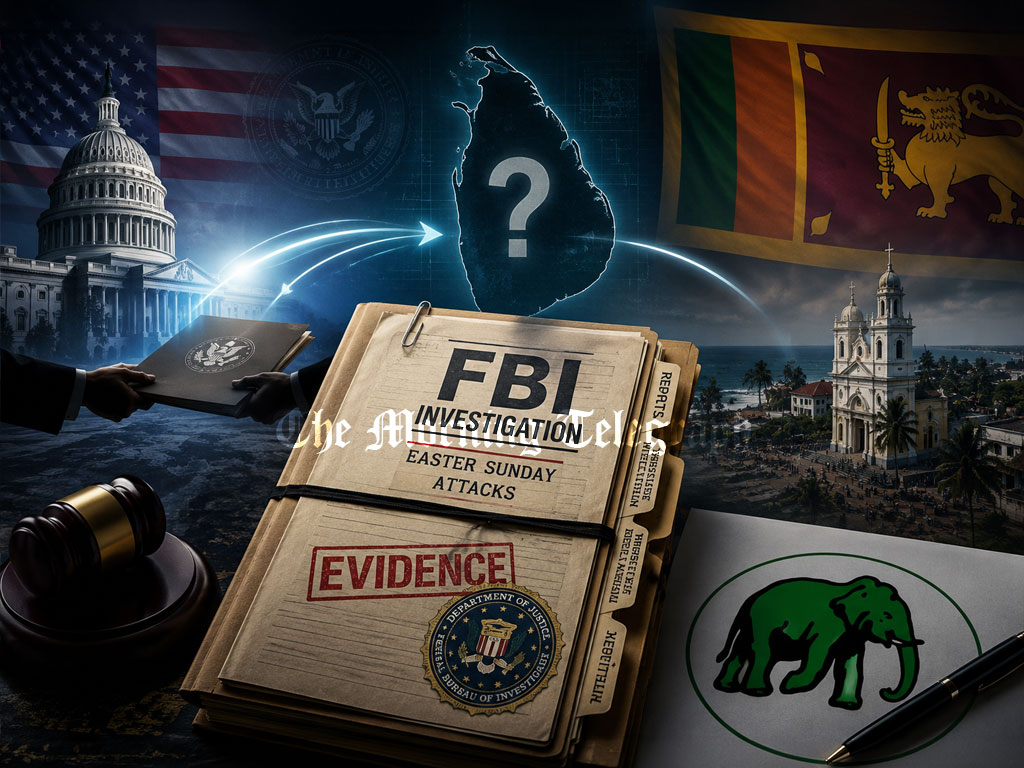
UNP questions if government secured FBI records and evidence from the U.S. investigation into the 2019 Easter Sunday attacks, urging disclosure to Sri Lankan courts.
The United National Party (UNP) has formally questioned whether the current government has taken steps to obtain all records and evidence related to the FBI investigation into the 2019 Easter Sunday terrorist attacks.
The party issued an official statement on June 18, raising concerns over the status of critical investigative materials that remain in U.S. custody.
Following the Easter Sunday attacks on April 21, 2019, Sri Lankan authorities lacked sufficient forensic and technical expertise to conduct a comprehensive probe. In response, then-Prime Minister Ranil Wickremesinghe formally requested the U.S. government to carry out a full investigation and provide a detailed report. He assured full cooperation from Sri Lankan agencies.

On April 22, 2019, Wickremesinghe held a telephone conversation with then-U.S. President Donald Trump, during which the request was reinforced. Trump later tweeted:
“Spoke to Prime Minister Ranil Wickremesinghe of Sri Lanka this morning to inform him that the United States stands with him and his country in the fight against terrorism. I also expressed my strong condolences on behalf of myself and the people of the United States!”
Following the request, the FBI conducted an extensive investigation into the attacks, working alongside Sri Lankan authorities, including the Criminal Investigation Department (CID), military intelligence, and state intelligence services. The joint probe examined the origins, planning, and execution of the suicide bombings that targeted three churches and three luxury hotels, killing over 260 people and injuring hundreds more.
Based on the evidence collected, the FBI compiled a comprehensive report and submitted it to the Government of Sri Lanka. All relevant authorities accepted the findings at the time. However, the UNP now contends that the full evidentiary record was never fully integrated into domestic legal proceedings.
On November 12, 2020, FBI Special Agent Merrilee R. Godwin filed a 71-page sworn affidavit in the U.S. District Court for the Central District of California. The affidavit detailed the U.S. investigation’s findings and laid the groundwork for criminal charges.
On December 11, 2020, a federal criminal case was officially filed in the U.S. District Court in Los Angeles. The named defendants included Mohamed Nawfer, Mohamed Anwar Mohamed Riskhan, and Ahmed Milhan Hayathu Mohamed. By that time, all three had already been taken into custody by Sri Lankan authorities. Other suspects linked to the attack were also in local detention when the U.S. case was initiated.
Despite these developments, the UNP statement emphasizes that the complete set of information and physical evidence gathered by the FBI and the U.S. Department of Justice remains outside Sri Lanka’s reach.
The party now asks whether the government has formally applied to the U.S. government to obtain this material. It also questions what response, if any, has been received. If no such application has been made, the UNP demands to know the reason for the omission.
The UNP further asserts that all evidence and information related to the FBI probe should be made available to Sri Lankan judicial authorities, particularly given that the current administration has announced plans to recommence investigations into the attacks.
The party’s statement underscores the urgency of securing international cooperation to ensure that domestic legal proceedings are informed by the full body of evidence already compiled by U.S. law enforcement.
The Easter Sunday attacks remain one of the deadliest acts of terrorism in Sri Lanka’s history. Over the years, survivors and families of victims have repeatedly called for a transparent and complete accounting of the events. The UNP’s intervention adds political pressure on the government to demonstrate progress in obtaining foreign intelligence and forensic data.
At the time of the attacks, Sri Lanka’s security and intelligence apparatus faced severe criticism for failing to act on prior warnings. The subsequent investigations, both local and international, sought to identify systemic failures and individual culpability.
The FBI investigation was widely regarded as a critical component of the broader effort to understand the attack’s international connections, including alleged links to foreign extremist networks. The U.S. legal proceedings provided a rare public window into the evidence collected, but much of the underlying material remains classified or restricted.
The UNP has not accused the government of intentional delay, but it has signaled that the issue must be addressed transparently. The party’s statement suggests that without access to the full FBI file, any domestic reinvestigation would remain incomplete.
Political analysts have noted that the government’s decision to reopen the Easter attack probe has been met with mixed reactions. Some families have welcomed the move, while others have expressed skepticism over the likelihood of new findings.
The UNP’s formal query now places the onus on the administration to clarify its position regarding international legal assistance and evidence sharing. The government has yet to issue a public response to the party’s questions.
As the anniversary of the attacks approaches, the demand for accountability continues to resonate across Sri Lanka’s political and civil society landscape. The UNP’s call for transparency reflects broader public concerns about the handling of the investigation and the fate of those still awaiting closure.
The party’s statement concludes by stressing that the information and evidence obtained by U.S. authorities were gathered with Sri Lankan cooperation and should therefore be accessible to Sri Lankan courts. It remains unclear whether the current administration will pursue this avenue or offer a justification for its inaction.