Sri Lanka judiciary faces mounting pressure as NPP delays superior court vacancies and pushes judge retirement age controversy.
Sri Lanka judiciary concerns have intensified as the ruling NPP faces growing criticism over delays in filling vacancies in the Supreme Court and Court of Appeal.
The controversy has also widened over the Government’s alleged proposal to extend the retirement age of judges serving in the superior courts. Opposition parties have urged Speaker Dr. Jagath Wickremaratne to intervene, while the Bar Association of Sri Lanka, Colombo High Court lawyers, the Lawyers Collective and the Commonwealth Lawyers’ Association have all criticised the Government’s handling of the issue.

Sri Lanka Muslim Congress leader Rauff Hakeem, MP, recently raised concern over the alleged killing of Balachandran Prabhakaran, the 12-year-old son of LTTE leader Velupillai Prabhakaran, on May 19, 2009.
A section of the Tamil media highlighted Hakeem’s remarks on the death of Balachandran, the youngest of Prabhakaran’s three children. Prabhakaran himself was also killed on the same day.
The question now being asked is why Hakeem chose to raise such a contentious and largely forgotten issue at this moment. Sinhala and English print and electronic media did not report the SLMC leader’s comments. Some questioned the motive behind Hakeem revisiting Balachandran’s death, while others even suggested possible Tamil Diaspora influence.
The Island obtained the official parliamentary video of Hakeem’s 10-minute speech delivered on June 10. His reference to Balachandran’s killing came toward the end of a fiery address mainly focused on President Anura Kumara Dissanayake’s continuing failure to fill vacancies in the Court of Appeal and Supreme Court.
The deliberate and deeply troubling delay in judicial promotions cannot be separated from the disputed attempt to introduce a constitutional amendment increasing the retirement age of judges in the Court of Appeal and Supreme Court.
President Anura Kumara Dissanayake, who leads both the Janatha Vimukthi Peramuna and the National People’s Power, appears to be heading toward a confrontation with the Opposition. With 159 MPs in Parliament and a two-thirds majority, Dissanayake has the numbers to introduce the required amendment despite protests.
However, the electorate may not accept such a dogmatic approach. Those who voted for Dissanayake and the NPP at the September 2024 and November 2024 national polls would not have expected the administration to act in a manner critics now describe as heavy-handed.
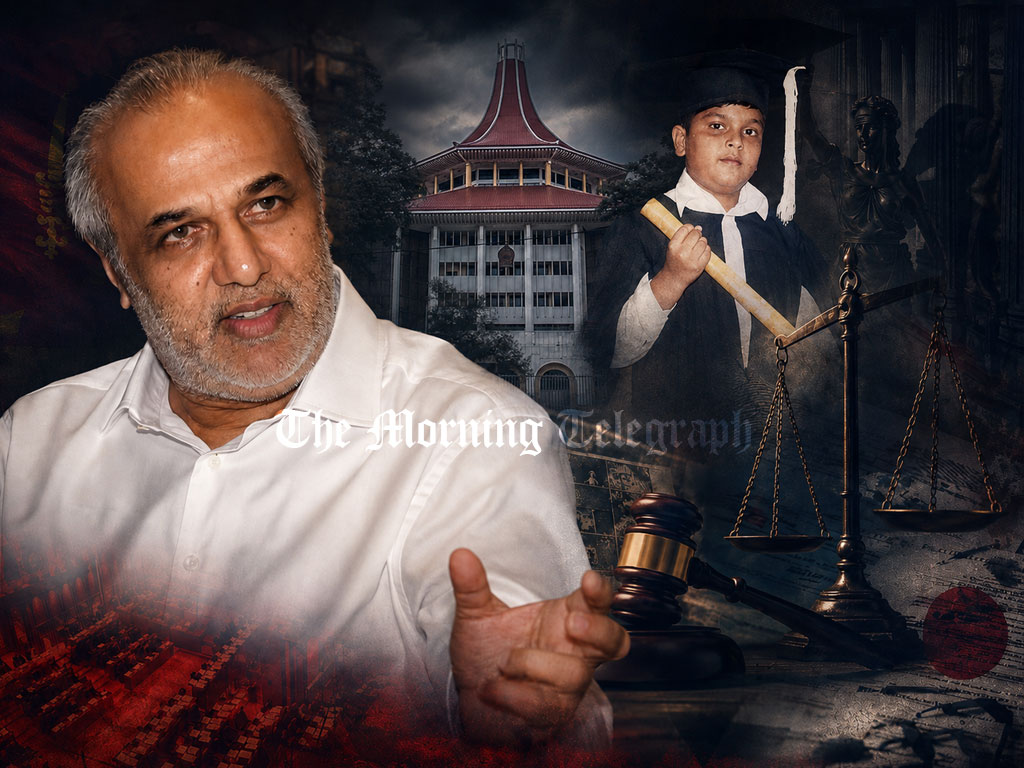
Attorney-at-law and former Justice Minister Rauff Hakeem strongly criticised the President and the ruling party ahead of joint Opposition action to pressure the President into filling the vacancies. The Opposition’s appeal to Speaker Dr. Jagath Wickremaratne may also be read as collective resistance to the proposed amendment on judges’ retirement age.
The SLMC parliamentary group consists of five MPs. Three were elected under the SLMC symbol, including two elected members and one National List MP, while two entered Parliament through the Samagi Jana Balavegaya, one of them also through the SJB National List.
Hakeem, who has served in Parliament for more than 30 years, began his speech by questioning the sudden decision to introduce regulations compelling exporters to convert export proceeds into U.S. dollars. He said the Government had taken such panic action because of the rapid depreciation of the rupee against the U.S. dollar.
He then commented on the continuous extension of the Emergency, alleging that it was being done for the NPP’s own narrow political purposes. Hakeem said the Opposition expected the Government to end that practice.
He next turned to the alleged move to extend the retirement age of top judges. Referring to Chief Government Whip Dr. Nalinda Jayatissa’s statement that the issue had not even been discussed within the Government, Hakeem challenged that claim.
The former Justice Minister pointed to statements issued by the Bar Association of Sri Lanka and the Colombo High Court Lawyers’ Association. He also noted that the Lawyers’ Collective and the Commonwealth Lawyers’ Association had strongly opposed the alleged move.
Despite the Cabinet spokesman’s denial, Justice Minister and Attorney-at-Law Harshana Nanayakkara had indicated in his comments that the matter was under discussion. Nanayakkara had even referred to the higher retirement age of top judges in other countries to support the NPP’s controversial move.
The Government, therefore, does not appear to be speaking with one voice.
Hakeem Takes Aim At Judicial Delay
Emphasising that he was addressing the issue as a member of the BASL, Hakeem said there had been four vacancies each in the Court of Appeal and the Supreme Court for the past six months.
“The President has failed in his constitutional duty to nominate judges for promotion. From the High Court to the Court of Appeal and from the Court of Appeal to the Supreme Court. By denying the rights of the judges, undue pressure is being brought on them,” Hakeem said.
He reminded Parliament that when the current President was in Opposition, he had strongly protested when previous Presidents failed to gazette names decided upon by the Constitutional Council.
“This very President, when he was in the Opposition, when the previous Presidents failed to gazette the names decided on by the Constitutional Council, he made a big protest. Several times he spoke about this very vociferously in the House. But, since becoming the President, he has not nominated any names,” Hakeem said.
He argued that the 21st Amendment was designed to prevent Presidents from delaying decisions taken by the Constitutional Council. However, he said the President was now doing the reverse by failing to nominate anyone to the top two courts.
“This is much worse. As a consequence, even our fundamental rights are impacted. Because we as litigants or lawyers or public, our right for the expeditious disposal of cases is being impacted by the delay in appointing judges to the Superior Courts,” Hakeem said.
He warned that the delay was also frustrating judges who had served for years in the judiciary.
“What happens to the minor judiciary and others? There are heavy concerns among the judiciary about extending the retirement age. That’ll block their path. That’ll deprive many suitably qualified individuals the right to get onto the bench or the superior bench. High court judges will now await their chances of being promoted. Undue pressure will be brought upon them,” he said.
Hakeem alleged that the President was deliberately violating the Constitution. Having made serious allegations against the President, he stressed that the Speaker had a responsibility to take up the matter with the President on behalf of Parliament.
He questioned why the President had unduly delayed promotions, saying the failure had caused unnecessary frustration among judicial ranks and deprived those who served the judiciary of their due rights.
Hakeem also explained how senior officers of the Attorney General’s Department had been affected by the President’s inaction. He alleged that those officials had been deprived of the opportunity to move to the superior courts because of deliberate inaction and constitutional violation.
The former Justice Minister then made an even more serious allegation. He claimed the NPP was delaying the process until a favoured individual became eligible to join the bench.
“You are picking and choosing people by that thereby undermining the judiciary,” Hakeem alleged.
Hakeem also addressed the long-disputed Prevention of Terrorism Act, which has been opposed by many political parties, civil society organisations and international groups such as Amnesty International.
He raised the issue following the controversial arrest of Major General (Retired) Suresh Sallay, former Director of the Directorate of Military Intelligence from 2012 to 2016 and Director of the State Intelligence Service from 2019 to 2024, under the PTA.
Hakeem criticised the NPP for proposing a new anti-terrorism law under a different title to replace the PTA. He declared that the proposed law would be worse than the current law and accused the police and Attorney General’s Department of abusing the PTA.
The former Minister alleged that the standards of the police and the Attorney General’s Department had continued to deteriorate because of their dependence on the draconian law.
Balachandran Killing Raised In Parliament
Referring to Tamil media reports about a new UK Channel 4 video dealing with the killing of Prabhakaran’s 12-year-old son, Hakeem compared the treatment of the families of LTTE leader Prabhakaran and JVP leader Rohana Wijeweera.
Wijeweera was captured with his family by the military before being killed on the night of November 13, 1989. Hakeem noted that although Wijeweera was killed, his family members were not harmed and lived under the protection of successive governments.
He said the situation was different in Prabhakaran’s case.
Hakeem criticised the JVP/NPP Government for conveniently forgetting its own leaders, even though an annual ceremony is held in Colombo in memory of those who died during the insurgency.
He added that even the daughter of Zahran Hashim, who led the 2019 Easter Sunday attacks, had been spared. If Prabhakaran’s daughter Duwaraka had been killed as alleged, Hakeem said that too should be investigated.
He ended his speech by addressing Parliament in Tamil.
Prabhakaran’s wife Mathivathani was also killed during the final phase of the ground offensive. Prabhakaran’s eldest son, Charles Anthony, was killed in the Karayamullavaikkal area of Mullaitivu the day before Prabhakaran, Mathivathani, Duwaraka and Balachandran were killed.
Hakeem has the right to raise the controversy over the alleged manner in which Prabhakaran and his family died while in government custody. However, it is also relevant to note that Hakeem, as Justice Minister from November 2010 to December 2014, could have pushed the Mahinda Rajapaksa Government to investigate the incident.
The writer once sought a meeting with then Minister Hakeem to discuss accountability issues and the Government’s failure to address them. Although Hakeem gave a patient hearing and acknowledged the urgent need for remedial measures, the war-winning Rajapaksa Government played politics instead of taking tangible action.
By late 2014, the SLMC switched allegiance to the UNP-led coalition formed with U.S. backing to support the candidacy of Maithripala Sirisena at the 2015 presidential election.
Hakeem later received the Urban Development, Water Supply and Drainage portfolio in the Yahapalana Government. The Tamil National Alliance, an integral part of that alliance, served Yahapalana interests while refusing Cabinet office. The JVP also stayed outside the Cabinet, though its role in the Yahapalana operation is widely known.
The Yahapalana Government betrayed the armed forces at the Geneva-based United Nations Human Rights Council in October 2015. The scale of that betrayal became clearer two years later when the administration dismissed Lord Naseby’s revelations concerning the final phase of the war.
The issue now is what led Hakeem to compare three events: the killing of Wijeweera and protection of his family in November 1989, the killing of Prabhakaran and his family at Nanthikadal in May 2009, and the rescue of Zahran Hashim’s daughter after the Sainthamaruthu blasts in April 2019.
Whatever Hakeem’s motive in highlighting the LTTE issue now, the need for a collective parliamentary response to address the concerns of the loved ones of those who engaged in terrorism cannot be overstated.
The deaths of Prabhakaran, his wife, daughter and youngest son remain surrounded by controversy. Like more than 11,000 LTTE cadres, including male and female fighters and suicide cadres who surrendered to advancing troops on multiple fronts, Prabhakaran and his family could have surrendered to the Army on the Vanni front.
They did not do so, apparently believing in a possible U.S. operation to evacuate them.
Opposition Unity On Court Vacancies
As Hakeem mentioned during his June 10 speech, a group of Opposition MPs handed over a letter expressing concern over the prolonged delay in filling vacancies in the superior courts.
The Opposition MPs pointed out that the President, as Chairman of the Constitutional Council, had failed to fill the vacancies. They stressed his responsibility to act according to the Constitution and reminded the Speaker that protecting judicial independence is part of safeguarding the sovereignty of the people.
Kandy District MP Anuradha Jayaratne represented the New Democratic Front in the SJB-led effort. NDF MP Ravi Karunanayake also joined, despite being in conflict with the UNP over taking the National List seat won by the NDF at the last parliamentary election.
Former President and UNP leader Ranil Wickremesinghe had backed the NDF at the November 2024 General Election, but the party failed to achieve the expected result. It secured only five seats, including two National List slots.
All Ceylon Tamil Congress leader Gajendrakumar Ponnambalam, representing the Jaffna electoral district, signed the petition along with Sarvajana Balaya leader Dilith Jayaweera.
The SLPP was not part of the grouping. However, SLPP sources told The Island that although they did not sign the petition handed to Speaker Wickremaratne, they fully supported the initiative.
Any attempt by political parties or governments in power to interfere with the judiciary must be opposed at every level. The Rajapaksas went as far as impeaching Chief Justice Dr. Shirani Bandaranayake and removing her under deplorable circumstances.
The Rajapaksas reacted aggressively after Supreme Court rulings, including one against then SLFP/UPFA strongman Basil Rajapaksa.
The ruling UPFA made a series of unsubstantiated allegations against Dr. Bandaranayake, including financial impropriety and interference in legal cases. SJB MP Dayasiri Jayasekera recently referred to her impeachment when criticising the NPP move to extend the retirement age of superior court judges.
Jayasekera questioned whether the NPP wanted to keep Chief Justice Preethi Padman Surasena beyond the stipulated retirement age.
Although there have been many interventions, the 2013 impeachment of the 43rd Chief Justice remains the worst case. The appointment of former Attorney General Mohan Peiris as her successor made matters worse.
The UPFA turned against Dr. Bandaranayake following controversy over the Town and Country Planning Amendment Bill and Divi Neguma, gazetted in 2011 and 2012 respectively. The UPFA abandoned the first Bill and amended the second to avoid a referendum and a two-thirds approval requirement.
By then, the UPFA had decided to impeach Dr. Bandaranayake, who had stood up to direct political intimidation.
Ranil Wickremesinghe, during his presidency from July 2022 to September 2024, reacted angrily to the Supreme Court ruling that he, as Finance Minister, and the Election Commission had violated voters’ rights by arbitrarily delaying the 2023 Local Government polls.
Wickremesinghe had also been angered by his failure to secure Supreme Court backing for his attempt to appoint Deshabandu Tennakoon as IGP in the run-up to the 2024 presidential election.
There have been many instances where ruling parties or coalitions believed the judiciary had obstructed their agenda. Few examples better show the challenge faced by the UPFA than the Supreme Court’s stand during Dr. Bandaranayake’s tenure as Chief Justice.
But in the post-Aragalaya period, few expected President Dissanayake to pursue an agenda that would force the BASL to issue hard-hitting statements.
Since May Day 2026, the BASL has issued two such statements that should have raised alarm. The NPP appears to be on the wrong path, believing that its two-thirds parliamentary majority allows it to proceed unhindered.
The first BASL statement addressed President Dissanayake’s controversial May Day prediction of a court ruling in a high-profile case. The second responded to the move to extend the retirement age of superior court judges.
The Government should now rethink its strategy. With the national economy facing severe difficulty and pressure mounting to abolish fuel and electricity subsidies at the request of the IMF, the NPP should focus on saving the economy instead of creating new crises that cannot be brushed aside simply because it commands a parliamentary supermajority.