By Roy Denish
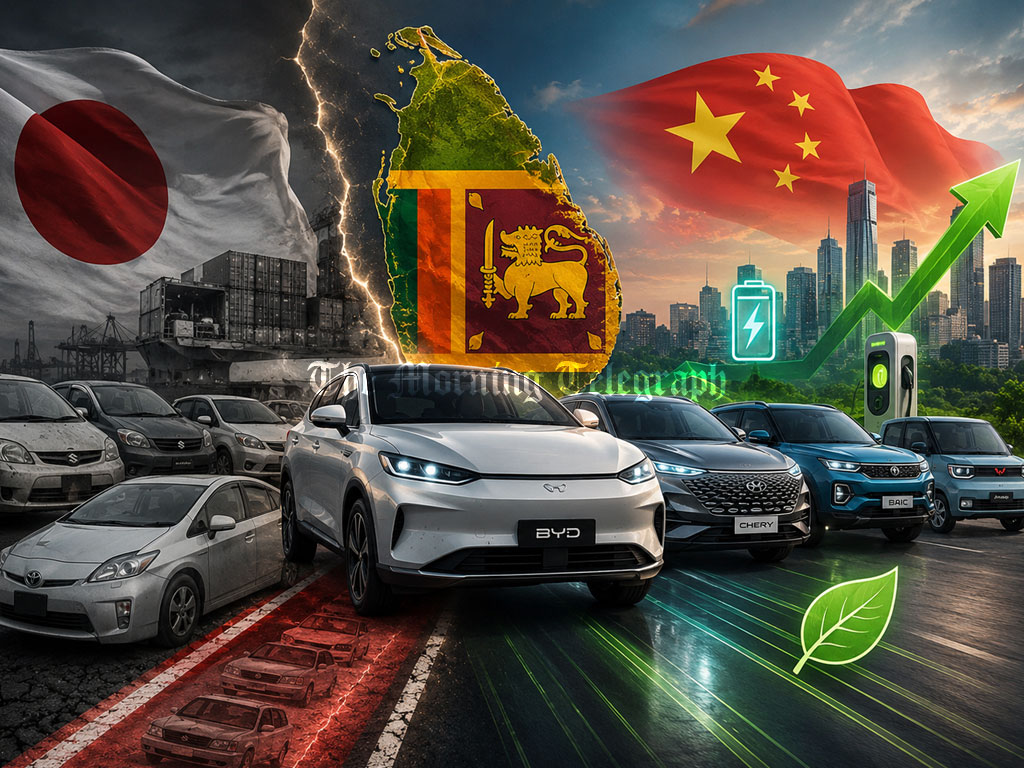
Chinese electric vehicle brands are rapidly reshaping Sri Lanka’s automotive market, challenging decades of Japanese dominance as new import regulations, EV incentives, and aggressive dealership investments drive a dramatic shift in consumer preferences.
The automotive landscape in Sri Lanka, once a stronghold for Japanese OEMs, is experiencing a major structural shift as vehicle imports resume. For decades, the domestic market was anchored by reconditioned JDM units like the Toyota Prius, Vitz, Axio, and the ubiquitous Suzuki Wagon R. These high-liquidity models dictated floor prices and trade-in values across local dealerships, celebrated for their mechanical resilience, low total cost of ownership, and rock-solid residual values. However, the lifting of the protracted import ban has completely disrupted established market shares, paving the way for aggressive market penetration by Chinese automotive brands aiming to break Japan’s long-standing dominance.

This market disruption stems from a convergence of strict regulatory frameworks, changing consumer behavior, and heavy investments by Sri Lanka’s premier tier-one distributors. The government’s phased relaxation of import controls came attached to stringent technical compliance mandates, including tight age-at-import caps restricting internal combustion engine passenger cars to a maximum of three years, mandatory Euro 6 emissions certification, and highly incentivized duty structures tailored specifically to battery electric vehicles.
As traditional Japanese automakers lag behind in deploying mass-market, budget-conscious global battery electric vehicle platforms, a glaring inventory deficit opened up across local showrooms. Chinese manufacturers, heavily backed by mature domestic supply chains and vertical integration in lithium-ion battery production, immediately capitalized on this gap. Nameplates such as BYD, Chery, Great Wall Motor, BAIC, and Wuling are successfully shedding their historic budget-tier reputations. They are bombarding local ports with highly digitized, feature-dense product portfolios featuring advanced driver-assistance systems, electronic stability control, and comprehensive passive safety structures.
Crucially, this rapid volume injection has been validated by institutional weight. Top-tier Sri Lankan conglomerates have snapped up master distribution rights, with John Keells Holdings managing BYD, Hayleys Mobility backing Chery’s premium Omoda and Jaecoo sub-brands, and the David Pieris Group driving the BAIC account. This heavy corporate backing mitigates buyer anxiety by underwriting the necessary capital expenditure for premium retail touchpoints, advanced high-voltage diagnostic equipment, and robust regional component networks.
On a unit-economics level, when factored against recent customs surcharges and social security levies, a zero-meter Chinese battery electric vehicle delivers a significantly higher value proposition than a three-year-old, high-mileage JDM hybrid. The traditional retail focus on long-term resale value is rapidly giving way to critical electric vehicle metrics, including battery degradation warranties, over-the-air software capabilities, and DC fast-charging compatibility.
While established Japanese brands maintain a massive active car parc and a hard-earned reputation for build quality, the market momentum has clearly pivoted. The combination of green-mobility mandates and a steady influx of technologically advanced, price-competitive Chinese products marks the end of a half-century Japanese monopoly, steering the Sri Lankan automotive sector into a highly competitive, multi-polar era.