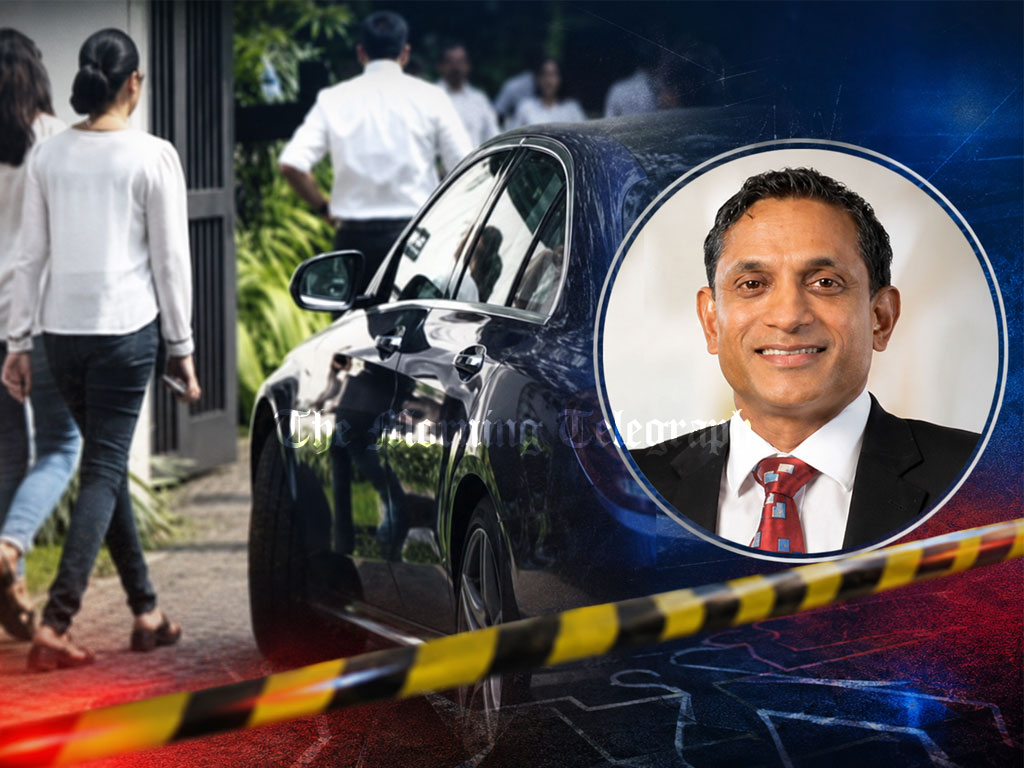
The Dinesh Schaffter murder investigation has been revived as new evidence, financial links and forensic findings place renewed focus on the case.
The Dinesh Schaffter murder investigation has been formally revived after remaining dormant for a considerable period, reigniting scrutiny over one of Sri Lanka’s most controversial and widely discussed deaths. With the launch of the renewed inquiry, political sources claim that influential political interests and key authorities have been thrown into a difficult position. Far from being a simple personal tragedy, the case has evolved into a complex controversy involving high-level financial dealings and serious questions surrounding the manner in which the original police investigation was conducted.

Financial Links and Alleged Intermediaries
The Schaffter family, headed by Chandra Schaffterr, is regarded as one of Sri Lanka’s most influential yet relatively low-profile business families. The family has traditionally been involved in providing financial backing and investment support for major projects across various sectors.
According to information and records currently under discussion, allegations have surfaced that Dinesh Schaffter had provided a substantial sum of money to a member of the powerful Rajapaksa political family. Information has also emerged suggesting that a well-known cricket commentator identified as Brian allegedly acted as an intermediary in relation to these financial transactions. Over time, a serious dispute reportedly developed between Shafter and the parties involved over the money and the commission percentages connected to it. Investigators have reportedly focused attention on call tower records indicating that the same intermediary contacted Shafter and arranged a discussion under the pretext of resolving the dispute.
The Borella Cemetery Puzzle and Missing CCTV Evidence
The incident occurred on December 15, 2022. Information linked to the case indicates that Schaffter was instructed to purchase food while travelling to the meeting location, a circumstance that investigators and observers believe suggests a carefully planned operation.
A particularly significant detail is the allegation that Schaffter was instructed to enter the Borella Public Cemetery through the exit gate rather than the main entrance.
At the time of the incident, the Colombo Municipal Council’s CCTV camera system within the cemetery was reportedly not functioning. Only a single camera, positioned at a 45-degree angle facing the crematorium, captured footage of Schaffter vehicle arriving at the location. Civil society groups have noted similarities between this situation and other high-profile cases in which CCTV evidence was allegedly unavailable, missing or rendered unusable.
Questions Surrounding the Original Investigation
The Borella Crime Division initially handled the investigation into the death before transferring the case to the Criminal Investigation Department (CID) within a very short period under instructions issued by the then Inspector General of Police. Reports have further indicated that the minister responsible for the subject area at the time also intervened in the matter.
Public concern intensified when senior officials associated with the investigation issued what were viewed as contradictory explanations regarding the cause of death. At different stages, the death was described as resulting from “self-strangulation” and later as involving the “injection of a chemical substance.”
The controversy deepened further after a preliminary judicial medical report suggested the possibility of suicide linked to business debts or family-related disputes. However, several forensic experts expressed concerns that the condition in which the body was found, including the way wires were wrapped around Schaffter and the manner in which his hands were tied, did not appear consistent with a suicide scenario.
The Forensic Panel That Changed the Direction of the Case
A major turning point emerged when the Schaffter family, represented by President’s Counsel Anuja Premaratne, challenged both the police investigation and the findings contained in the preliminary reports through legal action before the courts.
As a result, a special panel consisting of five distinguished forensic medical experts was appointed to conduct a comprehensive scientific examination of body parts and all available forensic evidence connected to the case.
Following their analysis, the panel reached the conclusion that the death was not a suicide but a homicide under Section 296 of the Penal Code, committed by an external party. The finding marked a significant development because, for the first time in Sri Lankan legal history, a preliminary judicial medical report was effectively rejected through the conclusions of such a specialist expert panel. The determination created a new legal pathway for investigators seeking to identify those responsible for the killing.
The Road Ahead and the Search for Accountability
With new scientific findings now available and additional circumstantial evidence reportedly gathered, the Criminal Investigation Department has commenced a fresh and extensive investigation into the case.
Investigators are expected to present substantial new information before the courts in the coming weeks, including evidence and circumstances that have not previously been disclosed publicly.
As the renewed investigation gathers momentum, there is growing public expectation that the rule of law will ultimately prevail. Many are hopeful that legal action will be pursued against any suspects, as well as against individuals who may have misled or obstructed the investigation, irrespective of their influence, position or status.