President Anura Kumara Dissanayake says corruption, drugs and organized crime will be confronted as the government pledges justice and democratic reform.
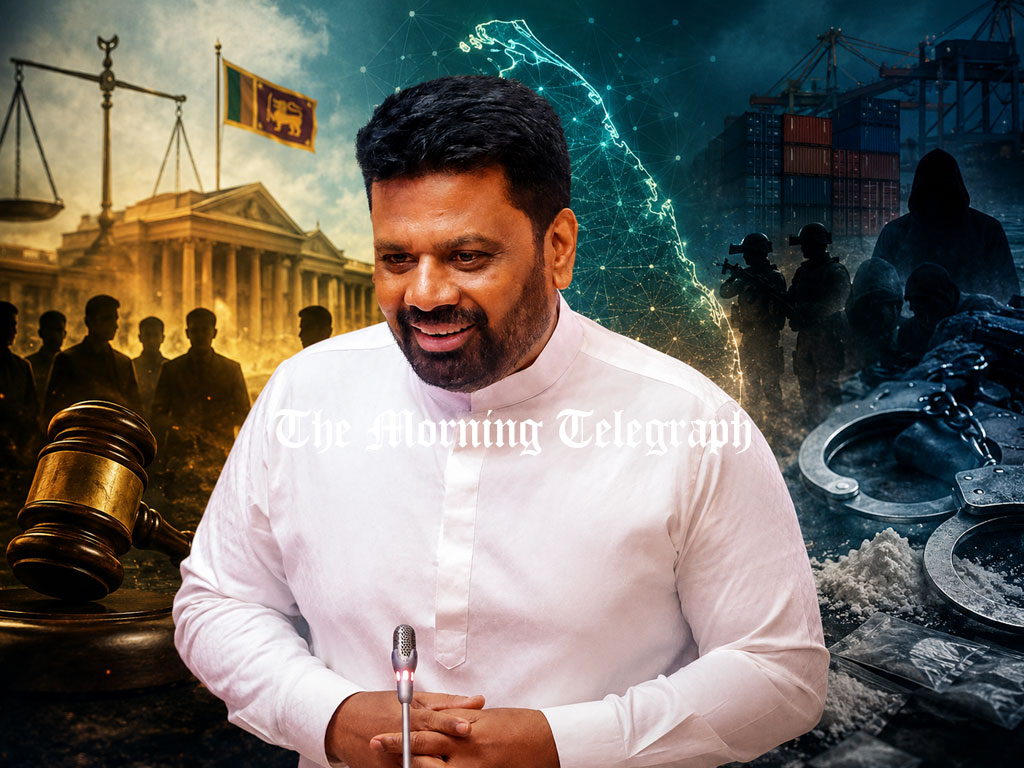
President Anura Kumara Dissanayake told Parliament that the government is fulfilling the public demand to punish those accused of fraud, corruption, drug trafficking and organized crime, insisting that no crime would be allowed to be buried under the “sand of time.”
The President said those who had stolen public property, abused state power or enabled criminal networks would be brought properly before the law, adding that the government had a duty to meet the people’s expectation for justice.
He made the remarks this morning (25) while joining the parliamentary debate held during the adjournment of the Committee on the Suppression of the Drug Menace.

Dissanayake said the central meaning of the mandate given to the current government was the creation of a civilized state. He stressed that the administration was not driven by personal revenge, but by the responsibility to make everyone, from the President to the lowest political leadership, and from the Secretary to the President to the lowest state official, stakeholders in such a state.
The President also said the government had already taken strong measures to suppress drug trafficking and armed criminal gangs linked to it, declaring that the country had now set foot on a long-term stable path.
President Anura Kumara Dissanayake’s Full Address
I am pleased to have the opportunity to present several facts regarding the proposals submitted for debate in Parliament today on eradicating the drug menace and suppressing organized crime.
The drug menace and organized criminal gangs in our country have been growing for a long time, terrorizing society and causing serious destruction. Therefore, it is the role and responsibility of all of us to contribute to the eradication of this drug menace and the suppression of organized crime.
We do not believe at all that drugs and organized criminal gangs emerged and grew in isolation. There are very clear networks of relationships. Therefore, if we are to suppress drugs and organized criminal gangs, we must pay attention to that entire sector. Organized criminal gangs, drug dealers, corruption that spread through state institutions and political authority, as well as criminal elements that entered the state, organizations that acted for political expediency, and political connections must all be addressed. This can only be ended by suppressing all of it. That is why we have now decided that all of this must be destroyed.
In that regard, I know there is a group that is deeply committed to this role. Unfortunately, that group has become the main accused in the eyes of the opposition today. Corruption, organized criminal gangs, drug dealers and crimes that operated from within the state body must all be suppressed. Laws have been enacted for this. Institutions exist. But institutions alone are not enough. What is needed is a state official mechanism that can give direct leadership to those institutions and defeat this menace. The group committed to that task has become the enemy of the opposition today. In this exercise, the Director of the Criminal Investigation Department, Deputy Inspector General of Police Shani Abeysekara, plays a major role. Today, he is an enemy of the opposition. In this task, the Director General of the Commission to Investigate Allegations of Bribery or Corruption, Mr. Ranga Dissanayake, plays a major role. He too is an enemy of the opposition today. Similarly, Secretary of Public Security Mr. Ravi Seneviratne, Minister Ananda Wijepala and Mr. Dileepa Peiris of the Attorney General’s Department are making a great contribution. Today, they have become enemies of the opposition. Likewise, the judiciary is playing a major role here, and the judiciary too has become an enemy of the opposition today.
Why have justice, fairness and civility become unbearable to certain groups in the opposition today? They cannot tolerate democracy and good governance. If crimes have been committed with state patronage from within the state, should those criminals not be exposed? Is that a betrayal of the country? Is that treason? No. It is the intention of building a civilized country.
Our state must be transformed into a civilized state. Everyone from the President to the lowest political leadership, and from the Secretary to the President to the lowest state official, must become stakeholders in a civilized state.
We have respect, appreciation and heartfelt gratitude for our military and intelligence services. But if our military and intelligence services have been used for the power of a certain family, for the power of a certain political camp, through a very small group within them, then I want to say that our government will not hesitate to provide the appropriate punishment for that as well.
We must do that for our military. We must also do it to build a civilized state. We must do it for the protection of the people of our country.
How was Lasantha Wickrematunga assassinated? It was not a conflict between ordinary civilians. A journalist who opposed the government was assassinated. It is reported that intelligence services were used. Should that be hidden? Keith Noyar was abducted and assaulted. It is reported that he was detained in a military safe house. Upali Tennakoon was assaulted. Poddala Jayantha was assaulted. Namal was assaulted. These were not civilian conflicts. These were crimes committed for the power of a family and a political camp. The assassination of Thajudeen is the same, and the Easter attack is the same. Is that all? Sirasa was set on fire. The Sunday office was set on fire. Siyatha was bombed. Such a history exists. Behind all of this were operatives of a very small state mechanism. Does this not need to be revealed to the country? Was there not a “white van” fear in the country? Were those who protested against their houses being broken into not abducted by unregistered white vans? These were not ordinary civilian conflicts. These were brutal assassinations and crimes committed by a very small group within the team that should have acted for the security of the state and the people, using them for their own political expediency. We are a government committed to enforcing the law against those brutal assassinations and crimes.
We must do this for the justice of those victims. We must do it for the reputation of the military. We must also do it for the civility of the state. Can anyone oppose that? Only criminals can oppose it. Only those who gained power and benefit from crimes can oppose it. No civil citizen, no citizen who respects democracy, human rights and humanity, can oppose these investigations.
Today, Shani Abeysekara, Ranga Dissanayake, the police and the judiciary are being heavily attacked. What crime did they commit? Their crime is that they are exposing and investigating crimes committed against the people of this country. They are not wrongdoers. If anyone thinks they can stop this exercise by threatening and intimidating officials individually, I assure you that we will not allow that at all. We will stand for this. We must stand for the public, not for criminals. I invite everyone to do that.
There was also a political connection to this. Money was taken to prevent the killing of criminals. When someone was arrested, the proper procedure was to produce that person before court. But they took money to kill them without producing them before court. They took money to save them from death. There was no party difference in that. People thought these matters would be buried under the sand of time. We will not allow them to be buried under the sand of time. Bringing criminals properly before the law is the responsibility of our state. Investigate, arrest, file cases through the Attorney General’s Department and deliver punishment through the judicial system.
But there was a history of arresting and assassinating. There was a history of taking bribes to save people from assassination. The secrets of the group arrested this morning will be revealed soon. I do not know whether you have such people in your parties. There is also a political leader who called a drug dealer in prison 92 times. He received 54 of those calls. The rest were received by others. I do not know whether even a disciplinary inquiry was conducted within the party regarding this.
This political authority has facilitated the growth of drugs and organized crime. We will completely end the protection given by political authority to this. There was a great mandate from the people. There was a core within that mandate. That core is transforming our state into a civilized one. Parliament must be civilized. They must listen. They must record facts. Is this the kind of Parliament the people of this country expect in this century? Direct leadership is needed for civility. Your MPs must be civilized. We must bring civility back to this country. We are engaged in the struggle to bring civility into Parliament as well as into state institutions.
Corruption was discussed on our election platforms for a long time. From 2023 to now, through TT, payments have been made, with advance payments of nearly one billion dollars. But the goods have not arrived. This is not money that ordinary people can take out. There is drug money. There is money earned through corruption. There is wealth earned through crimes. We have launched investigations into that.
This has been happening for over two years. We have now imposed regulations to prevent it. There are relationships with banks. We have identified several bank branches. It is this wealth earned through corruption that has gone out as dollars. That corruption has contributed to the collapse of the country’s economy and social body. Should investigations not be conducted into that? We have no personal revenge and no personal agenda to settle scores.
Nearly two years have passed since the government came to power. If we wanted revenge, it would have happened the moment we gained power. This is not revenge. We formally enacted strong laws through Parliament to suppress corruption and bribery. We established institutions for investigations. Some investigation institutions had collapsed. We strengthened those investigation institutions. We made new recruitments to the Attorney General’s Department. Cases in courts were delayed. That is why we established new High Courts separately. Our expectation is to expedite this process and deliver punishment through the courts.
The people of this country had an expectation that those who stole public property would be punished. There was no party division in that. It was a public expectation. Therefore, this government has become the government that is breathing life into the expectation among the general public of this country to punish the corrupt and fraudulent.
Especially after our government came to power, large quantities of drugs have been seized. Those raids have been strengthened. Drug arrivals through the airport, port and postal routes have been identified. Arrests are being made regardless of status. Without any discrimination, from the underworld to the respectable, everyone involved in this trade to some extent is being arrested. Similarly, we are making great efforts to suppress organized criminal gangs. Already, 23 people against whom red notices were issued have been brought to the country from abroad. Another 35 people involved in various drug trafficking activities have been arrested and brought to Sri Lanka.
We also know that crimes were directed from prisons. We have established a new prison in Welisara with the best facilities for prisoners, while completely disrupting external transactions. We are taking major criminals to Welisara. All communication networks there have been disrupted today. As a result, we have significantly disrupted the ability of organized criminal gangs to direct those activities from within prisons. Therefore, our government has taken a number of very strong measures to suppress drug trafficking and related armed criminal gangs.
We do not believe that drug trafficking and armed criminal gangs can be broken within a few months or within a year. However, we have taken a number of long-term, stable and strict measures required for this.
I am confident that we will completely uproot these organized criminal gangs, the underworld connected to them and the drug networks connected to them from Sri Lanka. We are not doing any of this by undermining democracy. If there are issues in their respective fields, they have the right to criticize the government. We do not want a society that lives in fear and submission to the ruler. We want a government that is constantly questioned by the people, a government that is accountable and knows it has a bond with the people. That is the nature of the relationship between the people and the state in a civilized society. A society that fears the ruler does not move forward. There must be an opportunity to question the ruler with a free mind. That is why we are a political movement that always works to expand every opportunity for democracy in this country.
For a long time, the people fought to abolish the Prevention of Terrorism Act. I want to say that this Prevention of Terrorism Act will be abolished this year. The final discussion on that has also been held. Accordingly, we will abolish the Prevention of Terrorism Act very soon. But we know that there is a threat of organized crime at this time. We will enact a strong law necessary to suppress those organized crimes.
Terrorism could be interpreted in various ways to file cases under the PTA. There is a wide range of interpretation under the Prevention of Terrorism Act. But we will always set the interpretation exactly as needed for organized crime. The Prevention of Terrorism Act has a very wide range. If they want to target someone, or if they disagree with someone, they can find a provision under the PTA to target them. That is how wide the interpretations of terrorism are within the PTA. We will amend it very soon to fully protect people’s fundamental rights, freedom of speech and democratic rights.
Next, the Organized Crime Act will target the suppression of organized criminals and will create a very clear definition for that. You can speak about that in Parliament. We will bring that act to a definition that entirely targets organized crime.
Next, a long debate was held in this Parliament when the Online Safety Act was passed. We opposed it. There were amendments to it at that time. After the Act was passed in Parliament, the Cabinet will add amendments to it next week. This is how it was in history. We will not implement the Online Safety Bill in its entirety. But we will amend it entirely. We obtained Cabinet approval last week to present a bill.
These are laws that were meant to violate people’s rights. We will abolish them. Not only that, many protests have arisen. Not a single water cannon has been used against the people during our governance in Sri Lankan history. Tear gas has not been used against the people. This is that kind of government. On one occasion, there was a conflict in the Matara prison. They tried to break out of the prison. Tear gas was used only within that prison. But this is the only era in the country’s history where tear gas was not used against the people’s struggle. This is the history where water cannons were not used. This is that kind of government. We are democratic. We want a state that empowers people. If we do not build that, we know no one else will. People must be able to question the ruler. There must be freedom. Rights must be given. To move forward as a country, we need a government that gives people their democratic rights. Therefore, we need a state that respects democracy as well as human rights. How many journalists have been threatened in history? How many media institutions have been targeted and attacked? Not now. But amid all this, we know that the citizens who receive the rights of that democracy must also come to their civility.
There is a problem in some of our political camps. They are not used to acting freely in a democracy. They are used to acting in fear and submission. So how do they present their opinions in a democratic free space? How do they fight? Is it democratic to go to the house of the Secretary to the Ministry of Finance to fight? You can fight any fight in front of the Ministry of Finance or in front of Parliament. That is democratic. But going to the Secretary to the Ministry of Finance’s house is uncivilized.
There is a very small group that does not know how to enjoy freedom in a democratic country. How do you maintain the civility of your slogans in a democratic country? How do you define the limits of your freedom in a democratic country?
They have no idea about that. We know what will happen if the opposition comes down to Parliament when the Mace is raised. The government will also come down. The day before yesterday, they came down somewhere, but not a single government MP came down from this bench. Why? There was always a history in this country where taking the Mace away was considered a heroic act of the opposition, and preventing it from being taken away was considered a heroic act of the government. But this time it was not like that. The people see taking the Mace away and carrying it on their shoulders not as a heroic act, but as an uncivilized act.
But somewhere, we must come to that civility. I think the best place for that is this Parliament. We know that we have set foot on very long-term stable steps in our country’s journey. Therefore, these are the steps we are taking to transform this country.
I also saw that there has been a great controversy regarding the judiciary. I inquired from the Chief Justice regarding the non-appointment of Supreme Court judges. He has sent a very detailed explanation. What is the reason? We are not looking at one person retiring from one court. We are thinking about the existence of the entire judicial system.
Today, several Magistrate’s Courts have been closed. The Attorney General has requested a three-judge High Court. But there are no judges to appoint three-judge High Courts. The judges in some three-judge High Courts that were established are handling more work. Therefore, there is a large number of vacancies at the lower levels. Accordingly, we need to proceed with lower-level appointments. The Judicial Service Commission has now given permission to recruit fifty new Magistrates. As far as I know, interviews are now being conducted. From that, thirty-three have been selected. I do not know how many will be selected after they also participate in the interviews. We should bring those who have that capacity into this field. Therefore, we need to make a decision regarding the appointment of Supreme Court judges without allowing the lower courts to collapse. We have also had to close several Additional Magistrate’s Courts. We are doing all of this by managing everything. The Chief Justice has sent a detailed explanation regarding that.
Similarly, he has given an idea about the targets regarding these appointments. Therefore, we can fill the vacancies in the Supreme Courts within a very short time. I saw it being said that these vacancies are being kept to give a carrot and obtain court decisions. There is no greater insult to judges than that. Do not insult our judicial system like that. Do not insult judges like that.
We are striving to deliver justice properly to victims. We have no need whatsoever to control a court. We have no need to control the media. We have no need to control protests. You know that the media was divided every other day. They have the right to criticize. They have the right to question. They have the right to point out if the government is making a mistake. Similarly, I believe they will learn what their civilized framework is. We are not going to teach them. But they will learn someday, because they must understand where public society stands. If the media stays in the old garbage dump while society moves forward, the media’s existence in society will be eliminated.
Therefore, I will conclude by expressing the hope that everyone’s support will be received for the program we are carrying out to transform this country into a civilized state and a civilized society, while especially protecting democracy and suppressing drugs and other crimes.