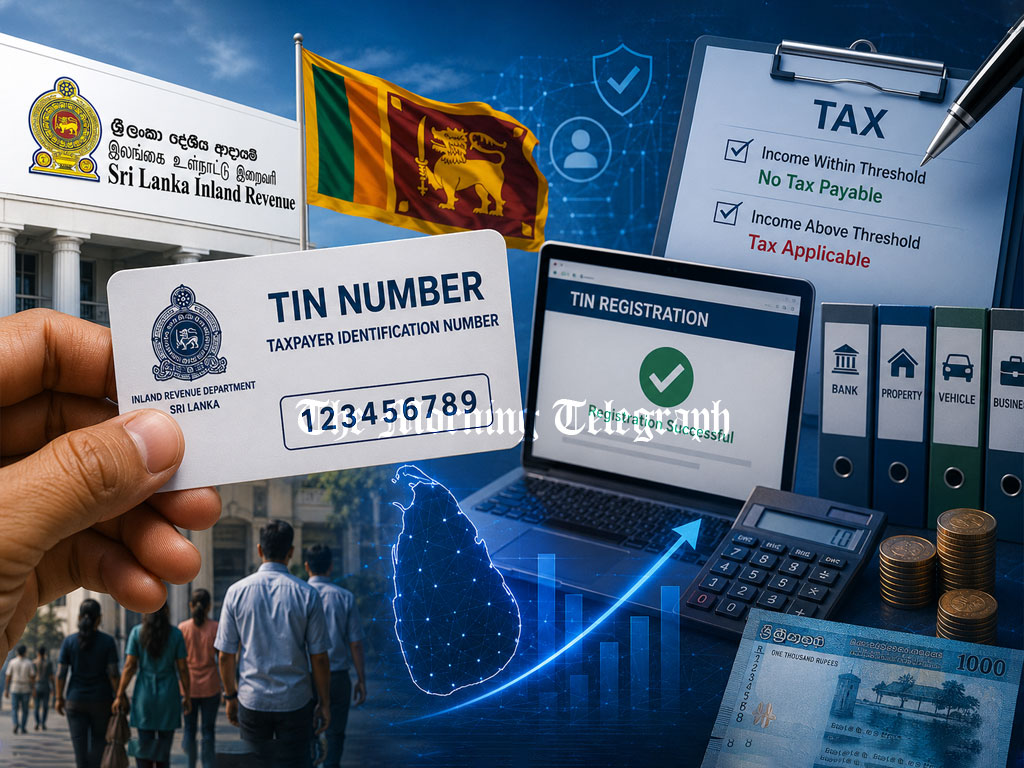
The Inland Revenue Department says obtaining a TIN number does not automatically mean paying tax, which applies only to those above income thresholds.
The TIN number issued by Sri Lanka’s Inland Revenue Department does not automatically require every holder to pay tax, with officials clarifying that taxation applies only to individuals and businesses that exceed the income thresholds set by the government.
Commissioner of Tax Policy at the Inland Revenue Department, Nandana Kumara, made the clarification while addressing a media briefing held at the Government Information Department auditorium.

He said the department has issued nearly 1.3 million Taxpayer Identification Numbers (TINs) between January 1, 2024, and the present, noting that public interest in obtaining the special identification number has increased significantly.
Following the introduction of the new system, the number of tax files maintained in the country has risen by approximately 120,000. One of the key objectives of issuing the TIN is to bring eligible taxpayers into the formal tax system.
The Commissioner of Tax Policy pointed out that around 40% of Sri Lanka’s population currently remains below the tax-paying threshold. He also stated that Value Added Tax (VAT) collections have already reached 59% of the targeted revenue, emphasizing that the proper implementation of the country’s tax system benefits society as a whole.
The TIN issued by the Inland Revenue Department is a unique nine-digit identification number that is separate from the National Identity Card (NIC) number and is used exclusively for taxation-related purposes.
While every Sri Lankan citizen aged 18 years or above is required to obtain a TIN, the number can be obtained conveniently through the department’s online system.
Individuals earning more than Rs. 1.2 million annually, or over Rs. 100,000 per month, are required to officially open a tax file. However, paying income tax becomes necessary only if their earnings exceed the applicable taxable limits.
Similarly, business owners are required to pay tax only if their annual income exceeds Rs. 1.8 million. Businesses earning below that threshold may simply obtain a TIN number and continue operating without interruption or additional tax liability.
The government has also made the TIN number mandatory for a growing number of public and professional transactions.
Accordingly, the TIN is now required when opening current accounts at banks, obtaining approval for building plans, registering vehicles, and transferring vehicle ownership.
In addition, the number must be presented when registering ownership of land and other property, completing customs procedures, and applying for various government-issued business licences and other public services.