By: Roshan Jayasinghe
The football game has always given humanity something very simple to believe in. It gives us a field, a ball, two teams, a referee, a clock, and a set of rules that every player is expected to follow. That is why people from every part of the world can sit together and watch a World Cup match, even when they do not speak the same language or come from the same background. The game explains itself through fairness. It tells us that the powerful nation and the smaller nation, the famous player and the unknown player, the favorite team and the underdog, must all begin from the same line. That is the beauty of football. That is also why any decision that appears uneven must be looked at carefully, not out of anger, but out of respect for the game itself.
In my human thought process, this red card situation is not simply about one player, one country, or one World Cup match. It is about something much bigger. It is about the true meaning of a level playing field in football. It is about whether the rule that applies to one player also applies to another. It is about whether the mercy, review, exception, or correction given to one team would also be available to every other team under the same circumstances. When the football game begins to give that doubt to the public, the conversation moves beyond one match. It becomes a conversation about trust, neutrality, authority, and the moral responsibility of those who govern the game.

A football field is one of the most honest places humanity has created, or at least that is what we want to believe. The lines are drawn before the players arrive. The goalposts do not move because one team is more famous. The clock does not run faster for one country and slower for another. The ball will not roll toward the more famous player or the more powerful team. That is the innocent beauty of the football game. It places human beings on a field and says, for the next ninety minutes, let skill, discipline, courage, teamwork, and fairness decide what happens.
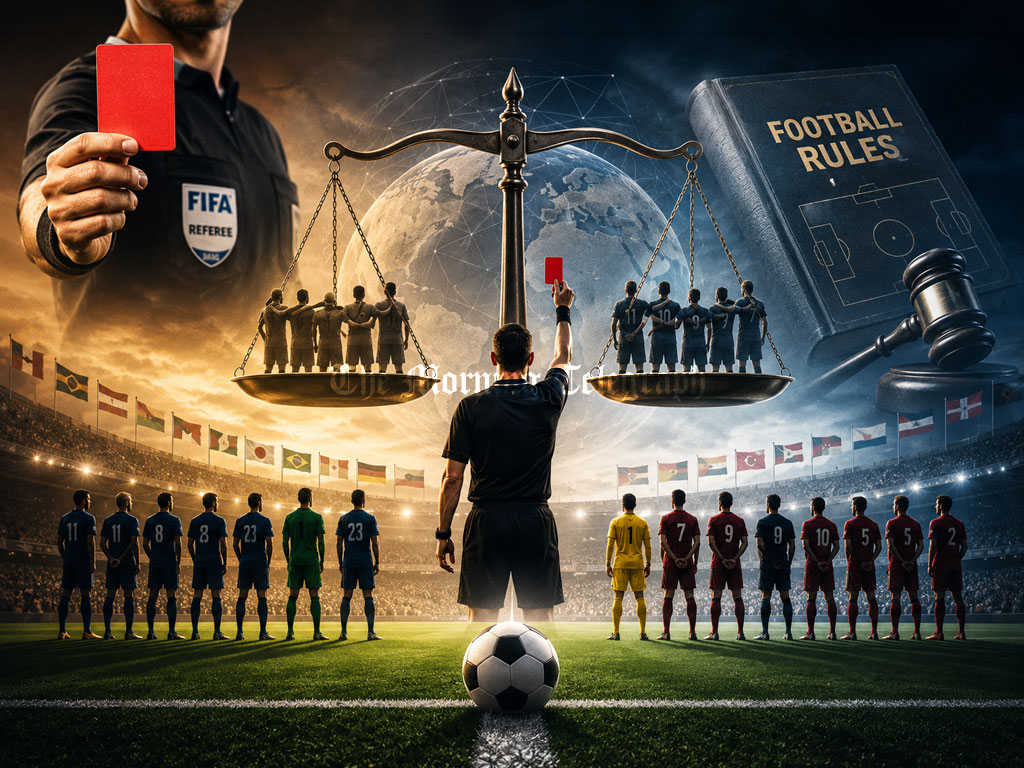
That is why a red card carries such weight. It is not just a card held in the hand of a referee. It is the law of football speaking in public. It tells the player, the team, the opponent, and every person watching that a line has been crossed. Sometimes the decision may be harsh. Sometimes the player may not have intended harm. Sometimes the viewers may disagree. That is part of football, because football is played by human beings and judged by human beings. But the strength of the game does not come from every decision being perfect. It comes from the belief that once a decision is made under the rules, the consequence will be applied equally.
This is where the concern begins. If the normal rule says that a player sent off must miss the next match, then the public understands that rule very clearly. It may hurt a team. It may hurt a tournament. It may remove an important player from a big game. But that is what makes the rule meaningful. A rule that only applies when it is convenient is no longer a rule in the full moral sense. It becomes a tool. And when a rule becomes a tool, people begin to ask who is holding that tool, and for whose benefit.
The deeper question is not whether one player deserves compassion. The deeper question is whether every player would receive the same compassion. The question is not whether a decision can be reviewed. The question is whether the same review is open to every team, from every continent, with the same urgency and the same respect. In football, fairness cannot only be written inside the rulebook. Fairness must also be seen by the players, the teams, and the people who trust the game.
If FIFA has a disciplinary power that allows a suspension to be delayed, reduced, or placed under probation, then that power must live in the daylight. It must be clearly explained. It must be available under known standards. It must not appear to wake up only when a powerful voice speaks, or when a powerful nation is affected, or when a major match is at risk. The rulebook may allow a legal path, but legality alone does not always satisfy the human sense of fairness. Fairness must also be felt and understood by the ordinary fan who is not a lawyer, not a referee, and not sitting in a committee room.
This is why the appearance of influence is so dangerous in football. Even if the final decision can be defended through a written article in the disciplinary code, people will still ask a simple human question. Would the same thing happen for a player from a smaller country? Would the same review happen for a less powerful football nation? Would the same speed of review happen if the player did not carry tournament value, political value, or commercial value? These questions may be uncomfortable, but they are fair questions, because trust is not protected by silence. Trust is protected by transparency.
The football game must be bigger than power. That is the whole reason we love it. A small nation can defeat a giant. An unknown player can become a hero. A goalkeeper can save a penalty and change history. A team with less money, less fame, and less global influence can still win if they play better on the day. That is what makes football beautiful. But when outside influence appears to touch the inside of the field, even lightly, the public begins to feel that the game is no longer standing fully on its own two feet.
The word sportsmanship is often used after the match, when players shake hands or exchange jerseys. But true sportsmanship in football begins much earlier than that. It begins with the rulebook. It begins with the referee’s authority. It begins with the governing body applying the same measure to every player. It begins with the losing team believing it had a fair chance. It begins with the winning team being able to say, without doubt, that it won under the same conditions as the other side.
There must always be room for human judgment. If a red card is clearly wrong, then the football game must have a way to correct injustice. If a disciplinary review is needed, then fairness must allow a remedy. But correction must not become selective. Mercy must not become privilege. Review must not become influence. A fair exception is one that every team can understand and access. An unfair exception is one that arrives only when the right people ask for it.
The World Cup is not only a football tournament. It is one of the few stages where the world gathers under one shared emotion. People wear their colors with pride. Families sit together. Children learn the names of players they may never meet. Nations that may disagree politically still meet under the same rules of the game. That is a beautiful thing. But that beauty depends on neutrality. The field must not carry the shadow of power. The whistle must not sound different depending on the jersey. The disciplinary process must not appear stronger for some and softer for others.
In this situation, the thought is very simple. If the red card rule applies, let it apply. If the disciplinary code allows relief, let that relief be explained clearly and offered equally. If a player can have a suspension placed under probation, then every team should know when and how that can happen. There should be no mystery, no special door, no silent influence, and no feeling that one nation was able to reach a place that another nation could not.
The greatness of the football game is not only in the goals. It is in the belief that the game belongs to everyone. It belongs to the star striker and the substitute waiting on the bench. It belongs to the host nation and the smallest qualifier. It belongs to the fans in the stadium and the child watching from a living room far away. That shared ownership is sacred. Once people feel that the rules are not applied evenly, the game may still continue, but something inside the public trust begins to weaken.
This observation is for the football field. It is for the line drawn in white grass. It is for the referee’s whistle to mean the same thing to all. It is for the young player watching and learning that discipline matters. It is for the smaller football nation that must believe the law of the game will protect it just as much as it protects the powerful. It is for the simple human idea that fairness must not depend on who is asking.
In the end, a World Cup should remind humanity of what equality looks like when it is practiced in front of our eyes. Eleven against eleven. One ball. One field. One set of rules. That is the promise of football. That is the beauty. That is the trust. And that trust must be guarded carefully, because once the football game loses the feeling of equal treatment, it loses more than a match. It loses part of the reason people loved it in the first place.
Author’s Note
Football is emotional because people believe in it. They believe that what happens on the field is protected from outside power. When a rule is applied, people can accept pain. When a rule is corrected fairly, people can accept that too. But when the correction appears selective, the heart of sportsmanship is questioned. The game must remain bigger than influence, bigger than politics, and bigger than the importance of any one match. The same rule, the same mercy, and the same process must be available to all. That is how neutrality is protected. That is how the football field remains truly equal.