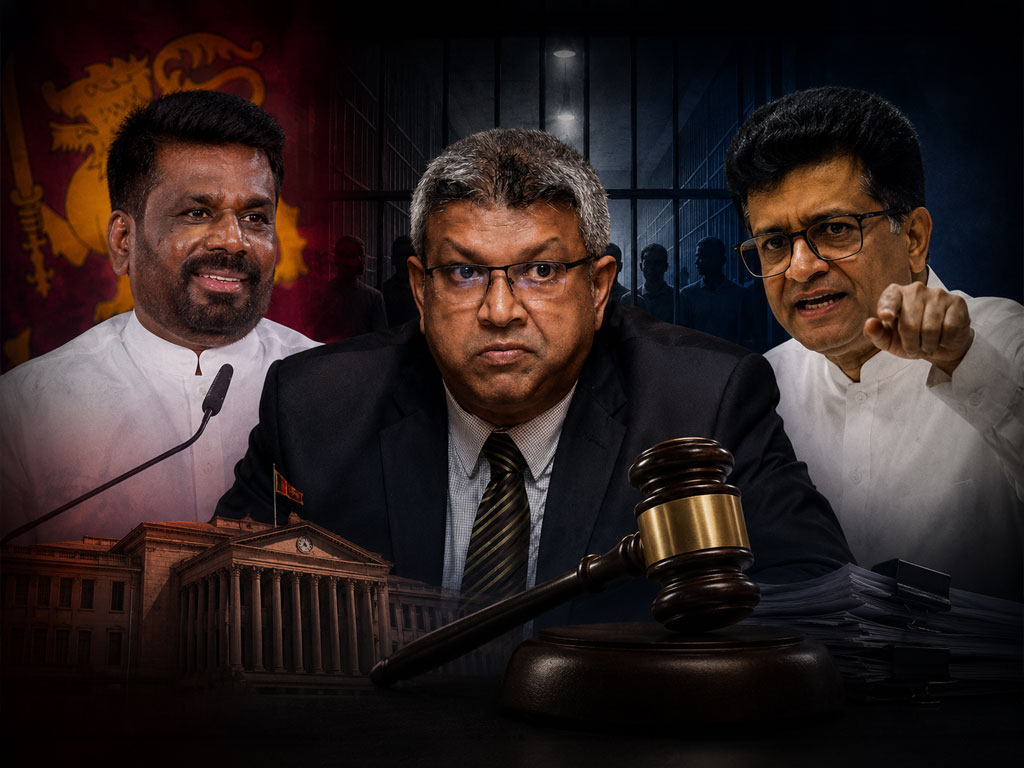
- Gammampila Lists 10 Reasons Justice Minister Must Go
Justice Minister no-confidence motion gains support as Udaya Gammampila lists 10 failures involving prisons, courts and drug cases.
The Justice Minister no-confidence motion has received the full backing of Pivithuru Hela Urumaya leader and attorney Udaya Gammampila, who outlined ten reasons for supporting it.
Gammampila presented his allegations during a media briefing held today. He said the opposition had moved to bring the motion against Justice Minister Harshana Nanayakkara.
“We give our full support to that no-confidence motion, based on ten reasons,” he said.
Gammampila began by highlighting severe overcrowding in Sri Lanka’s prisons. He claimed the current prison population stands at four times the system’s capacity.
According to him, overcrowding has placed enormous pressure on inmates and prison officers. He said his party warned last week that these conditions were increasing clashes among prisoners and between inmates and officers.
He also claimed the prison population doubled between 2022 and 2026. Of all prisoners, he said 75% are on remand. Among remand prisoners, 80% reportedly face drug-related charges.

Drug Reports and Bail Delays Drive Prison Crisis
Gammampila referred to allegations from anti-drug campaigners that major traffickers hire skilled lawyers and escape prosecution while drug users ultimately enter prison.
He said the Ranil Wickremesinghe government introduced a legal amendment in 2022 to address the issue.
Under that amendment, a person allegedly possessing more than two grams in net drug weight can obtain bail only from the Court of Appeal. Those accused of possessing less than two grams may seek bail from the High Court.
Gammampila said the law intended to place greater pressure on traffickers. Even a suspect in Jaffna would have to approach the Court of Appeal in Colombo when the quantity exceeded two grams.
However, the Government Analyst Department must determine whether the net weight falls above or below that threshold.
Gammampila argued that delays in analyst reports have sharply increased the number of drug suspects held on remand. Without a report, suspects cannot determine which court they should approach for bail.
He blamed this situation for the doubling of the prison population since 2022.
Recruitment stopped between 2022 and 2024 amid the economic crisis, he said. Although authorities lifted the recruitment ban in 2024, Gammampila accused the Justice Minister of failing to expand the Government Analyst Department’s capacity.
He identified that as his first reason for supporting the Justice Minister no-confidence motion.
His second reason concerned staffing at the Attorney General’s Department. Gammampila alleged that the minister had failed to increase the number of officers needed to handle cases efficiently.
The third reason was the failure to increase the number of judges serving in lower courts.
His fourth allegation concerned vacancies in the higher courts. Gammampila said the President had left several positions vacant for a long period. He argued that the Justice Minister had failed to persuade the President to fill them.
Court Vacancies and 2022 Law Come Under Fire
Gammampila said the fifth reason involved the large number of vacancies across the lower judiciary.
He claimed those vacancies were delaying court proceedings. However, he said the minister had failed to persuade the Judicial Service Commission to appoint judges to the vacant positions.
The sixth reason concerned the controversial 2022 amendment governing bail in drug cases.
Gammampila argued that the minister should have temporarily suspended the law until the Government Analyst Department, Attorney General’s Department and courts had enough staff to process cases efficiently.
He said the minister took no such action while the five earlier problems continued.
The seventh reason concerned the leadership of the Prisons Department.
Gammampila said the department had operated for more than a year without a permanent Commissioner General of Prisons.
He described former Commissioner General Thushara Upuldeniya as a highly capable officer who had earned widespread respect. He alleged that authorities suspended Upuldeniya on false charges.
Gammampila said the Human Rights Commission later concluded that the suspension was wrong and recommended his reinstatement.
However, he accused the Justice Minister of ignoring that recommendation. As a result, he said, the Prisons Department now resembled “an aircraft flying without a pilot.”
His eighth allegation concerned the Government’s anti-drug media campaign.
Gammampila said authorities had imposed arrest targets on police officers, creating unnecessary pressure on them.
He referred to serious allegations that some officers plant drugs on arrested people when they cannot prove those individuals are traffickers or users. He described that situation as another Government failure for which the subject minister must accept responsibility.
Officials Allegedly Afraid to Make Decisions
Gammampila’s ninth reason focused on what he described as a culture of fear across the public service.
He argued that the Government’s approach to officials who make mistakes had discouraged public servants from taking decisions.
Gammampila quoted an unnamed officer as telling the Justice Minister: “Sir, this was something that could have been stopped with a fingernail, but we could have stopped it if we had been given orders.”
He said officials were now reluctant to act because they feared punishment.
According to Gammampila, the Government had pushed officials towards the attitude of “more work, more troubles; less work, less troubles; no work, no troubles.”
He argued that the Justice Minister, as the relevant Cabinet minister, must accept responsibility for this institutional paralysis.
Gammampila described his tenth reason as the most important.
He recalled a statement that President Anura Kumara Dissanayake allegedly made on November 30, 2020, while serving as an opposition MP.
According to Gammampila, Dissanayake said prisoners remain under the Government’s care and that the State therefore bears responsibility for their lives.
He also claimed Dissanayake said the Justice Minister must accept responsibility and resign if even one prisoner dies inside a prison.
President Anura’s Past Statement Returns to Spotlight
Gammampila argued that the statement represented the policy of the National People’s Power and its leader.
He said the issue differed from criticism against Justice Ministers in earlier governments because they had not publicly established such a standard for themselves.
According to him, voters gave the NPP power in 2024 to approve and implement the policies its leaders had previously presented.
Therefore, Gammampila said, the Government must now prove those words through action. He called on Justice Minister Harshana Nanayakkara to resign.
He said his party had highlighted similar contradictions one year earlier under what it called “Newton’s Fourth Law.”
The argument did not initially attract much public attention, he said. However, Gammampila claimed people had now become familiar with the pattern.
He defined “Newton’s Fourth Law” as a statement made by Anura Kumara Dissanayake while in opposition that directly contradicts his words or conduct after assuming power.
Gammampila said some people described the present situation as “Ditta Dhamma Vedaniya Kamma.”
He argued that people who once believed such consequences would never occur may now witness them after bringing the current administration to power.
Gammampila concluded that the opposition’s parliamentary numbers did not reflect the wider public mood.
“Regardless of the majority in Parliament, our belief is that the majority of the country supports this no-confidence motion,” he said.