By Roy Denish.
The Dedduwa tourism project remains stalled after two decades, exposing land misallocation, investor screening failures and rising public costs.
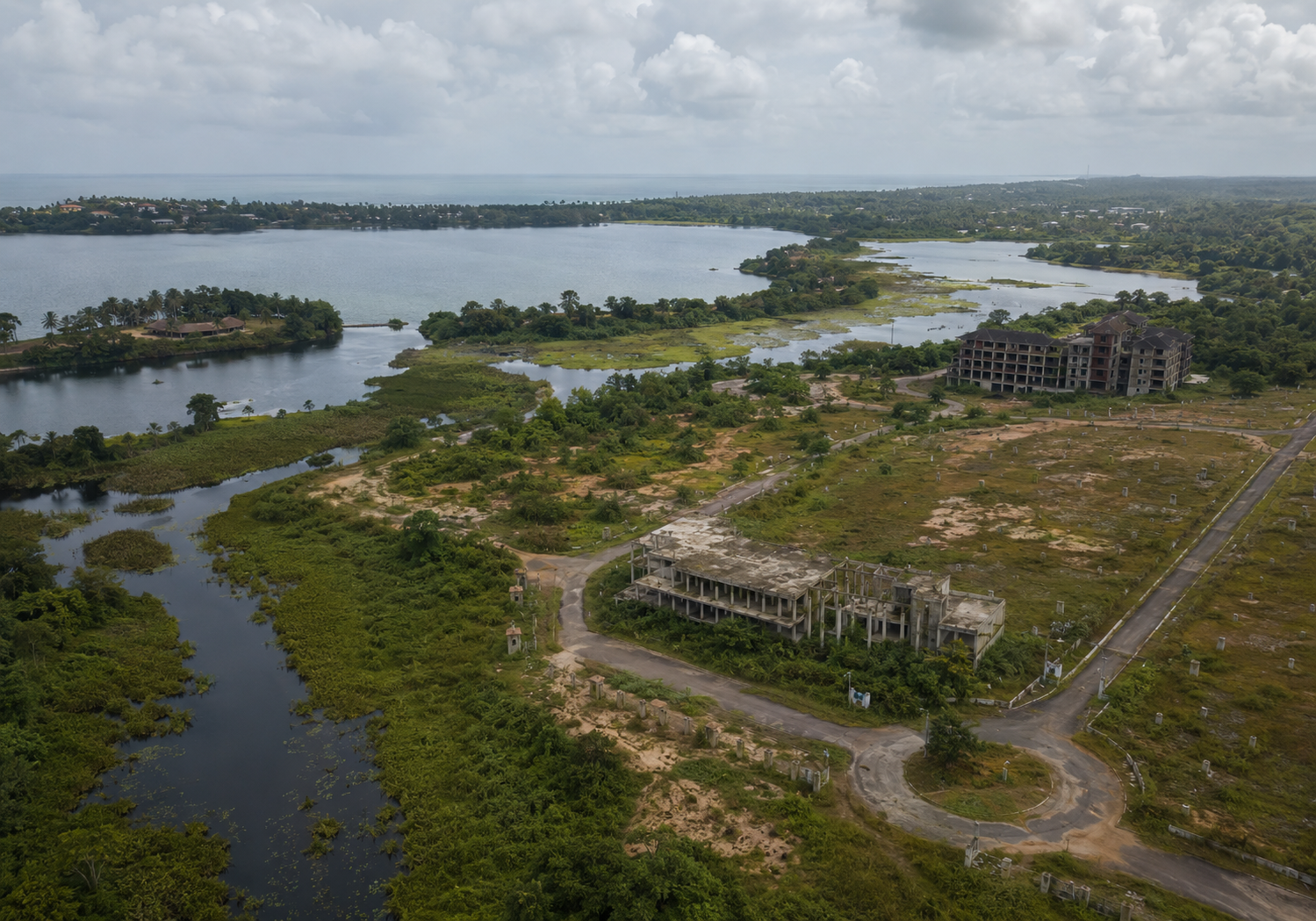
The Dedduwa tourism project in Bentota remains locked in an institutional and financial stalemate, two decades after public land acquisition began for the lake-based resort development. The latest need to seek fresh Expressions of Interest after prospective investors failed to show adequate financial capacity highlights deeper weaknesses in feasibility, capital allocation, and sovereign risk management. Once promoted as a multi-use mega-resort that could expand Bentota beyond coastal tourism into higher-yield eco-tourism, Dedduwa now reflects persistent asset misallocation, regulatory friction, and fiscal inefficiency.

Dedduwa Tourism Project Faces a Land Capital Problem
From an economic perspective, the central weakness is the prolonged use of high-value land without productive returns. Land acquisition began in 2005 and concluded in late 2017, absorbing public funds through compensation to private landowners and substantial interest payments caused by statutory delays.
Nearly 700 hectares have remained tied up in administrative limbo for more than twenty years. That creates a major opportunity cost. Had the land and capital entered direct lease arrangements, private development, or continued local production, the discounted economic return over two decades could have exceeded the current zero-return position.
The cancellation of a major investment agreement, followed by the failure of all bidders to qualify in recent procurement rounds, also points to weaknesses in investor screening. Complex request-for-proposal processes without effective pre-qualification checks raise transaction costs for both the state and prospective developers.
When repeated tenders attract bidders that cannot meet financial requirements, the outcome may indicate that investors see the project’s risk-adjusted returns as uncompetitive. It may also suggest that the project structure depends on valuations the market considers too speculative.
Rising Sunk Costs Increase Investor Risk
The capital burden is growing further. Local authorities must now acquire additional land to build dedicated access roads while also addressing unauthorized encroachments and boundary disputes.
Weak enforcement of property rights on state-vested land increases institutional uncertainty and can raise the perceived risk premium for credible international investors. Additional acquisitions at current market prices also deepen sunk costs and push the project’s break-even threshold higher. Meanwhile, coordination across multiple agencies continues to slow decisions.
The Dedduwa crisis therefore extends beyond a simple shortage of investor interest. It reflects a broader failure in public-sector asset monetization.
Continuing to add public debt and land-acquisition costs to a framework already burdened by two decades of delay risks reinforcing the sunk cost fallacy. Unlocking value in the Dedduwa tourism project will require a shift away from speculative mega-resort master planning toward modular development, phased land parceling, clearly provided infrastructure, and rigorous financial pre-screening of foreign capital partners.