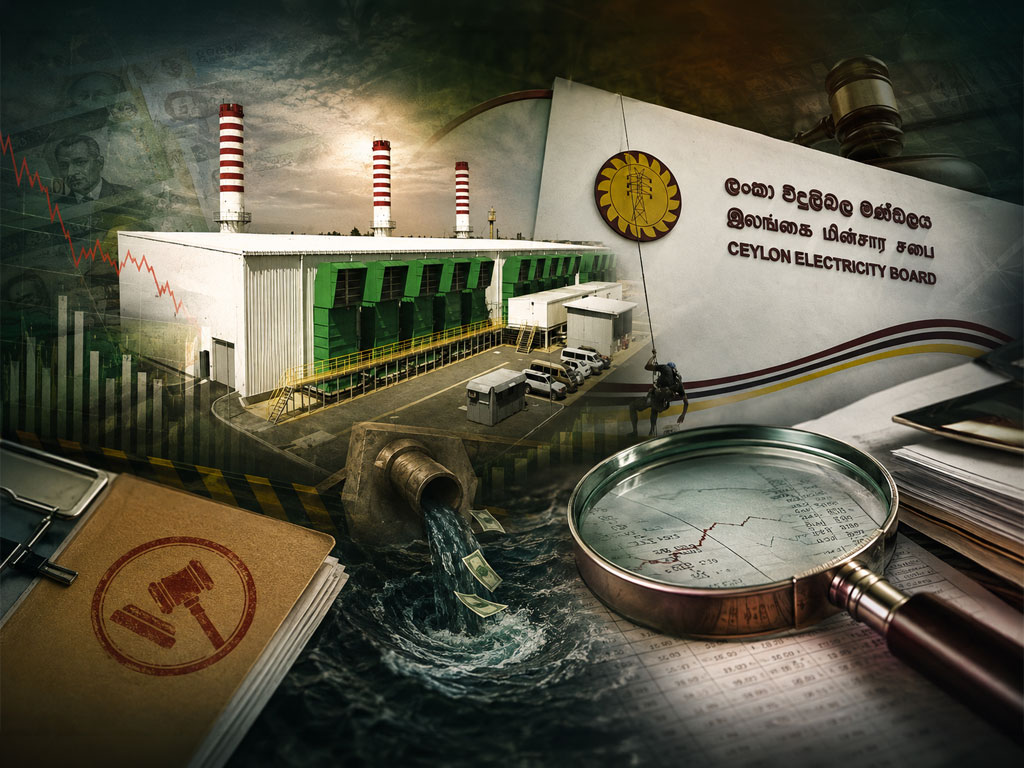
Ace Power Embilipitiya deal faces renewed scrutiny over capacity payments, emergency purchases and calls for a forensic audit.
The Ace Power Embilipitiya power deal has emerged as a major focus of scrutiny over emergency electricity purchases, capacity payments and allegations of serious financial irregularities involving public funds.
Critics have long described networks surrounding emergency power purchases as an “electricity mafia”. They allege that artificial electricity shortages were created to justify buying power from private plants at exceptionally high prices.
At the centre of these allegations is the Ace Power Embilipitiya plant. Questions have persisted over payments made after its original agreement ended and over the government’s failure to acquire the facility.
The controversy has gained renewed significance following calls in September 2025 for a forensic audit into emergency electricity purchases and capacity charges.
Get Breaking News First
on WhatsApp

Ace Power Embilipitiya Plant and the Original Agreement
The Ace Power Embilipitiya power plant began operations in 2003 with a generation capacity of 100 megawatts.
Its initial capital investment stood at Rs. 1,676 million.
During the contractual period from 2003 to 2015, the Ceylon Electricity Board, or CEB, paid approximately Rs. 10 billion in capacity charges alone.
According to the figures cited in the allegations surrounding the transaction, the company earned a return equivalent to 511% of its investment by the end of the agreement. This represented a reported net profit of Rs. 8,572 million.
The original account states that the plant’s capital cost had effectively been fully recovered by the time the contract ended.
Against this background, the Cabinet decided in March 2016 that the government should acquire the plant.
However, the proposed acquisition soon became contentious.
The company reportedly sought US$17 million, equivalent at the time to approximately Rs. 2.44 billion, for the facility.
In July 2017, the Government Chief Valuer placed the value of the plant at Rs. 2.37 billion.
According to the account, the company rejected a transfer at that valuation. Officials and ministry authorities subsequently abandoned the acquisition process rather than pursuing further action.
Critics argue that the failure to complete the acquisition opened the door to costly contract extensions over subsequent years.
Capacity Charges and Alleged Double Payments
After the proposed acquisition collapsed, the CEB continued extending agreements to purchase electricity from the plant.
These extensions were justified on the basis of electricity shortages, particularly in the Southern Province.
However, the central allegation concerns capacity charges linked to capital costs and loan components that had reportedly already been recovered.
Critics claim those amounts continued to appear in calculations for capacity payments, generating substantial financial benefits for shareholders.
The figures cited illustrate the scale of the disputed payments.
From April 2016 to April 2017, fixed capacity charges reportedly totalled US$4.16 million. Of this amount, US$3.16 million was described as shareholder benefits.
Under six-month and one-year extensions implemented in 2017, another US$4.37 million was reportedly paid in capacity charges.
The account states that US$3.32 million of that amount represented shareholder benefits.
The largest payments came during the three-year extension covering 2018 to 2021.
During that period, capacity charges allegedly reached US$13.17 million, with US$10.02 million reportedly flowing to shareholders as benefits.
COPE investigation material cited in relation to the controversy also states that between 2018 and 2024, approximately US$10.39 million was paid in benefits to shareholders of the private company.
Those figures have fuelled questions over whether purchasing the plant at the Government Chief Valuer’s Rs. 2.37 billion valuation would have been more economical for the state.
The original account also points to the financial growth of parent company Aitken Spence’s energy sector.
It states that revenue in the sector increased fourfold, from Rs. 4.1 billion to Rs. 16 billion, during the period of continued power purchases from 2016 onwards.
Questions Over Regulation and Emergency Power Purchases
The allegations also centre on compliance with Section 43 of the Sri Lanka Electricity Act No. 20 of 2009.
According to the claims, prior approval from the Public Utilities Commission was required for emergency electricity purchases.
Critics allege that the CEB proceeded despite regulatory objections and relied instead on Cabinet decisions to support the transactions.
Several incidents have also been cited as examples of broader problems surrounding emergency electricity procurement.
One involved Deputy General Manager of Energy Purchases Sujeewa Abeywickrama.
In April 2018, authorities suspended Abeywickrama after he reportedly refused to approve an invoice worth Rs. 840 million that he regarded as unlawful.
The 2023 Samanalawewa electricity crisis has also been linked by critics to concerns over emergency procurement.
The account alleges that warnings from engineers were ignored and that the Samanalawewa reservoir was allowed to fall to critically low levels.
A subsequent energy emergency reportedly resulted in electricity purchases from private suppliers, including Ace Power, at high rates without competitive tender procedures.
During Sri Lanka’s 2022 economic crisis, the state also reportedly faced electricity costs of approximately Rs. 37 per unit through such emergency arrangements.
These claims form part of a broader argument that weaknesses in planning and procurement allowed expensive short-term electricity contracts to continue.
End of Ace Power Embilipitiya Purchases
A major change came with the Sri Lanka Electricity Act No. 36 of 2024.
The legislation introduced a restructuring of the electricity sector, including plans to separate the former Electricity Board into 12 institutions and establish a new national electricity market.
Against that backdrop, on January 30, 2025, the newly restructured state institution formally informed Ace Power Embilipitiya that electricity purchases from the company would no longer be required.
The decision effectively ended a long-running relationship between the plant and the state electricity sector.
However, questions surrounding earlier contracts and payments remained unresolved.
Those concerns became the focus of a COPE committee inquiry held on September 24, 2025.
Following that investigation, the committee recommended a comprehensive forensic audit into emergency electricity purchases and disputed capacity-charge payments.
Unlike a routine financial review, such an audit would seek to examine the circumstances behind the transactions and identify possible conflicts of interest or wrongdoing.
What the Proposed Forensic Audit Would Examine
One major objective would be to investigate officials who approved capacity charges linked to capital that critics claim had already been fully recovered.
The proposed investigation would examine personal financial dealings, relationships and potential conflicts of interest involving ministry and Electricity Board officials connected to those approvals.
It would also examine whether there was evidence of deliberate wrongdoing or criminal intent.
A second area would involve the failed government acquisition of the Ace Power Embilipitiya plant.
Investigators would be expected to determine whether bribery, improper influence or other interventions played any role in preventing the state from acquiring the facility in 2016.
Another objective would be the potential recovery of money if investigators establish that public funds were unlawfully paid.
Supporters of the forensic audit argue that any amounts improperly obtained should be recovered from the responsible parties and returned to the state.
The controversy surrounding Ace Power Embilipitiya has therefore become a prominent example cited by critics of the risks created when government procurement, private power generation and emergency electricity purchases overlap.
The allegations involve policymakers, public officials and private-sector interests. However, the precise extent of any legal wrongdoing would ultimately require findings from competent investigative or judicial authorities.
Although the 2024 Electricity Act introduced structural changes designed to reshape Sri Lanka’s electricity sector, questions remain over transactions carried out under the earlier system.
For that reason, calls continue for the forensic audit proposed by the Committee on Public Enterprises to be implemented fully.
Supporters argue that establishing what happened, holding any responsible parties accountable and recovering any unlawfully lost state funds would represent an important step towards transparency and economic accountability in Sri Lanka’s electricity sector.