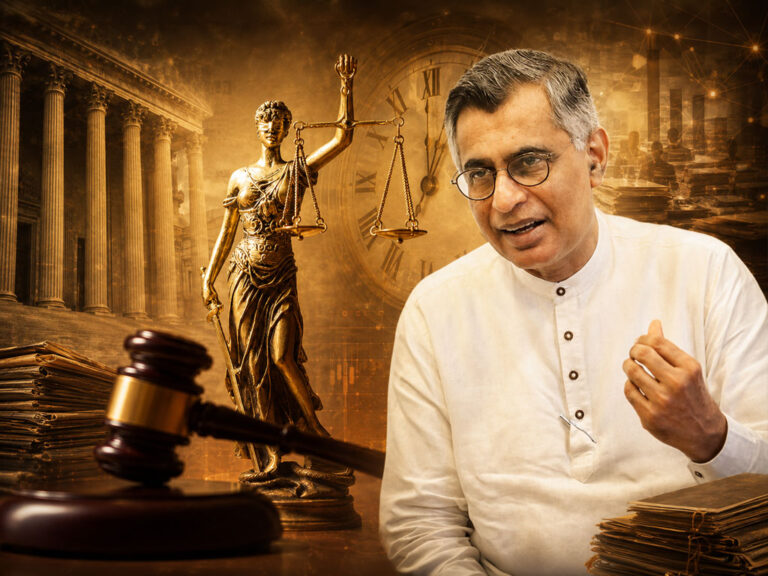
Judges retirement age extension will not solve Sri Lanka’s court backlog, Patali Champika Ranawaka argues, alleging a political motive behind it.
Former Minister Patali Champika Ranawaka says extending the judges retirement age will not solve Sri Lanka’s severe court backlog and has alleged that political considerations lie behind the proposal.
Speaking to the media, Ranawaka argued that judges cannot simply be compared with other professionals such as doctors or engineers.
He said constitutional protections governing judicial tenure and remuneration exist to safeguard judicial independence and limit possible executive influence.
Sri Lanka’s Constitution currently sets the retirement age at 65 for Supreme Court judges and 63 for Court of Appeal judges. The proposed change would raise those limits to 67 and 65 respectively.

Judges Retirement Age and the 1% Argument
Ranawaka pointed to Sri Lanka’s wider case backlog to question whether the amendment would meaningfully reduce delays.
Recent figures presented on judicial delays put the total number of pending cases above 1.13 million. Of those, 5,785 were before the Supreme Court and 4,572 before the Court of Appeal. Together, those two courts account for slightly under 1% of the overall backlog.
Ranawaka therefore argued that extending the tenure of judges serving in the two highest courts would leave the overwhelming majority of pending cases untouched.
Instead, he called for greater use of digital technology and Artificial Intelligence within the judicial system.
He also said younger professionals should contribute to modernising court administration and reducing delays.
The judges retirement age proposal has already become a major constitutional and political controversy, with Parliament formally considering an increase of two years for judges of both superior courts.
Ranawaka Alleges Wider Political Objective
Ranawaka went further, alleging that the Government has a hidden political strategy behind the reform.
He claimed the administration could seek to consolidate its position through a referendum in 2027 and alleged that strong opposition figures could face politically motivated prosecutions before heavier debt repayments resume.
Those claims are political allegations and have not been established as fact.
Sri Lanka is, however, expected to resume significant external debt repayments from 2028 following its debt restructuring, a timeline also acknowledged in Government and international reporting.
Ranawaka also criticised what he described as selective accountability.
He claimed authorities had failed to act adequately against those responsible for Sri Lanka’s economic collapse, fuel shortages and major losses to the Treasury.
He further referred to allegations surrounding the 323-container controversy, coal procurement and diesel transactions.
Ranawaka argued that pursuing political opponents over comparatively minor historical allegations, including matters such as poster-related offences, would be difficult to justify while larger financial controversies remain unresolved.
His central argument is that reducing Sri Lanka’s court delays requires structural reform, technology and greater judicial capacity, rather than simply extending the tenure of a small number of senior judges.