Suranjith Wevita appointment as SLTDA Chairman has triggered legal questions over the Tourism Act and his reported role as an active tour guide.
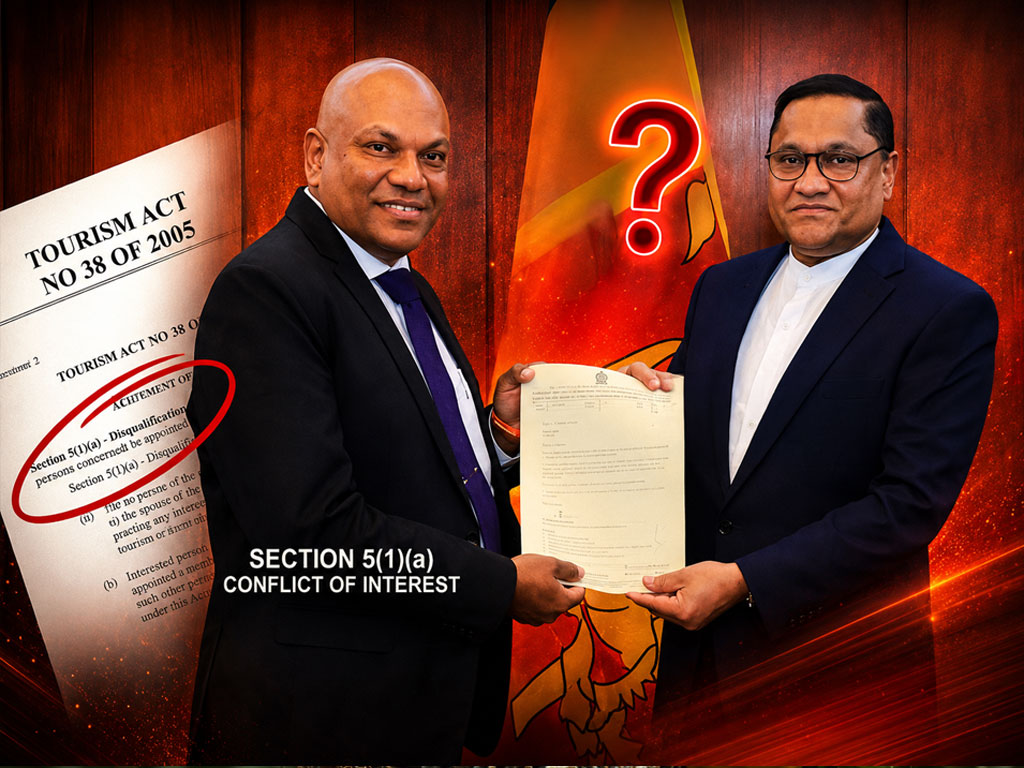
The Suranjith Wevita appointment as Chairman of the Sri Lanka Tourism Development Authority has triggered fresh legal questions over the Tourism Act and possible conflicts of interest.
The controversy follows the resignation of Buddhika Hewawasam, who President Anura Kumara Dissanayake had previously appointed to lead the SLTDA.
The President had repeatedly praised Hewawasam’s conduct and capabilities. Against that background, subject minister Vijitha Herath’s decision to appoint Wevita as the new Chairman has sparked considerable discussion.
Various opinions and rumours are now circulating on social media over the reasons behind the sudden leadership change.
However, legal experts argue that the more significant issue lies beyond the political speculation.
They say the Suranjith Wevita appointment may create a legal problem if reports that he remains an active national and regional tour guide are correct.
Recent newspaper reports and his own social media activity have been cited as indicating that he continues to work as a tour guide. He has also advocated for provincial-level tourism service providers against what he describes as the dominance of Colombo-based elite associations.

Suranjith Wevita Appointment and the Tourism Act
Legal experts say the central question concerns the Tourism Act No. 38 of 2005, which established the Tourism Authority.
They point specifically to Section 5(1)(a), which sets out disqualifications for appointment as a member of the Authority, including its Chairman.
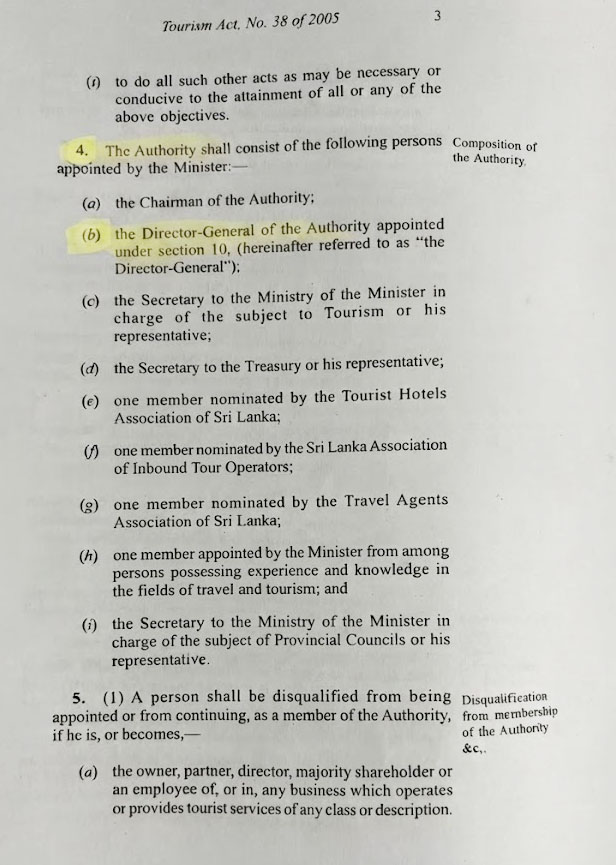
The provision states:
“if he is the owner, partner, director, majority shareholder, or employee of any business of any class or description providing or operating tourist services, then that person shall be disqualified from being appointed as a member of the Authority or from continuing to serve as a member.”
Legal experts argue that this provision could become relevant if the Chairman continues to earn income directly from tourism services.
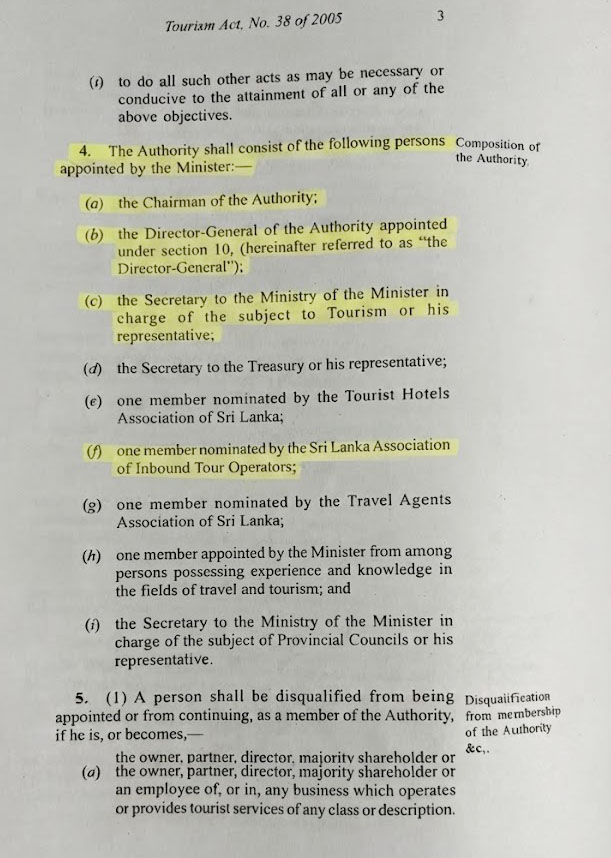
They also point to Section 4 of the Act.
That section provides a special exemption from the restriction for industry representatives appointed under paragraphs (e), (f), (g) and (h), including representatives from sectors such as hotels and travel agencies.
However, they argue that the Chairman appointed under Section 4(a) does not receive the same exemption.
According to their interpretation, the law therefore requires the Chairman to remain independent of direct commercial interests within the tourism industry.
Conflict-of-Interest Questions Raised
The issue becomes more significant because of an existing professional dispute over tour guide fees.
Under Section 53 of the Act, legal experts say the Tourism Authority and its Chairman hold final authority to determine such fees through Gazette notifications.
That creates a potential conflict, critics argue, if the Chairman is simultaneously working as an active tour guide.
They question how a person earning income from that sector could independently decide matters directly affecting the same professional group.
For that reason, some legal experts describe the situation as a serious conflict-of-interest concern and argue that it could undermine principles of impartial decision-making.
However, these remain legal interpretations and allegations surrounding the appointment. No official determination cited in the article has concluded that Wevita’s appointment is unlawful.
Appointment Also Sparks Wider Political Debate
Beyond the legal arguments, political commentators have offered broader interpretations of the appointment.
Some critics view the controversy as another example of the Government taking contentious approaches to existing laws and statutory procedures.
Others interpret such decisions differently.
Certain political analysts argue that challenging established practices could represent part of the wider “systemic change” that sections of the public expected from the current administration.
The Suranjith Wevita appointment has therefore developed into more than a dispute over personalities within Sri Lanka’s tourism administration.
It now raises questions about how the Tourism Act should be interpreted, what level of independence the SLTDA Chairman must maintain and how the Government intends to balance industry representation with corporate governance and public accountability.