
By Marlon Dale Ferreira
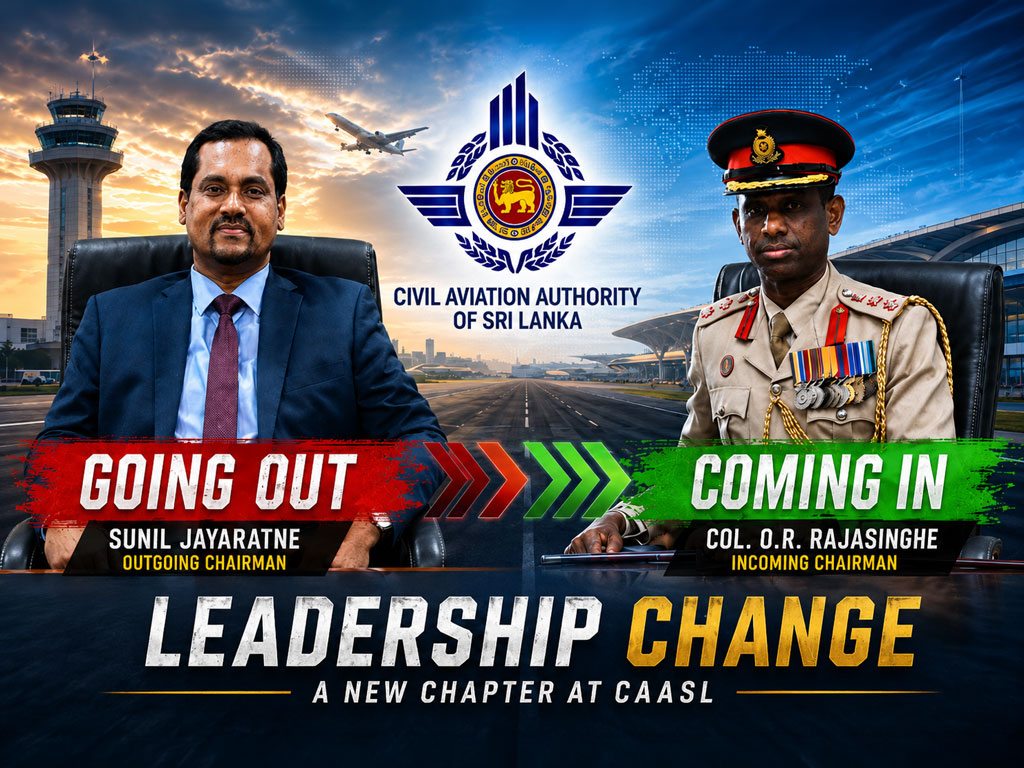
Sri Lanka’s aviation leadership carousel is spinning again. Less than seven months after Harsha Abeywickrema was removed from the chairmanship of Airport and Aviation Services, Civil Aviation Authority Chairman Sunil Jayaratne is now on his way out, with August 24 set to be his final working day and Colonel O.R. Rajasinghe expected to take over.
COLOMBO – The revolving door at the top of Sri Lanka’s aviation establishment appears to be turning once again, with Civil Aviation Authority of Sri Lanka Chairman Sunil Jayaratne set to leave office after August 24, 2026, paving the way for Colonel O.R. Rajasinghe to take over the chairmanship.
The change means that within the space of a year Sri Lanka’s two most visible aviation institutions, the Civil Aviation Authority of Sri Lanka (CAASL) and Airport and Aviation Services (Sri Lanka) (Private) Limited (AASL), will both have experienced upheaval at chairman level.
It also raises a broader question: why have the hottest seats in Sri Lankan aviation suddenly become so difficult to hold onto?
Jayaratne was still publicly identified by the CAASL as its Chairman as recently as August 12, when he attended the closing meeting of an International Civil Aviation Organization technical assistance mission alongside Ports and Civil Aviation Minister Anura Karunathilaka, Ministry Secretary W.W.S. Mangala and Director General of Civil Aviation Capt. Daminda Rambukwella. The Authority published details of that meeting on August 17.
Yet little more than a week later, his tenure is heading for an abrupt end.

From Customs to Civil Aviation
Jayaratne assumed duties as CAASL Chairman in November 2024.
His appointment was unusual from the outset because, unlike many senior figures traditionally associated with aviation regulation, he did not come from an aviation operational or technical background.
Jayaratne had instead spent more than 37 years at Sri Lanka Customs, eventually serving as an Additional Director General. His background included trade facilitation, Customs valuation, cargo procedures and international trade, and he had also served as Chairman and Director General of the National Enterprise Development Authority.
That is substantial public-sector experience.
But it is not aviation experience.
And herein lies one of the uncomfortable questions surrounding appointments to some of Sri Lanka’s most technically sensitive State institutions.
The Chairman of the Civil Aviation Authority does not fly aircraft, issue licences personally or conduct inspections. Those statutory and technical functions sit primarily with the Director General of Civil Aviation and professional regulators.
Nevertheless, the Chairman heads the governing board of an authority responsible for overseeing an industry where mistakes can have consequences considerably more serious than an accounting error or administrative delay.
Jayaratne was therefore, in essence, a government-appointed non-aviation Chairman overseeing the country’s aviation regulator.
Was Performance the Problem?
There is now considerable speculation within aviation circles that Jayaratne’s removal followed dissatisfaction over his performance in the role.
However, The Morning Telegraph has not independently established that underperformance was the official reason for his removal, and no publicly available Government statement examined for this report has yet provided a detailed explanation for the decision.
That distinction matters.
Political appointments can end for many reasons: changes in policy, internal disagreements, administrative restructuring, loss of confidence, performance concerns or simply a Government decision to install a different appointee.
Until the appointing authority explains the decision, claims that Jayaratne was removed specifically for poor performance should therefore be treated as speculation rather than established fact.
But his departure inevitably invites scrutiny because it comes after a tenure already marked by controversy.
The ‘Love Nest’ Story That Would Not Go Away
In February, The Morning Telegraph reported allegations that Jayaratne had occupied an official apartment that had been designated for the Director General of Civil Aviation rather than the Chairman.
The report, headlined “Chairman Civil Aviation Authority Booted Out From Illegally Occupied ‘Love Nest’”, alleged that the Ministry intervened and ordered him to vacate the premises.
The article further alleged that the residence had been used privately and questioned how the Chairman had obtained the keys to premises which were not assigned to him.
Those allegations were never presented as a criminal finding, and no court determination establishing wrongdoing by Jayaratne has been identified.
But politically, the episode did something else.
It placed the CAASL Chairman under an uncomfortable spotlight at an institution whose credibility depends heavily on governance, procedure and regulatory discipline.
The Morning Telegraph subsequently reported another aviation controversy in May involving the appointment of Ministry Secretary W.W.S. Mangala’s son, W.W.S. Kaveesha, as a Civil Aviation Inspector, with that report stating that the appointment had been endorsed by Jayaratne. That story raised questions over transparency and possible political influence in recruitment.
Again, those reports concerned allegations and governance questions, rather than findings of criminal liability.
Nevertheless, they formed part of an increasingly turbulent backdrop to Jayaratne’s chairmanship.
And Before Jayaratne, Harsha Was Shown the Door
The latest change becomes more striking when viewed alongside what happened at Airport and Aviation Services (Sri Lanka) (Private) Limited, the State-owned company that operates Sri Lanka’s principal airports and air-navigation infrastructure.
Air Chief Marshal Harsha Abeywickrema, a former Commander of the Sri Lanka Air Force and a highly experienced military aviator, was appointed AASL Chairman on October 9, 2024.
By January 2026, he was out.
Ports and Civil Aviation Minister Anura Karunathilaka subsequently said Abeywickrema’s removal formed part of necessary administrative structural changes within AASL. The Ministry specifically rejected social-media claims that his departure resulted from a dispute involving airport access granted to a Buddhist monk.
AASL’s current leadership page now lists Ministry Secretary W.W.S. Mangala as Acting Chairman.
The contrast is difficult to miss.
Abeywickrema was an aviation professional with decades of flying, command and operational experience.
Jayaratne came from Customs rather than aviation.
Yet both have now found that the chairman’s chair in Sri Lanka’s aviation sector can eject its occupant rather quickly.
Musical Chairs at 30,000 Feet?
That is where the latest appointment takes on a wider significance.
Colonel O.R. Rajasinghe is expected to assume the CAASL chairmanship following Jayaratne’s departure.
His appointment will inevitably be judged against the same question that surrounded his predecessor: what experience and independence should the person chairing Sri Lanka’s aviation regulator possess?
CAASL is not merely another State corporation.
It is Sri Lanka’s statutory civil aviation regulator, responsible for the framework governing airworthiness, flight operations, personnel licensing, aerodromes, aviation security and the country’s compliance with international civil aviation standards.
Indeed, Jayaratne’s impending departure comes at a particularly sensitive moment.
Sri Lanka has only just completed an ICAO Combined Action Team technical assistance mission, held between August 5 and 12, aimed at strengthening the country’s aviation safety oversight system ahead of a future ICAO Universal Safety Oversight Audit Programme Continuous Monitoring Approach assessment.
Changing the Chairman days after such an exercise is therefore bound to attract attention within the sector.
Political Appointment or Professional Governance?
There is nothing inherently unlawful about appointing someone from outside aviation to chair CAASL.
Boards frequently include individuals with backgrounds in finance, law, administration, commerce and other disciplines.
Jayaratne also brought extensive experience in Customs, international trade and border facilitation, areas that overlap with aviation commerce and passenger and cargo movements.
But the broader governance question remains.
Should the leadership of highly technical national institutions be treated principally as political appointments that change whenever governments or ministerial preferences change?
Or should those appointments be anchored in clearly published qualifications, performance targets and transparent criteria?
That question becomes increasingly difficult to avoid when chairmen appear to come and go before institutional strategies have had time to mature.
Two Aviation Bodies, Two Chairmen Gone
The pattern is now striking.
Harsha Abeywickrema: appointed AASL Chairman in October 2024 and removed in January 2026.
Sunil Jayaratne: appointed CAASL Chairman in November 2024 and now set to leave after August 24, 2026.
Two different institutions.
Two different professional backgrounds.
Two departures from the highest governing positions in Sri Lanka’s aviation sector.
And now a third figure prepares to take a seat that has suddenly begun to resemble less of a chairman’s office and more of an aviation ejector seat.
Colonel O.R. Rajasinghe will inherit an Authority facing substantial responsibilities: maintaining regulatory independence, preparing for international oversight, strengthening safety systems and restoring confidence that appointments and decisions are driven by institutional need rather than political convenience.
Jayaratne, meanwhile, leaves behind a mixed and controversial tenure: an experienced Customs administrator who entered aviation without a professional aviation background, weathered damaging allegations over an official residence and remained Chairman through several other internal controversies before his removal less than two years after taking office.
Whether his departure ultimately proves to have been about performance, politics, governance or simply another restructuring remains to be officially explained.
But one fact is becoming increasingly difficult to ignore:
In Sri Lankan aviation today, taking the Chairman’s seat may be considerably easier than staying in it.


The problem within the CAASL is that there is a CANCER, it entered the body through deception and blackmail, it spread through the CAASL creating equally destructive sub-cells, which were involved with selling answer scripts in the licensing section, granting of irregular approvals to operators, appointing of buddies as examiners or observers for tests and the list goes on.
The recent audit is a Technical Evaluation Matter and not an Administrative one, Jayaratne was a mere rubber stamp to whatever the DGCA/CEO who is actually responsible for the Technicality within CAASL, did or wanted done. He was easily manipulated.
What the government has done instead of removing the Cancer in total and giving the body radiation therapy to kill the remaining cells, it simply changes the Medication.
There is absolutely nothing the government can do at this time to avoid a failure result at the upcoming ICAO Safety audit with the present DGCA/CEO in place. No knowledgeable person outside the Authority nor within want to help in correcting the mistakes made and have the Authority pass the Safety Audit all because the government appointed the wrong and a destructive corrupt force to the high position.
The Chairman needed to eventually go, but the need of the hour is for the Incumbent DGCA/CEO to go IMMEDIATELY!