Three-wheeler age limit proposal to raise the minimum to 40 has not been finalised, as the Government focuses on youth vocational training.
The three-wheeler age limit debate has intensified after the Government clarified that no final decision has been taken to raise the minimum driving age to 40.
Health and Mass Media Minister Dr. Nalinda Jayatissa said the Government has not approved any change to the existing age requirement for three-wheeler drivers.
His clarification follows public discussion over proposals aimed at encouraging young people to pursue vocational education instead of immediately entering three-wheeler driving after leaving school.
Jayatissa said several proposals have been submitted on providing vocational training and education to young people who leave school early or complete their studies after A-Levels.
Some initiatives are already being implemented. However, he stressed that the Government has not made a decision to change the age limit for driving three-wheelers.

Three-Wheeler Age Limit Debate Follows Nalin Hewage Remarks
The controversy emerged after Deputy Minister of Vocational Education Nalin Hewage addressed the issue at a ceremonial gathering.
Hewage said the Government hoped to increase the minimum age to 40 as part of a broader effort to guide school leavers towards vocational training and skilled employment.
He argued that Sri Lanka must make better use of its human resources.
The Deputy Minister also highlighted the high percentage of young people classified as Not in Education, Employment or Training, commonly known as NEET.
He described the situation as a national concern.
According to Hewage, education reforms are being introduced to provide stronger vocational pathways for the large number of students who leave the school system each year.
He later clarified his position through social media.
Hewage said the Government’s real objective was not to restrict the three-wheeler profession. Instead, it wanted to create broader opportunities for young people to develop employable skills.
Drivers and Passengers Divided Over Proposal
The possible three-wheeler age limit change has produced mixed reactions among drivers and passengers.
Some three-wheeler operators in Colombo and surrounding areas believe better vocational opportunities could naturally reduce the number of young people entering the profession immediately after school.
They also argue that three-wheeler driving carries significant responsibility.
For that reason, some drivers believe stronger regulation or a formal system governing the profession could improve standards.
However, long-term three-wheeler drivers have raised concerns about the economic consequences of an age restriction.
Many families depend directly on income from three-wheeler operations.
Drivers therefore warn that introducing a higher minimum age without first creating realistic alternative employment and training opportunities could damage household livelihoods.
Passengers are also divided.
Some believe younger drivers are more likely to engage in speeding or reckless driving and argue that greater responsibility is necessary to improve passenger safety.
Others say young workers play an important role in maintaining an efficient transport service.
For them, better regulation, discipline and enforcement should take priority over imposing a strict age barrier.
Similar Three-Wheeler Proposal Emerged in 2018
Sri Lanka has debated similar restrictions before.
In 2018, the then-Government discussed changing the minimum age for issuing licences to drivers operating passenger three-wheelers.
At the time, authorities proposed increasing the minimum age to 35.
However, protests and subsequent Cabinet decisions prevented the proposal from being implemented.
The latest discussion therefore revives a policy question that has remained unresolved for years.
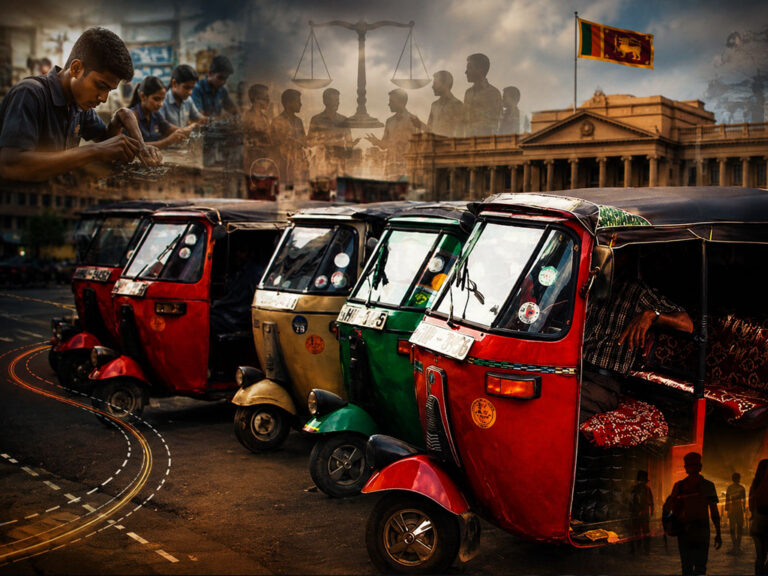
Sri Lanka currently has more than 1.1 million three-wheelers and a large workforce that depends directly or indirectly on the sector.
Any major regulatory change would therefore affect not only young drivers but also thousands of families and passengers who rely on three-wheelers every day.
The Government now faces the challenge of balancing two competing priorities.
One is the need to improve vocational education and guide young people towards skilled careers.
The other is protecting existing livelihoods and ensuring that transport regulation remains practical.
For now, however, the Government’s position is clear: no final decision has been taken to raise the three-wheeler driving age to 40.