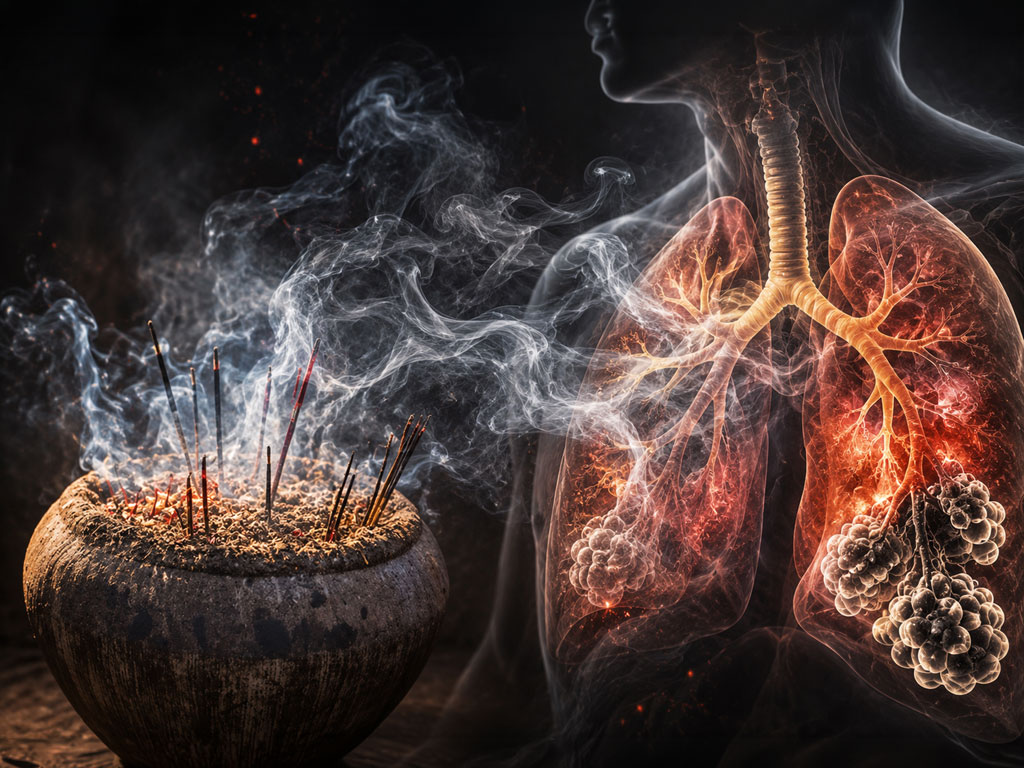
Incense smoke health risks are under scrutiny in Sri Lanka as concerns grow over fine particles, chemical exposure and outdated product standards.
Incense smoke health risks are drawing renewed attention in Sri Lanka ahead of Nikini Full Moon Poya, when millions of families and devotees burn incense during religious observances.
Incense remains deeply connected to Buddhist worship and household traditions. However, combustion can also release fine particles and chemicals into indoor air, particularly where ventilation is poor.
The source article states that Sri Lanka consumes more than 600 million incense sticks annually. It also claims around 40% are low-cost imported products without adequate standardisation or testing, while many locally manufactured products use imported fragrances and chemicals.
The public-health issue is therefore not the religious practice itself, but what people may inhale when incense burns repeatedly in enclosed spaces.

Incense Smoke Health Risks Begin With Fine Particles
Burning incense involves incomplete combustion. Scientific research has established that incense smoke can generate substantial quantities of fine and ultrafine particulate matter.
The supplied article cites figures suggesting incense may emit more particulate matter by weight than cigarettes. However, direct comparisons between incense and cigarette health risks depend on product composition, exposure duration and ventilation.
Particles such as PM2.5 can penetrate deep into the respiratory system. Even smaller ultrafine particles may reach the deepest sections of the lungs.
Research has also detected volatile organic compounds and polycyclic aromatic hydrocarbons in incense smoke.
These can include substances such as benzene, toluene and formaldehyde, depending on the product and burning conditions.
The World Health Organization identifies fine particulate pollution as an important health hazard, particularly for children, older people and those with existing respiratory or cardiovascular conditions.
Questions Over Auramine O and Artificial Fragrances
Another concern involves Auramine O, a yellow dye identified in some incense products.
Research has detected Auramine O in incense smoke condensate and found that laboratory exposure could promote aggressive characteristics in existing lung-cancer cells. However, this does not mean incense smoke automatically causes cancer in people.
The International Agency for Research on Cancer classifies auramine itself as Group 2B, meaning “possibly carcinogenic to humans.” Evidence for carcinogenicity in humans remains inadequate.
The source article also raises concerns about synthetic musk fragrances and other chemicals used in inexpensive incense.
These issues strengthen the case for better testing of what incense products contain and what they release when burned.
Children and Elderly Face Greater Indoor-Air Concerns
Children and elderly people can be particularly vulnerable to polluted indoor air.
The source article cites research linking heavy incense exposure with reduced lung function and respiratory problems.
International scientific literature supports broader concerns about incense as an indoor pollution source. Studies have shown that burning incense can significantly increase indoor concentrations of fine particles, with smoke spreading through different rooms of a home.
However, the scale of individual health risk depends on frequency, duration, ventilation and the chemical composition of the incense.
Good ventilation can reduce indoor pollutant concentrations and inhalation exposure.
Sri Lanka’s Incense Standards Face Questions
The article also questions the effectiveness of Sri Lanka’s existing SLS 758 standard for incense sticks.
It argues that the standard, developed decades ago, does not sufficiently address modern concerns such as smoke emissions, toxic chemicals, heavy metals and combustion-related pollutants.
The central regulatory question is whether Sri Lanka should move beyond product dimensions and manufacturing procedures towards direct laboratory testing of emissions.
Such testing could establish maximum permissible levels for harmful substances released during burning.
Mandatory labelling could also advise consumers to use incense only in well-ventilated environments and avoid prolonged direct exposure to smoke.
Tradition and Health Protection Can Coexist
The debate does not require Sri Lanka to choose between religious tradition and public health.
Incense has profound cultural and spiritual importance.
At the same time, stronger product standards could reduce unnecessary exposure while protecting local manufacturers and consumers.
Authorities could review SLS 758, restrict hazardous colourants and fragrances where scientific evidence justifies action, and introduce clearer emission-testing requirements.
Manufacturers could also be encouraged to develop lower-emission products using safer materials.
As devotees observe Nikini Poya, the most useful message is not fear but awareness.
Burning incense in open or well-ventilated spaces, limiting unnecessary exposure and demanding safer products can preserve a longstanding tradition while reducing avoidable indoor air pollution.