- The full, unedited report is available at the end of the article.
Sri Lanka human rights report urges faster reforms on the PTA, land releases, accountability, policing, prisons and missing persons.
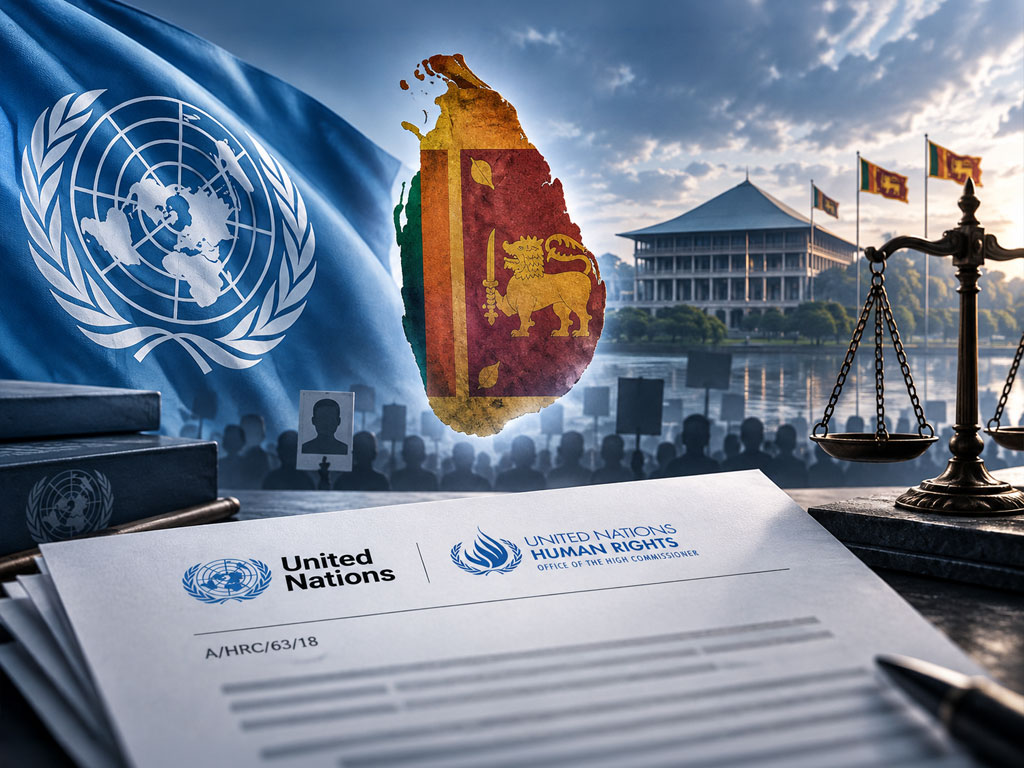
The Sri Lanka human rights report released in Geneva has called for faster reforms on accountability, reconciliation, security laws and the protection of fundamental rights.
The latest report by the Office of the United Nations High Commissioner for Human Rights examines developments in Sri Lanka from October 2025 to July 2026.
It assesses promises made by the government and the progress recorded during that period.
UN High Commissioner for Human Rights Volker Türk states that the current administration has shown some progress in fulfilling commitments on human rights and institutional reform.
However, the report says that process must move faster.
It particularly acknowledges measures taken against corruption and progress in investigations into certain political assassinations.

Sri Lanka Human Rights Report Flags PTA Concerns
One of the major concerns raised involves the Prevention of Terrorism Act.
The government had pledged to abolish the PTA. However, the report notes that authorities continue to use the legislation.
It states that arbitrary arrests and prolonged detention under the Act continue to be reported.
The report also raises concern over surveillance of civil activists and journalists in the Northern and Eastern Provinces by state intelligence agencies.
According to the assessment, such practices could undermine reconciliation efforts.
The report also examines the wider economic and humanitarian pressures affecting human rights.
It refers to the “Dithwa” cyclone, which affected Sri Lanka in November 2025.
According to the report, the disaster caused 687 deaths and extensive property damage.
It further states that debt repayment obligations have consumed a large share of government revenue.
As a result, allocations for health, education and social protection have remained restricted, creating severe hardship for poorer communities.
Prison Deaths and Police Conduct Draw Attention
The report also focuses on recent prison unrest and deaths linked to police arrests.
It calls for independent investigations into the deaths of 32 people during a conflict at Negombo Prison.
The report also highlights the assault and killing of a detainee at Welikada Prison.
In addition, it raises concerns over child abuse allegations involving Buddhist monks.
Accountability for major past incidents also receives attention.
The report notes the death sentence imposed on former Police Chief Pujith Jayasundara and former Defence Secretary Hemasiri Fernando in connection with the 2019 Easter Sunday attack as an important accountability development.
It also refers to progress in high-profile cases involving Prasanna Ekanayake and Nadaraja Raviraj.
UN Calls for Urgent Institutional Reforms
The Sri Lanka human rights report presents several recommendations to the government.
It calls for the immediate suspension and eventual abolition of the Prevention of Terrorism Act in line with international standards.
The report also urges authorities to accelerate the release of land held under military control in the Northern and Eastern Provinces.
Another recommendation is the establishment of an independent government prosecutor’s office.
The High Commissioner also calls for officials implicated in human rights violations to be removed from senior positions within the security forces.
The report further stresses the need to protect the independence and credibility of the Office on Missing Persons.
According to the UN assessment, these reforms require urgent implementation with support from the international community.
The report concludes that stronger institutions, accountability and rights protections are necessary to build sustainable peace and reconciliation in Sri Lanka.
Its central message is that while some progress has been recognised, unresolved concerns over executive power, security legislation, detention practices and institutional independence continue to demand faster action.