Sri Lanka’s vehicle import tax loophole could cost up to Rs. 120 billion in 2026 amid concerns over depreciation rules and parallel imports.
Sri Lanka’s vehicle import tax loophole could cost the Treasury between Rs. 100 billion and Rs. 120 billion annually, according to claims emerging from the motor industry.
The issue comes as Sri Lanka recovers from a severe economic crisis, making every rupee of government revenue critical.
Following the removal of the vehicle import ban, billions of dollars are flowing out of the country. According to Central Bank data cited in the article, vehicle imports cost US$600 million in the first quarter of 2026 alone. By year-end, that figure could reach US$2.4 billion.
Yet questions remain over whether government tax revenue reflects that level of spending.
Vehicle Customs tax revenue stood at Rs. 870 billion in 2025. However, Customs itself has reportedly forecast a 69.4% decline to Rs. 266 billion in 2026.
What, then, is driving this massive revenue gap?

The 70% Market and Vehicle Import Tax Loophole
A longstanding public perception holds that some car dealers import vehicles using undervalued invoices. Industry data and Customs reports cited in the article have further fuelled those suspicions.
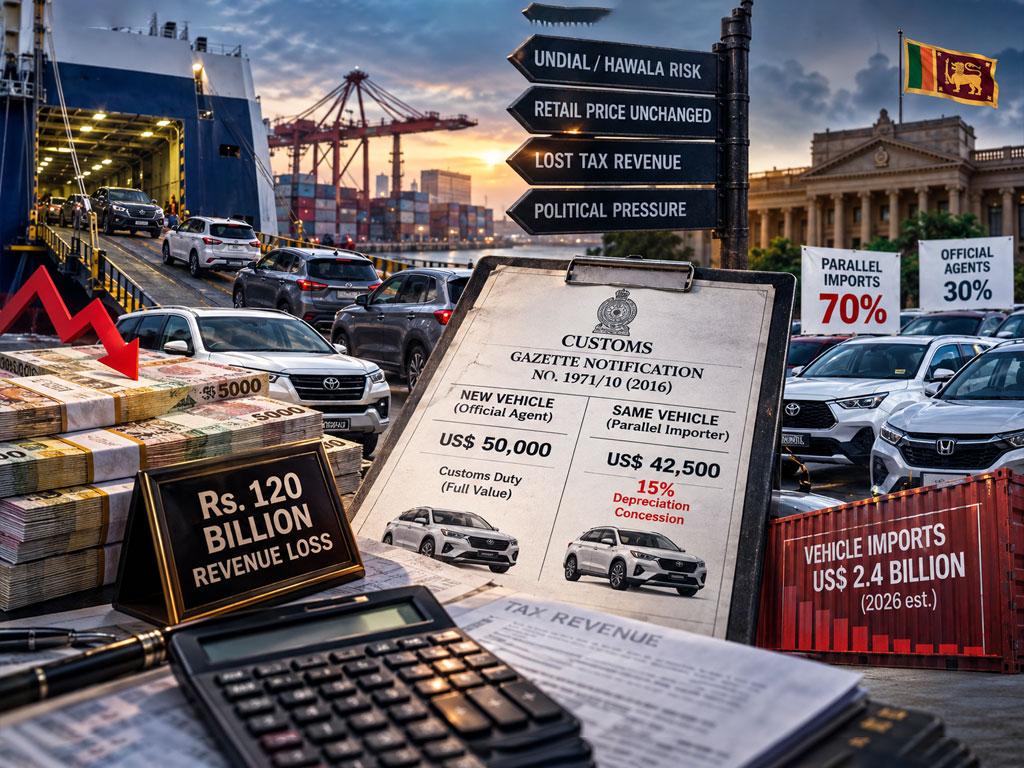
Only around 30% of vehicles recently sold in Sri Lanka’s market were completely brand-new vehicles supplied through authorized official agents.
The remaining 70% entered the market as reconditioned vehicles. The article argues that a major tax disparity exists within this dominant market segment.
At the centre of the controversy is Customs Gazette Notification No. 1971/10, issued in 2016.
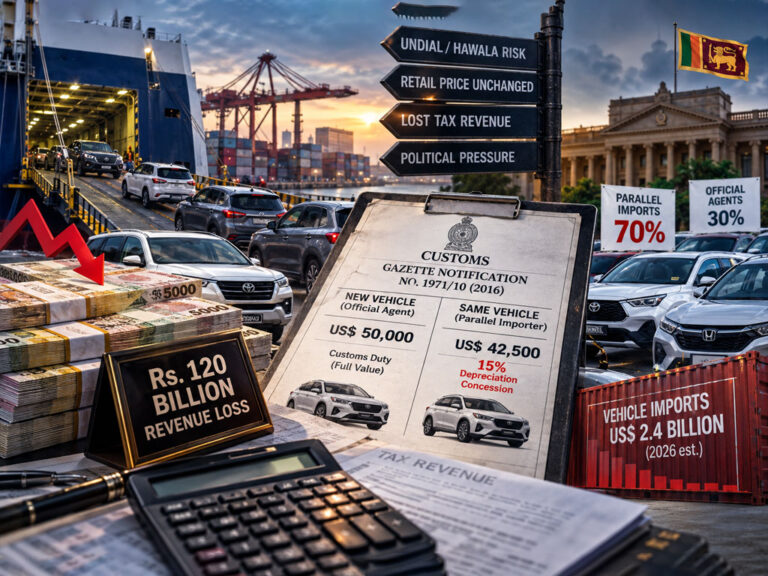
When an official agent imports a new vehicle worth US$50,000, Customs calculates duty on its full value.
However, the article states that a parallel importer can import the same factory-new vehicle after registering it overseas for only a few days. The law then treats it as a “used vehicle.”
Customs consequently grants a 15% depreciation on its value. Therefore, the Customs assessment on a US$50,000 vehicle falls to US$42,500.
The article provides another example involving a vehicle valued at £100,000 in England. The £20,000 VAT charged there disappears when the vehicle is exported. After a few days of overseas registration, the 15% concession can reduce the Sri Lankan Customs assessment to £85,000.
Rs. 120 Billion Revenue Loss and CC Declarations
Data presented by the Ceylon Motor Traders Association (CMTA) illustrates the alleged scale of this regulatory disparity.
For a Honda Vezel, an official agent reportedly pays Rs. 3.4 million in tax. A parallel importer pays Rs. 1.6 million, creating a difference of Rs. 1.8 million.
The article claims the government has lost Rs. 18.7 billion through 8,900 Toyota Raize vehicles imported so far. Another Rs. 12 billion has reportedly been lost through Toyota Yaris imports.
By the end of 2026, the total revenue loss is estimated at Rs. 120 billion.
Concerns extend beyond the 15% depreciation mechanism. The article also alleges attempts to reduce tax liabilities by incorrectly declaring engine capacities.
Recently, a group of parallel importers reportedly declared 13 Audi A5 vehicles as having 1400 CC engines.
After the official agent intervened, the vehicles were confirmed as having 2000 CC engines, according to the article. That intervention reportedly prevented a potential Rs. 160 million tax loss.
These claims concerning revenue losses and importer conduct remain allegations and should be assessed against official Customs and regulatory findings.
Undial and Hawala Risks Enter the Debate
Another concern is that the alleged tax advantage does not translate into lower retail prices for consumers.
Instead, the article argues that the additional margin created by the tax disparity becomes extra profit for the importer.
Industry experts also warn of another potential consequence. They claim large amounts of undeclared money generated through such transactions could flow overseas through informal financial mechanisms such as hawala or undial.
Licensed agents, meanwhile, highlight significant differences between their operations and those of some parallel importers.
They say official agents invest heavily in infrastructure and meet obligations relating to the Employees’ Provident Fund and ETF. In contrast, they claim some parallel importers operate businesses with little more than a telephone number.
Official agents also provide five-year warranties. They argue that this reduces foreign currency outflows because customers require fewer independently imported replacement parts.
COPF Questions Customs as Industry Dispute Deepens
The Vehicle Importers Association of Sri Lanka (VIASL), however, has raised allegations of its own.
VIASL claims US$500 million is wasted by providing tax concessions to a particular business assembling vehicles through SKD operations without domestic value addition.
The article also raises the possibility of the United States taking Sri Lanka before the World Trade Organization’s dispute settlement mechanism over distorted tax policies applied to imported vehicles.
Meanwhile, Committee on Public Finance Chairman Dr. Harsha de Silva has strongly questioned Customs about the tax structure.
Customs reportedly told COPF that it cannot change the system until the Ministry of Finance amends Gazette Notification No. 1971/10.
Further uncertainty has emerged from repeated changes to the vehicle loan-to-value ratio. The LTV ratio has fluctuated between 40% and 60%, adding instability to the industry.
Political Questions Over Delay in Changing Gazette
The continuing delay in amending the gazette, despite the matter reaching COPF, has generated political questions.
Public and political discussion has focused on whether any connection exists between the current government and powerful car dealers operating within the 70% market segment.
The article describes a public perception that authorities may fear the political consequences of abruptly removing the 15% concession.
According to this argument, tightening the rules could push a financially powerful business group away from the administration and towards another political camp.
No evidence establishing such a political arrangement is presented in the article, and the suggestion therefore remains speculation.
Nevertheless, the underlying tax-policy question remains significant.
Applying different tax assessments to two otherwise identical vehicles solely because one received brief overseas registration demands clear policy justification.
If the government intends to deliver genuine systemic reform, the article argues that political considerations should not determine tax policy.
It calls for the 2016 Customs Gazette Notification No. 1971/10 to be amended through the upcoming budget, or even before it.
Ultimately, closing the vehicle import tax loophole would test whether the government is prepared to protect Treasury revenue, address concerns over informal financial flows and create a more consistent vehicle taxation system.