22nd Amendment controversy grows as Sajith Premadasa questions how the executive knew of a Supreme Court determination before Parliament.
The 22nd Amendment has triggered a fresh political and legal controversy after Opposition Leader Sajith Premadasa questioned how the executive allegedly knew details of a Supreme Court determination before its official announcement to Parliament.
The controversy centres on the 22nd Constitutional Amendment and the Judicial Amendment Bill presented by the government. Both seek changes concerning the retirement age of judges.
Premadasa argues that the two pieces of legislation must be examined together because of their potential implications for judicial independence and institutional balance.

22nd Amendment and Judges’ Retirement Age
According to Premadasa, the 22nd Amendment applies to Supreme Court judges. Meanwhile, the Judicial Amendment Act applies to judges of the High Court, District Courts and Magistrate’s Courts.
He raised the issue while addressing local government members and electoral organizers of the Samagi Jana Balawegaya in the Western Province.
Premadasa warned that changing the retirement age in this manner could affect the independence of the judiciary and the institutional balance between the country’s governing structures.
The issue has consequently generated significant discussion across Sri Lanka’s political and legal sectors.
Sajith Questions Knowledge of Supreme Court Determination
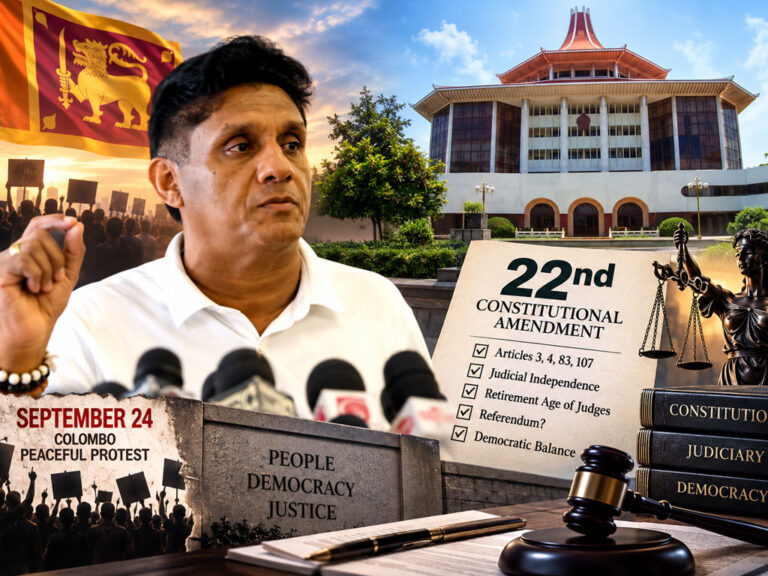
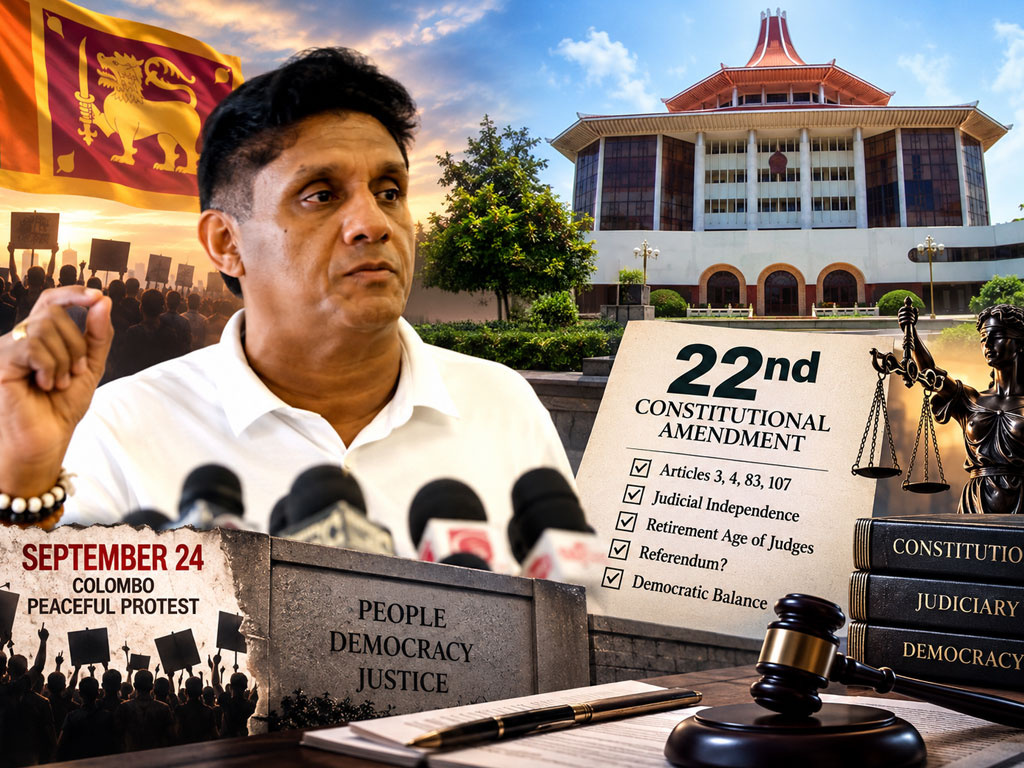
Premadasa also referred to Articles 3, 4, 83 and 107 of the Constitution.
He argued that if the proposed changes affect the sovereignty of the people under those constitutional provisions, approval would require more than a two-thirds majority in Parliament. A referendum would also become necessary, he said.
However, Premadasa questioned how the executive could indicate that the proposed amendment could pass through Parliament alone before the Supreme Court’s determination had officially reached Parliament.
His central question concerns how the executive allegedly obtained information about a Supreme Court determination that the legislature itself did not yet officially know.
Premadasa called for transparency over how such information could have reached the executive before its formal communication to Parliament.
The Opposition Leader’s comments represent his questions and concerns about the process. They do not, by themselves, establish that confidential information was improperly disclosed.
Government Defends Changes as Opposition Warns of Risks
The government, however, has defended the proposed amendments on different grounds.
It argues that retaining experienced senior judges for longer could help accelerate the resolution of hundreds of thousands of cases accumulated within Sri Lanka’s judicial system.
Government representatives have previously pointed to democratic countries such as the United Kingdom, Canada and the United States. They note that Supreme Court judges in those countries also have higher retirement ages.
However, the opposition and civil parties, including the Bar Association of Sri Lanka, have raised concerns about the proposed changes.
They argue that extending retirement ages instead of filling vacancies could weaken the system of checks and balances between the executive and judiciary.
The dispute therefore extends beyond the retirement age itself. It also concerns the broader relationship between judicial independence, executive authority and constitutional safeguards.
September 24 Protest Over Judiciary and Democracy
Premadasa stressed that Sri Lanka must protect the separation of powers between the legislature, executive and judiciary, describing them as fundamental pillars of democracy.
He also emphasized the importance of maintaining strong local government and provincial council mechanisms.
Against this backdrop, Premadasa announced that the Samagi Jana Balawegaya will hold a peaceful protest in Colombo on September 24.
The protest will focus on protecting judicial independence and democratic rights amid the constitutional debate and concerns over institutional independence.
The 22nd Amendment controversy is therefore moving beyond Parliament and the courts into the political arena, with the opposition preparing to mobilize publicly over what it describes as fundamental questions concerning democracy, judicial independence and the balance of state power.