By Roy Denish.
The Sri Lanka MiG deal returns to scrutiny as investigators revisit millions paid through Bellimissa Holdings in the 2006 procurement.
The air in Colombo on July 26, 2006, carried the persistent tension of an escalating civil war. Inside the corridors of the Ministry of Defence, pen was put to paper on an agreement that, years later, would become the subject of one of the most notorious financial and political controversies in modern Sri Lankan history.
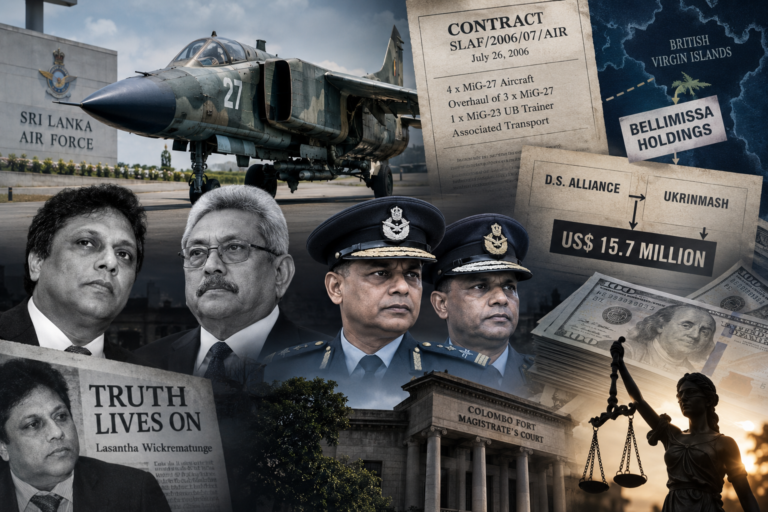
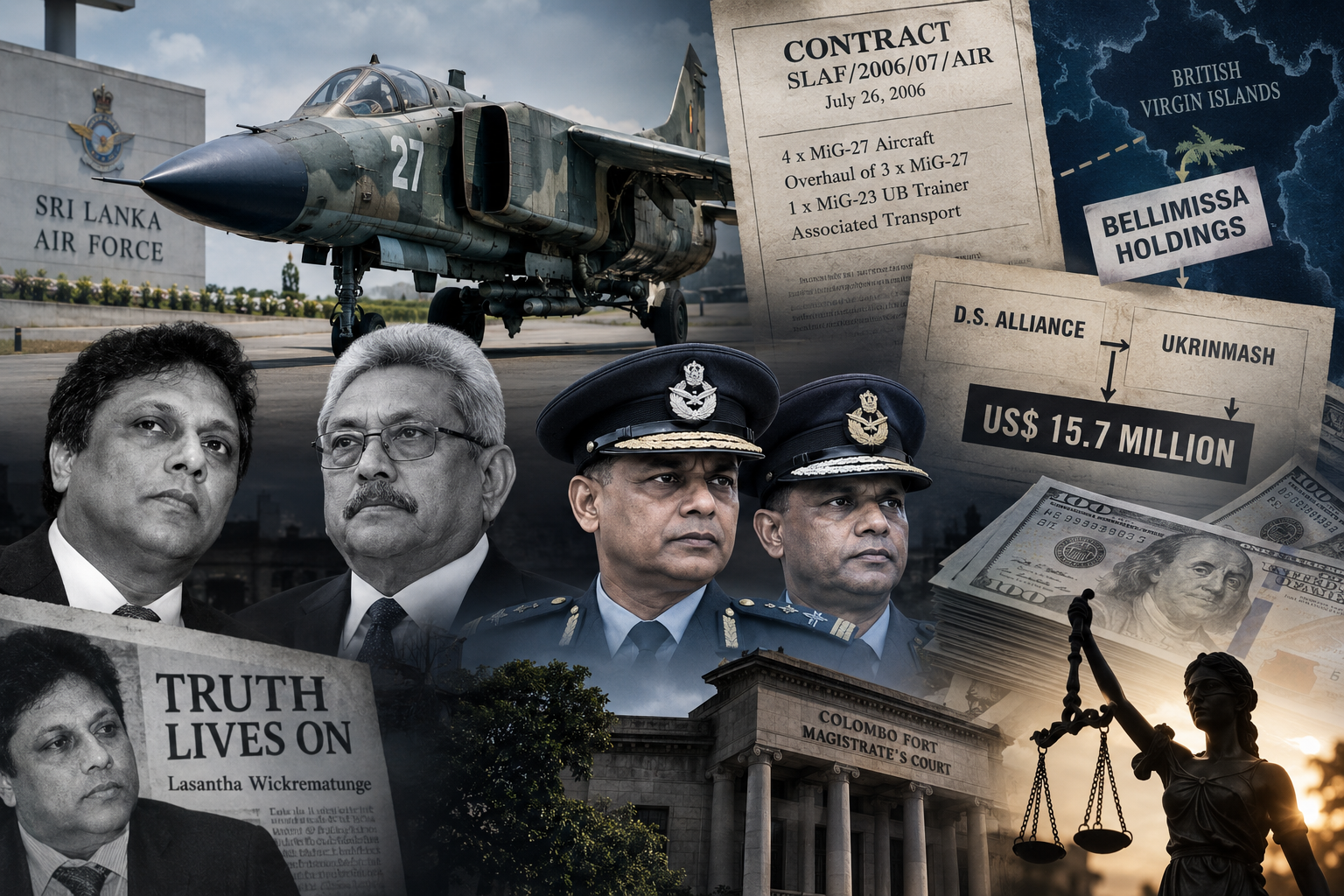
On that day, the Sri Lanka Air Force (SLAF) signed contract number SLAF/2006/07/AIR. The official objective appeared straightforward: purchase four used MiG-27 attack aircraft and overhaul four existing aircraft that the government had acquired in 2000. The transaction was presented as a direct government-to-government (G-to-G) deal involving Ukrinmash, a state-owned Ukrainian arms export enterprise.
Subsequent investigations, however, raised serious questions about that account.

The Illusion of a State-to-State Transaction
Investigators later alleged that the transaction had been structured in a manner that bypassed conventional competitive tendering procedures. While defence authorities maintained that Sri Lanka was dealing directly with the Ukrainian state entity, investigators uncovered a significantly different payment trail.
According to findings subsequently presented to court by the Financial Crimes Investigation Division (FCID), payments connected with the aircraft deal were made to Bellimissa Holdings rather than directly to Ukrinmash.
When investigators began examining the transaction following the 2015 change of government, questions surrounding the official account deepened. Investigators alleged that documentation connected with the July 26, 2006 agreement was fraudulent, while concerns were also raised over the whereabouts of original documentation relating to the transaction.
The supposed government-to-government nature of the deal consequently became one of the central issues under investigation.
Inflated Costs and Questions Over Upgrades
The financial discrepancies surrounding the purchase were substantial.
Figures reported in connection with the investigation indicate that approximately US$14.68 million represented the overall procurement package for the four aircraft, the overhaul of existing aircraft and associated transport costs. FCID documentation cited in subsequent proceedings has separately referred to approximately US$15.665 million being paid to Bellimissa Holdings under the agreement.
The four MiG-27 aircraft were reportedly priced at approximately US$2.46 million each.
A comparison with Sri Lanka’s earlier MiG purchases raised further questions. In 2000, Sri Lanka had purchased similar aircraft at significantly lower prices, reportedly ranging from approximately US$1.6 million to US$1.75 million per aircraft.
Investigators subsequently examined whether some of the aircraft purchased in 2006 had previously been considered during the earlier procurement process.
Officials who defended the transaction argued that the higher prices reflected extensive overhauls, life-extension work and warranties attached to the aircraft.
Investigators, however, questioned whether the claimed improvements justified the additional expenditure, particularly in relation to the operational flying hours available to the aircraft following the refurbishment.
For an air force engaged in an intense civil conflict, the operational value delivered by the refurbishment consequently became another significant element of the investigation.
The Shell Game: Bellimissa and DS Alliance
At the centre of the investigation was Bellimissa Holdings.
Although the company was associated in documentation with a London address, investigators later scrutinised its actual corporate structure and operations. Bellimissa was eventually linked to an offshore corporate network involving the British Virgin Islands and Singapore.
Investigators also focused on Bellimissa’s relationship with DS Alliance Private Limited, a Singapore-based brokerage company associated with businessman Lee Thian Soo, also referred to in reports as T.S. Lee.
DS Alliance had previously been involved in Sri Lanka’s earlier MiG transactions.
Investigators examined whether Bellimissa had effectively been used as an intermediary through which parties connected with DS Alliance could participate in the 2006 transaction despite previous concerns surrounding the brokerage company’s role.
The corporate arrangements surrounding Bellimissa, including connections involving members and associates of the Lee family, subsequently became an important part of attempts to reconstruct the transaction and trace the movement of funds.
Where Did the Money Go?
The flow of money became one of the most significant aspects of the investigation.
FCID findings reported publicly indicated that approximately US$15.665 million was paid to Bellimissa Holdings, while agreements covering the underlying aircraft and overhaul work between DS Alliance and Ukrinmash were valued at approximately US$7.833 million.
That left a difference of approximately US$7.8 million between the two figures.
The amount identified as an alleged loss to the Sri Lankan state has varied in different investigative and court records. FCID reporting in 2018 cited an alleged loss of approximately US$6.83 million, while later court proceedings referred in rounded terms to an apparent loss of about US$7 million.
Investigators attempted to trace funds through an international network of accounts and jurisdictions, including Singapore and the British Virgin Islands, as they sought to determine where money connected with the transaction ultimately went.
The investigation also examined financial links involving Lelum Duminda Mannapperuma, the brother-in-law of former Sri Lankan Ambassador to Russia Udayanga Weeratunga.
Investigators reportedly traced transactions involving funds used in connection with the purchase of property in the United Arab Emirates, including a luxury apartment associated with Weeratunga.
Those transactions became part of the wider effort to establish whether money originating from the MiG procurement had ultimately benefited individuals connected with the deal.
A Journalist’s Death and Unanswered Questions
The MiG transaction also became closely associated with the investigative journalism of Sunday Leader editor Lasantha Wickrematunge.
Wickrematunge published extensively about alleged irregularities surrounding the MiG purchase and repeatedly challenged the official explanation of the transaction.
He was assassinated in Colombo on January 8, 2009.
His murder remains one of Sri Lanka’s most notorious unresolved attacks on a journalist. Investigators and media reports over the years have examined whether his reporting, including his work on the MiG transaction, may have formed part of the motive for his killing. No final judicial determination, however, has established that his reporting on the MiG deal was the cause of his assassination.
The questions surrounding the aircraft transaction have persisted through successive governments and repeated investigations.
Nearly two decades after the agreement was signed, the case has again returned to public attention.
The Financial Crimes Investigation Division has recently renewed investigative activity surrounding the 2006 procurement, recording statements from several former senior officials as it examines the financial and administrative arrangements behind the purchase.
For Sri Lankans who have followed the controversy for years, the fundamental questions remain largely unchanged: who designed the transaction, where did the disputed millions ultimately go, who benefited from them, and will the evidence gathered over nearly two decades finally result in definitive answers?
The shadows surrounding the MiG deal have endured for almost 20 years. Whether the latest investigation can finally illuminate what happened behind one of Sri Lanka’s most controversial defence procurements remains to be seen.