By Roy Denish.
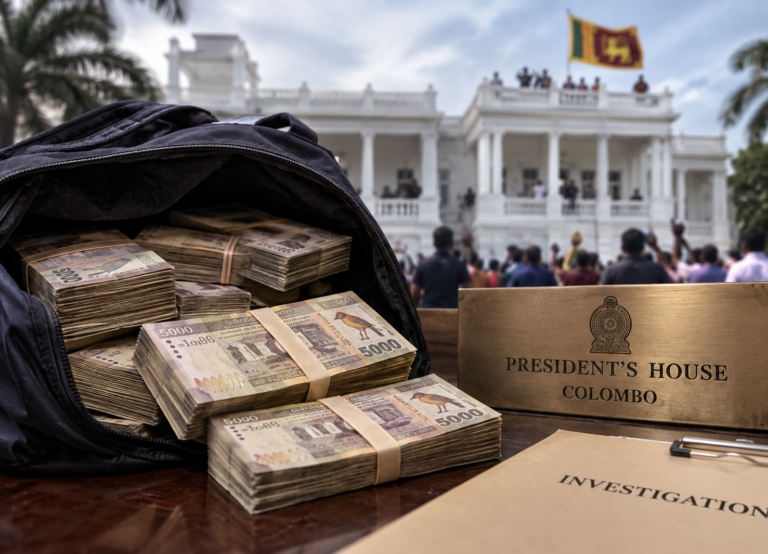
President’s House Rs. 17.85 million cash sparked police inquiries, a claim by Gotabaya Rajapaksa and a Bribery Commission investigation.
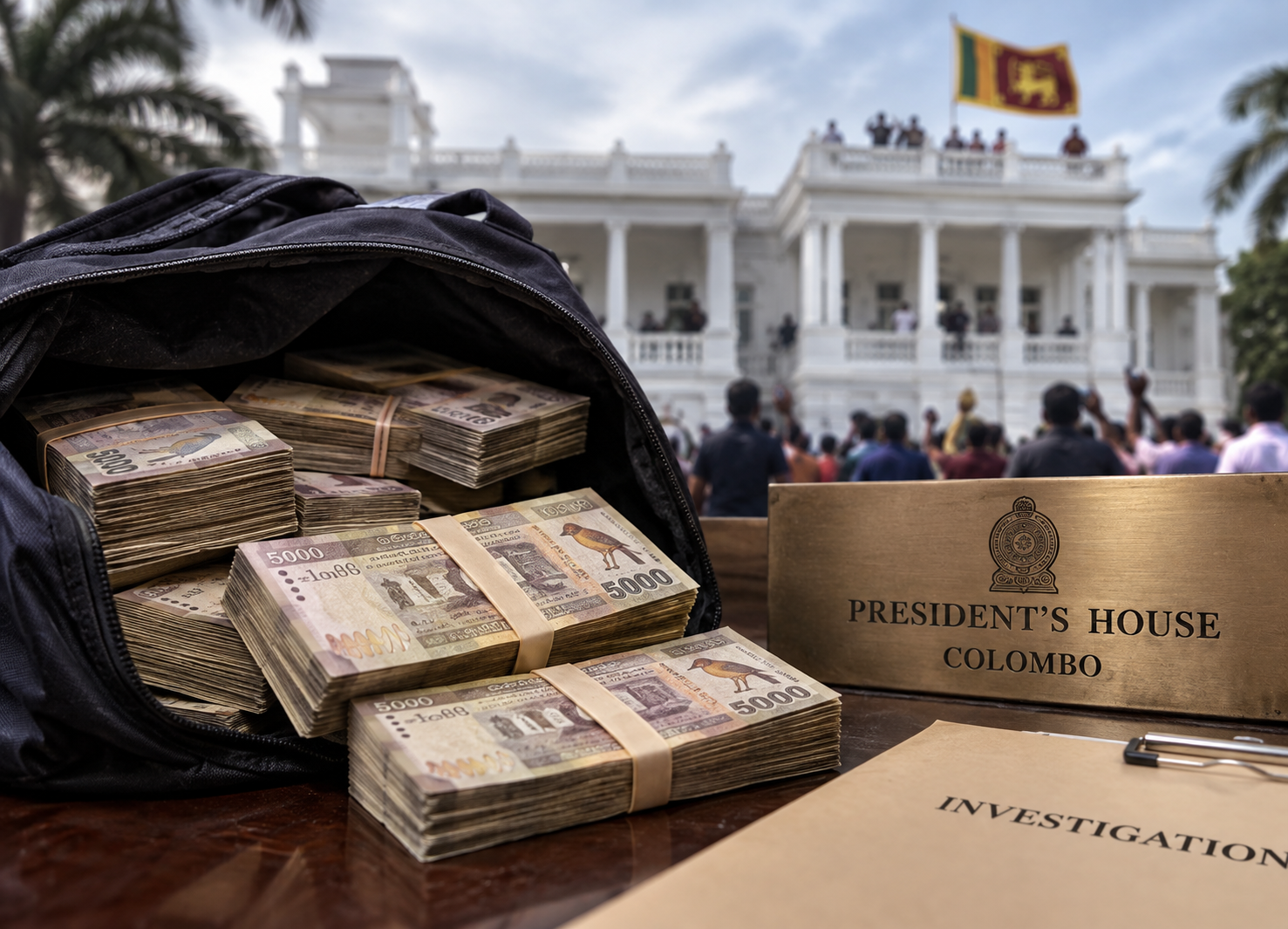
The fate of the Rs. 17.85 million in cash discovered by anti-government protesters inside the President’s House in Colombo during the height of the Aragalaya uprising on July 9, 2022, remains one of the most controversial and legally complex episodes of the political crisis.
What began as a startling discovery of cash inside a state residence soon developed into a web of conflicting police actions, high-level political manoeuvres, and a controversial decision by anti-corruption authorities to discontinue further legal action.

1. From the President’s House to the Police and Public Security
Following the takeover of the President’s House, the recovered currency notes, amounting to Rs. 17.85 million, were handed over to the Fort Police.
However, rather than depositing the seized funds directly with the court, the then-Officer-in-Charge of the Fort Police, Mahinda Sagara Vilegoda Liyanage, reportedly transferred the money to then-Western Province Senior Deputy Inspector General (SDIG) Deshabandu Tennakoon.
Investigations later alleged that SDIG Tennakoon had instructed the OIC by telephone to hand the money over to then-Public Security Minister Tiran Alles.
2. Legal Challenges and Gotabaya’s Claim
A complaint filed by JVP trade union leader Mahinda Jayasinghe before Colombo Fort Magistrate Thilina Gamage challenged these actions under Sections 100 and 109 of the Penal Code.
Months later, former President Gotabaya Rajapaksa, who had left the country during the protests, formally claimed ownership of the money through his legal counsel.
In statements to the Criminal Investigation Department (CID), Rajapaksa reportedly said that the money belonged to him and that he had kept it at the residence with the intention of using it to compensate or assist ruling-party MPs and ministers whose homes had been burned or damaged during the violence of May 9.
The explanation triggered significant public criticism and legal scrutiny.
President’s Counsel Rienzie Arsekularatne, appearing in court, argued that the former President’s actions had bypassed judicial procedure and that the funds should be investigated under the Bribery Act and the Convention on the Suppression of Terrorist Financing and money-laundering legislation, where applicable.
Arsekularatne also criticised the attempt to reclaim the money through administrative channels rather than through a direct application before the court.
3. The Bribery Commission’s Decision
Despite initial investigations and considerable public interest, the case later lost momentum.
Critics argued that investigations slowed during the administration of former President Ranil Wickremesinghe.
In a significant development, the Commission to Investigate Allegations of Bribery or Corruption (CIABOC) informed the court that it would not pursue further legal action concerning the Rs. 17.8 million, citing insufficient evidence to sustain criminal proceedings.
Questions That Remain Unanswered
The closure of the case has left several questions in the public domain.
The Origin of the Funds: How did such a large amount of cash come to be kept inside the official residence of the President?
The Intended Distribution: If the money was intended to assist politicians whose properties had been damaged, what legal mechanism would have governed the distribution of those funds?
Accountability: Given the unusual handling of the money by senior police officials and the eventual termination of the anti-corruption investigation, critics and civil society groups have continued to call for greater transparency regarding the sequence of events.