By Roy Denish.
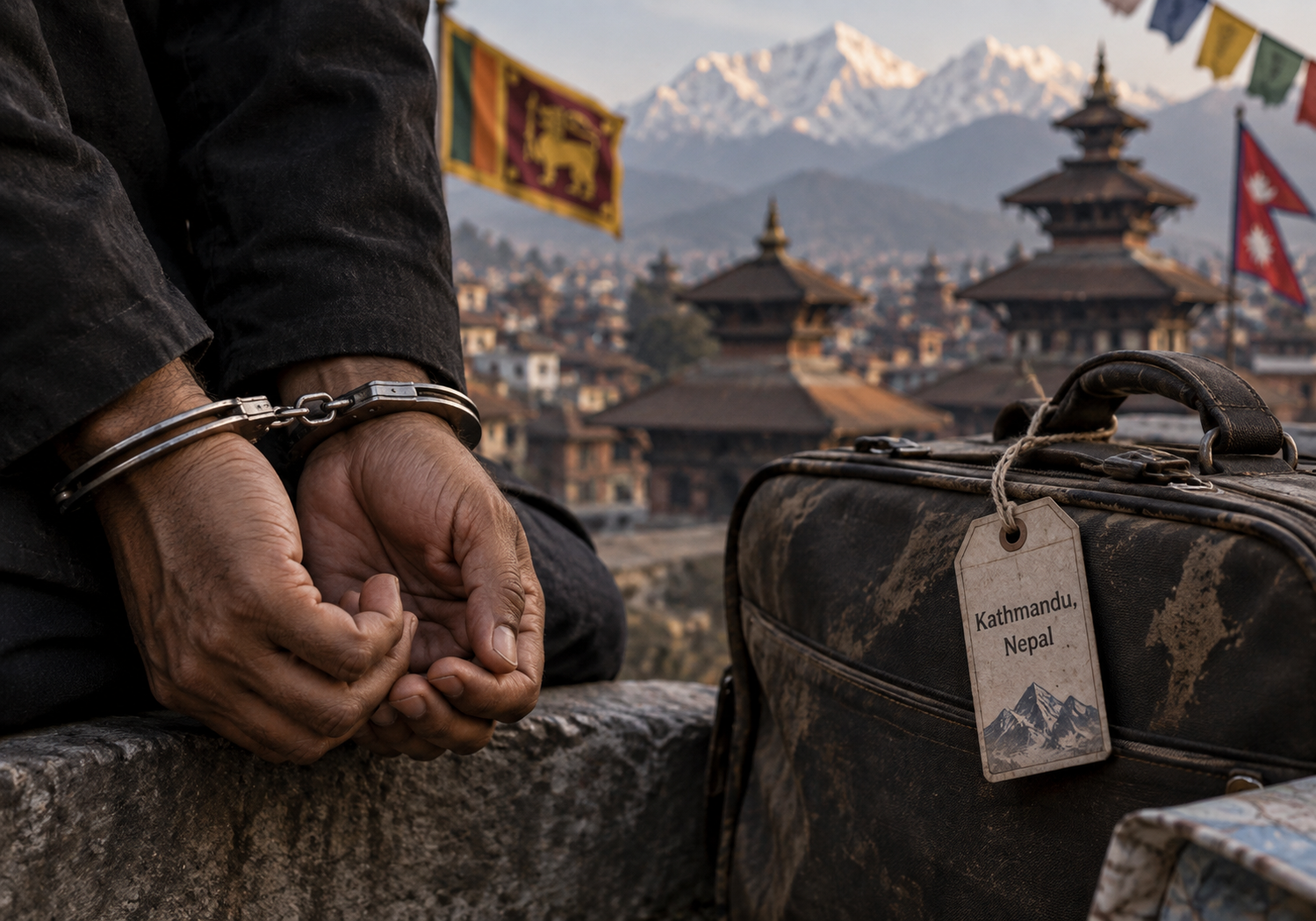
Ananda Jayakody says he has spent 17 years stranded in Nepal, facing a US$65,000 immigration fine and separation from his family.
Have you ever heard of a Sri Lankan who has been stranded in another country for 17 years?
This is the story of Ananda Jayakody, a former leader of the Sri Lanka Progressive Front, who says he has been living under extremely difficult circumstances in Kathmandu, Nepal, for nearly two decades.
According to Jayakody, he has accumulated more than US$65,000 in immigration-related fines owed to the Government of Nepal. He says he lost contact with his family, left behind his property and businesses, and fled Sri Lanka after receiving death threats.

In an interview with journalist Chamuditha Samarawickrama on Truth with Chamuditha, Jayakody spoke at length about the circumstances surrounding his departure from Sri Lanka, his political involvement, his present situation in Nepal, and his hopes for diplomatic assistance.
The following is an edited version of that conversation.
Chamuditha Samarawickrama: Mr. Ananda Jayakody, you have said that you have been stranded in Nepal for 17 years. What exactly do you mean by “stranded”? Are you in prison or some kind of detention camp?
Could you explain your situation? Very few people in Sri Lanka seem to know what happened to you or why you went to Nepal.
You have also said that you are required to pay a daily fine of US$10. What is the reason for this? I think the Sri Lankan public needs to understand how you came to be in this situation.
Ananda Jayakody: No, Mr. Chamuditha, I am not in prison. I am registered as an international refugee with the United Nations. However, the Nepali government does not recognise us as refugees and instead treats us as unauthorised immigrants.
That is why I have been ordered to pay a fine of US$10 a day. They will not allow me to leave the country without paying the fine.
I cannot afford to pay US$10 every day. Over the past 17 years, the accumulated fine has grown to approximately US$65,000.
I am not living in a camp. I rent a small room in a house.
Chamuditha Samarawickrama: So, according to you, there is no way for you to return to Sri Lanka?
It has been 17 years. Have you returned to Sri Lanka even once during that period? Are any of your family members or children with you in Nepal?
Is there any mechanism through which this fine could be waived so that you could leave Nepal? An ordinary person would find it extremely difficult to pay such a large amount.
You were also previously the owner of Ananda Enterprises. Could you tell us about the life you had in Sri Lanka and the property you owned before leaving?
Ananda Jayakody: I have not visited Sri Lanka for 17 years. I live alone in Nepal, and none of my family members are with me.
The Nepali authorities have said that the fine could be waived if I agree to return to Sri Lanka, but I cannot go back because I believe my life would be in danger.
At the time, I was a successful businessman in Sri Lanka. I owned a large business called Ananda Enterprises and paid a considerable amount in taxes.
I also owned a large three-storey house on a property facing the main Ingiriya Road. When I fled the country, I had to leave everything behind. My youngest child was only five years old at the time.
Chamuditha Samarawickrama: You have alleged that after you fled Sri Lanka, other individuals took control of your property.
Who do you believe was responsible for what happened to those assets? Who now controls the land and businesses?
You have also alleged that your brother, who served as a Police OIC, was involved. Why do you believe he became involved, particularly after you had previously helped him?
You have further accused individuals associated with the Rajapaksa family of involvement in the takeover of your property. Could you explain the basis of those allegations?
Ananda Jayakody: Yes. The three-storey house on my property was demolished. I later heard that a garment factory was operating on the land.
I allege that several individuals close to the Rajapaksa family, together with my own brother, took control of my assets.
My brother was a Police OIC. When he once told me he did not have a deed that could be used for his child’s school admission, I transferred my share of our ancestral home to him without charging him anything.
Despite that, I believe he later took control of what I had left behind.
I came to Nepal because I had received serious death threats, which I believe were connected to my political activities and my opposition to the Rajapaksa administration.
Chamuditha Samarawickrama: You were the leader of the Sri Lanka Progressive Front. Why do you believe you began receiving threats?
When did you first get to know Mahinda Rajapaksa, and what kind of political relationship did you have with him?
You have said that you supported him during the 2005 presidential election. What caused the relationship to deteriorate by 2010?
Ananda Jayakody: I first got to know Mahinda Rajapaksa around 1986. At the time, I was a trade union leader.
I was introduced to him through Vasudeva Nanayakkara because I needed a lawyer to appear in connection with a case.
At that time, Mahinda was not in Parliament. We became politically close, and we supported him during campaigns such as the Pada Yatra and Jana Ghosha.
In 2005, because we had little confidence that President Chandrika Kumaratunga would end the war, our party supported Mahinda Rajapaksa. We shared political platforms with the JVP as well.
However, after he became president, we became dissatisfied with several developments under his administration. By 2010, we had decided to support General Sarath Fonseka instead.
Chamuditha Samarawickrama: So, during the 2010 presidential election, your party decided to support Sarath Fonseka, although Mahinda Rajapaksa expected your continued support.
You have alleged that another candidate was then secretly nominated under your party’s name.
How did you discover this, and what happened when you approached then-Elections Commissioner Dayananda Dissanayake?
Do you believe this incident contributed to the threats you say you later received?
Ananda Jayakody: Yes. In 2010, we publicly announced that we were supporting General Sarath Fonseka.
However, without my knowledge, another individual was nominated as the presidential candidate representing our party.
I learned about it through the newspaper the following day. Members of General Fonseka’s campaign even joked with me, asking why I appeared to be supporting both sides.
I immediately went to the Elections Commissioner and asked for the nomination to be removed, relying on my authority as the party leader. The candidate was subsequently removed.
I believe that incident significantly intensified the hostility against me. From that point onward, I say I received serious threats.
Chamuditha Samarawickrama: You have also alleged that there were serious irregularities during the counting of votes in the 2010 presidential election.
You said you were present at the Colombo counting centre. What did you personally observe, and what evidence led you to question the officially declared result?
You have claimed that vote counting was interrupted around midnight. What happened after that?
Ananda Jayakody: Based on what I personally observed when results from Colombo, Kalutara, and Gampaha were being counted, I believed General Fonseka was performing strongly.
At around midnight, the counting process appeared to stop, and results began being announced again only after approximately 3 a.m.
I continue to dispute the official outcome of that election. That remains my personal position based on what I witnessed at the time.
Chamuditha Samarawickrama: What happened during the general election that followed?
You have claimed that steps were taken to prevent you from contesting under your own party.
You also say that your businesses and offices were attacked and that vehicles belonging to you were taken.
How did you eventually leave Sri Lanka, travel through India, and reach Nepal?
Ananda Jayakody: During the 2010 general election, I faced serious political difficulties.
I discovered that two people whom I did not know had been presented as secretaries of our party, and we were ultimately unable to contest as we had intended.
After the election, I feared for my life. I owned two air-conditioned buses, which I lost. My office was broken into, and files were removed.
People also came to my home looking for me, and I became afraid that I would be abducted or killed.
Through an acquaintance, I sold my Dolphin van, which was worth about Rs. 2 million, for approximately Rs. 1.4 million. I took the money and fled to India.
I later decided that India was not safe for me and travelled to Nepal.
Chamuditha Samarawickrama: You are now completely separated from your family.
You have three children. Do they have any contact with you? Do they know about the circumstances you are living under in Nepal?
Where are your wife and children now?
You have also spoken emotionally about your relationship with your brother and your belief that your family was turned against you.
Your greatest wish, you have said, is to see your children again.
Ananda Jayakody: That is the greatest pain in my life, Chamuditha.
My children no longer recognise me in the way they once did. They were very young when I left, and they are adults now.
I believe they were given a very negative impression of me over the years. My wife is also no longer in contact with me.
I also have serious personal grievances involving my brother and what happened to my family and property after I left Sri Lanka.
I loved my children more than anything. Now they have distanced themselves from me.
My greatest wish is simply to see my children at least once before I die.
Chamuditha Samarawickrama: Finally, what are you asking from the current government led by President Anura Kumara Dissanayake?
You have said that you previously supported political movements associated with members of the present administration and that your party supported the JVP during its earlier years.
If returning to Sri Lanka is not an option for you, what assistance are you seeking?
Are you asking the Sri Lankan government to engage diplomatically with Nepal and seek a waiver of the immigration fine so that you can travel to a third country?
Ananda Jayakody: Yes.
I supported this government and worked through social media to help bring about political change.
In the past, our party also supported the JVP during its efforts to gain parliamentary representation.
I am not asking anyone for a job or for financial benefits.
I do not believe I can safely return to Sri Lanka. What I am asking is for the Sri Lankan government to speak with the Nepali government and seek a waiver of the immigration fine.
If that happens, I hope I can travel to a third country and live the remainder of my life peacefully.
That is all I am asking for.
Chamuditha Samarawickrama: Thank you, Mr. Ananda Jayakody.
Your account raises serious questions about your circumstances, the political events you say led to your departure from Sri Lanka, and the difficulties you have faced during nearly two decades in Nepal.
The allegations you have made are significant and would require independent verification and responses from those you have named.
We hope the relevant Sri Lankan authorities, including the Ministry of Foreign Affairs, will examine your situation and determine whether any diplomatic assistance can be provided.
After nearly 17 years away from your homeland and separated from your family, you are asking for an opportunity to find a resolution and rebuild what remains of your life.