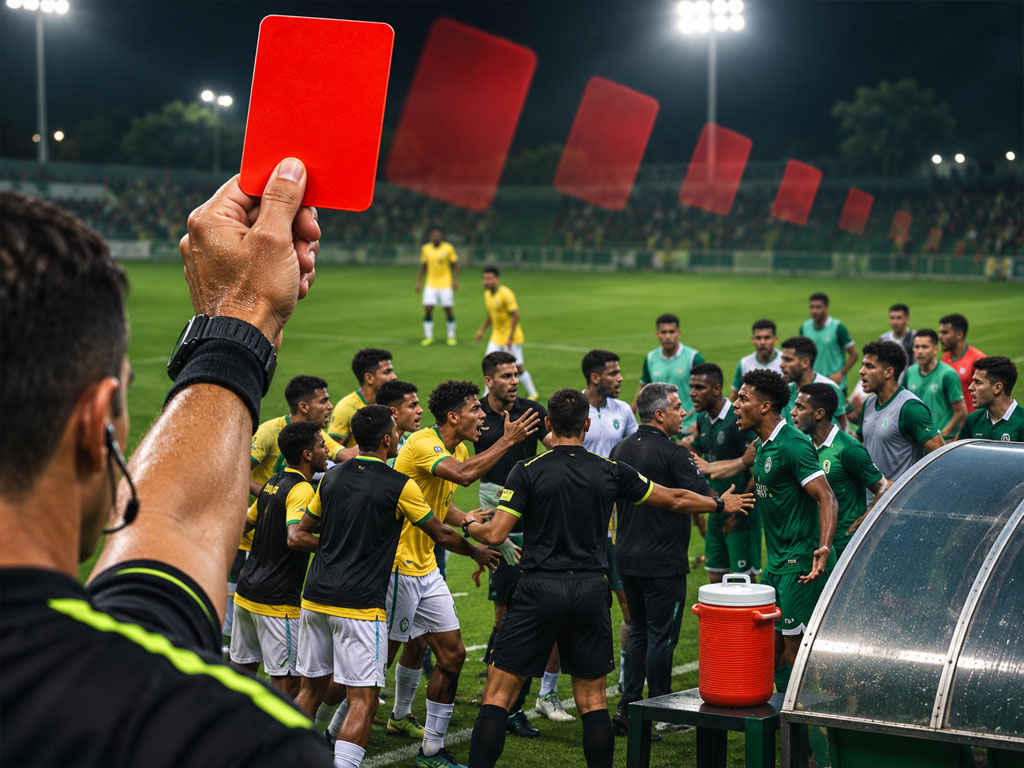
Note that the above image is AI generated
BRAZIL — Uberlândia withdraws from semifinal return leg as Mamoré advances to the final following an extraordinary disciplinary incident.
A Brazilian under-20 football semifinal descended into a mass brawl that resulted in 53 reported dismissals, surpassing the previous widely cited record of 36 red cards in a single match.
The incident occurred during the first leg of the Minas Gerais Under-20 Championship Second Division semifinal between Uberlândia and Mamoré at the Parque do Sabiá stadium.
According to Brazilian media reports and the referee’s disciplinary record, 43 players and eight members of the coaching staff were dismissed. Two Uberlândia club officials were also expelled, bringing the reported total to 53.
Brazilian reports differ in their headline totals because some count only the 51 players and coaching personnel. Although the incident has been widely described as a world record, formal recognition by Guinness World Records has not been established.
The previous record of 36 dismissals was recorded during a fifth-division match between Atlético Claypole and Victoriano Arenas in Argentina in 2011.

Goal Celebration Triggers Mass Confrontation
The violence erupted during the closing stages of the match, after Mamoré scored to establish a 3-1 lead.
According to the referee’s report, a Mamoré player celebrated the goal by taunting members of the opposition seated on the substitutes’ bench.
Uberlândia’s goalkeeping coach subsequently entered the field and confronted the player, triggering an altercation that quickly escalated into a confrontation involving players, substitutes and team personnel.
Three dismissals had reportedly occurred before the wider disturbance.
The referee recorded the confrontation as beginning in the 54th minute of the second half, during stoppage time. The disorder prevented him from completing the normal procedures for displaying red cards and formally concluding the match.
With the situation deteriorating, military police were called to intervene.
Stadium Sustains Extensive Damage
Police documentation described substantial damage to facilities at Parque do Sabiá.
The reported destruction included:
- 14 damaged or broken doors.
- Broken windows.
- Damage to bathroom and shower facilities.
- Destroyed benches, tables and chairs.
The widespread disorder forced a prolonged interruption of approximately 40 minutes.
Officials were ultimately unable to resume the match, and the referee abandoned proceedings.
The disciplinary incidents were subsequently documented in the referee’s official match report.
Uberlândia Withdraws From Semifinal
Following the incident, Uberlândia announced on Wednesday, November 4, that it would withdraw from the second leg of its semifinal against Mamoré.
The return fixture had been scheduled for Sunday, November 8.
The club explained that the dismissals would have left Mamoré with only seven eligible players, the minimum number permitted under the competition’s regulations.
Rather than contest the return leg against a severely depleted opponent, Uberlândia said it had decided to concede the fixture as a gesture of fair play.
The withdrawal was formally submitted to the Federação Mineira de Futebol, the governing body responsible for the competition, which approved the decision.
Mamoré consequently secured passage to the final, while Uberlândia shifted its attention to the third-place playoff.
Club Announces Disciplinary Action
Uberlândia also confirmed that it had begun taking internal disciplinary measures against individuals involved in the confrontation.
In its statement, the club emphasised that football development extends beyond technical ability and sporting results, encompassing personal development, discipline and respect.
Its decision to withdraw from the semifinal was presented as an attempt to uphold those principles despite the circumstances surrounding the match.
The extraordinary disciplinary tally has attracted international attention, placing the incident among the most serious episodes of misconduct recorded in a competitive football fixture.
Beyond the reported record, the confrontation has also drawn attention to player behaviour, match security and the responsibilities of clubs in maintaining discipline.
With Mamoré advancing to the final and Uberlândia preparing for the third-place match, the immediate sporting consequences have been resolved. The broader questions surrounding the violence and disciplinary accountability remain.