Source attribution: Adapted from a political commentary published on the Facebook page of Athulasiri Samarakoon, lecturer at the Open University of Sri Lanka and former teaching assistant at the University of Colombo.
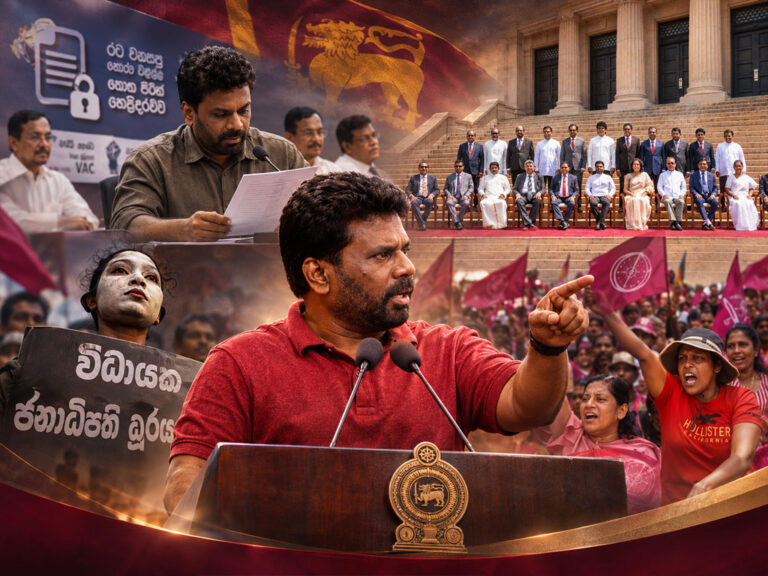
COLOMBO — Two years after the National People’s Power (NPP) secured an overwhelming electoral mandate, Sri Lanka’s political landscape remains divided between those who regard the administration as the beginning of a historic transformation and those who believe it represents another version of the political system it promised to replace.
Between these opposing positions stands a considerable section of the electorate, weighing the government’s achievements against its promises and attempting to distinguish genuine progress from political messaging.
The NPP’s electoral victories in 2024 represented more than a conventional transfer of political power. They reflected widespread public dissatisfaction with corruption, dynastic politics, political patronage and economic mismanagement. Voters expected not simply different political leaders, but a fundamentally different approach to governance.
Yet electoral success and institutional transformation are not necessarily the same.
A government may secure an overwhelming mandate, introduce reforms and achieve measurable improvements without fulfilling the broader expectations that brought it to power.
Examining ten widely circulated narratives about the NPP administration offers a more balanced understanding of its performance. Not all these claims are entirely false. Some contain considerable truth. The difficulty arises when partial achievements are presented as evidence of complete political transformation.

1. The Government Saved Sri Lanka’s Economy
Economic recovery is perhaps the most prominent achievement associated with the NPP administration.
Following the financial collapse of 2022, Sri Lanka has experienced a degree of macroeconomic stabilisation. Inflation declined from crisis levels, foreign reserves recovered and economic growth resumed.
These improvements deserve recognition, including the current government’s contribution to maintaining the recovery.
Nevertheless, economic stabilisation did not begin with the NPP’s arrival in office.
Sri Lanka’s International Monetary Fund programme, debt restructuring negotiations and fiscal adjustment measures were already underway in 2023. The present administration inherited that process and continued its implementation.
Crediting the entire recovery to one government therefore overlooks the continuity of economic policy across successive administrations.
More importantly, macroeconomic recovery must not be confused with improvements in household welfare.
According to World Bank estimates, Sri Lanka’s poverty rate remained at 16.9% in 2025, substantially above its pre-crisis level.
For households struggling with inadequate incomes, unemployment, debt and living expenses, stronger national economic indicators do not automatically translate into financial security.
The more meaningful questions concern whether domestic production has increased, whether young people have gained sustainable employment, whether small businesses have recovered and whether farmers are receiving better returns.
Stabilising an economy is an achievement. Transforming that stability into broad-based prosperity remains a considerably greater challenge.
2. The Government Has Won the Battle Against Corruption
Combating corruption was one of the NPP’s strongest electoral commitments.
Investigations involving former political leaders and influential individuals have contributed to public expectations that misconduct previously shielded by political influence will face greater scrutiny.
Such investigations are important, particularly when conducted independently and in accordance with the law.
However, corruption cannot be eliminated merely through arrests or prosecutions involving former officeholders.
Its deeper foundations may remain embedded in government procurement, state-owned enterprises, political financing, discretionary tax concessions and the allocation of public resources.
There must also be a clear distinction between an investigation, an arrest, a prosecution and a conviction. Criminal allegations remain subject to judicial determination, and those accused retain the presumption of innocence.
The ultimate measure of anti-corruption reform is not simply the number of individuals investigated. It is whether the institutions responsible for public expenditure and decision-making have become more transparent, accountable and resistant to abuse.
Holding former officials accountable matters. Preventing future misconduct matters even more.
3. The Old Political System Has Been Defeated
The 2024 elections delivered a decisive rejection of several established political parties and their leadership.
Yet the political system extends well beyond the politicians who operate within it.
Executive presidential powers, politicised institutions, patronage networks, centralised decision-making and weaknesses in public accountability are structural characteristics that cannot disappear through an electoral victory alone.
Replacing one political leadership with another does not automatically alter the machinery of government.
Meaningful reform requires changes in legislation, institutional independence, administrative practices and the political culture governing the exercise of authority.
The essential question is whether the NPP has transformed the operation of the state or merely assumed control of structures inherited from its predecessors.
That distinction separates electoral change from lasting institutional reform.
4. The Promise to Abolish the Executive Presidency Is Being Fulfilled
Abolishing Sri Lanka’s executive presidential system formed an important part of the NPP’s political platform.
As of November 2026, that constitutional transformation has not taken place.
In June 2026, Public Administration Minister Chandana Abayaratne acknowledged that constitutional reform, including abolishing the executive presidency, was not an immediate government priority.
Practical considerations surrounding constitutional change should be recognised. Such reforms require careful planning, legal scrutiny and political consensus.
Nevertheless, the absence of an established implementation timetable raises a legitimate question about the administration’s commitment to one of its central democratic promises.
The executive presidency has been criticised for concentrating extensive authority in a single office. Those concerns do not disappear merely because a different political party controls the presidency.
Political leadership is tested not only by how responsibly power is exercised, but also by its willingness to surrender powers it previously condemned.
The government’s commitment to constitutional reform must ultimately be measured through concrete proposals, parliamentary action and an identifiable path towards implementation.
5. The Public Service Has Been Disciplined by Overcoming Trade Union Resistance
Inefficiency within Sri Lanka’s public service has long frustrated citizens.
Politically motivated industrial action, institutional resistance to reform and disruptions to essential services deserve legitimate scrutiny.
Yet it would be misleading to categorise every trade union demand as an attempt to undermine the government.
During November 2026, teachers, principals and other public servants raised concerns over salary disparities, living costs and employment conditions.
Universities have also faced concerns involving academic staff shortages, inadequate research funding and delays in recruitment.
These matters extend beyond employment disputes. They directly affect educational quality, public administration and the country’s future professional capacity.
Trade union activism has historically played an important role in the political development of the Janatha Vimukthi Peramuna (JVP), which forms a central component of the NPP.
Its approach to organised labour while exercising state power therefore deserves particular scrutiny.
A strong administration should be capable of improving public sector efficiency while recognising legitimate employee grievances.
Effective governance requires dialogue, transparent decision-making and fair solutions rather than treating organised criticism as an inherent threat.
6. The NPP Government Is Entirely Free of Political Patronage
Rejecting nepotism, dynastic politics and political favouritism was central to the NPP’s appeal.
The electorate’s expectation was that public appointments, contracts and opportunities would no longer depend on political connections.
However, patronage is not confined to individual families or established political parties.
It can reappear through discretionary appointments, procurement decisions, development projects and the distribution of state resources, regardless of which political movement holds office.
Consequently, declarations of integrity must be supported by verifiable administrative practices.
Transparent recruitment, competitive procurement, independent audits and publicly accessible information concerning government expenditure are essential safeguards.
No administration should rely exclusively on the personal integrity of its leaders.
The objective must be to establish institutions in which political influence cannot easily override lawful procedures.
A genuinely reformed system does not merely depend on good people occupying public office. It reduces opportunities for misconduct regardless of who holds power.
7. Continuing the IMF Programme Guarantees Economic Independence
The NPP government’s decision to continue Sri Lanka’s programme with the International Monetary Fund reflects the economic realities confronting the country after the 2022 crisis.
Maintaining international confidence, progressing with debt restructuring and restoring fiscal stability are legitimate policy objectives.
Nevertheless, compliance with an IMF-supported programme should not be confused with achieving lasting economic independence.
A country’s economic resilience also depends on productive industries, export earnings, technological development, food security and sustainable employment.
Meeting external financing obligations may strengthen financial credibility without necessarily addressing weaknesses in domestic production or household incomes.
The government must therefore explain how the stability achieved through fiscal adjustment will support long-term economic transformation.
What policies will expand manufacturing and exports? How will domestic industries become more competitive? What opportunities will emerge for young people entering the labour market?
Economic stability provides the foundation for development. It cannot become a substitute for development itself.
8. A Major Transformation of the Education Sector Has Already Begun
Education reform is another important commitment of the NPP administration.
Proposals to modernise school education, incorporate technology and expand higher education opportunities represent potentially valuable initiatives.
The allocation of Rs. 148.4 billion for university education in the proposed 2027 Budget is a significant financial commitment.
However, increased expenditure does not automatically demonstrate that educational outcomes have improved.
Questions remain concerning academic staff shortages, research funding, recruitment delays, unequal access to educational resources and disparities between urban and rural schools.
Reform must be assessed through actual improvements in the learning environment.
Students should experience better teaching, stronger academic support, improved facilities and greater opportunities to develop their abilities.
Higher education should also cultivate research, independent inquiry and intellectual creativity rather than merely supply workers to the labour market.
Beyond employability, education has a democratic purpose.
It should produce citizens capable of critical thinking, respecting different opinions and participating responsibly in public life.
The success of educational reform will ultimately be demonstrated in classrooms, universities and the opportunities available to students, not solely in government budget documents.
9. A Two-Thirds Majority Guarantees Continued Public Approval
The NPP secured 159 seats in the 225-member Parliament at the November 2024 general election.
That result gave the government a commanding parliamentary majority and considerable capacity to pursue legislative and policy reform.
Such a mandate represents both an opportunity and a responsibility.
Electoral victory, however, cannot be interpreted as permanent public approval for every subsequent government decision.
Citizens retain the right to question policies, criticise elected representatives and demand explanations for the exercise of public authority.
A substantial parliamentary majority does not diminish the importance of opposition scrutiny, parliamentary debate, independent commissions or civil society participation.
Indeed, the greater a government’s legislative strength, the stronger the obligation to exercise power transparently and responsibly.
Where parliamentary obstacles are limited, governments have fewer grounds for explaining why their most important promises remain unfulfilled.
A mandate authorises a government to govern. It does not relieve that government of democratic accountability.
10. The Weakness of the Opposition Proves the Government’s Success
Sri Lanka’s established opposition parties have struggled to rebuild public confidence following their electoral setbacks.
The decline in support for traditional political movements has created substantial difficulties in developing a credible alternative to the NPP.
Nevertheless, the weakness of the opposition cannot be treated as proof of government success.
Effective parliamentary democracy requires competing ideas, meaningful scrutiny and the representation of differing public interests.
Opposition parties have responsibilities beyond criticising the administration. They must develop alternative policies, challenge government decisions constructively and hold public institutions accountable.
At the same time, the government should recognise that criticism is a necessary democratic safeguard rather than evidence of political hostility.
An administration’s achievements must be judged through its policies, institutional reforms and improvements in public welfare.
They cannot be measured by the inability of rival parties to regain electoral strength.
A healthy democracy needs both competent government and credible opposition.
The 2024 Mandate Was Not a Blank Cheque
These ten political narratives reveal why neither unconditional praise nor blanket rejection provides an adequate assessment of the NPP administration.
Sri Lanka’s economic recovery has continued under the government. Its commitment to investigating corruption has produced developments that deserve scrutiny and recognition. Its electoral victories have challenged political organisations that dominated the country for decades.
Yet substantial commitments remain open to examination.
Constitutional reform, institutional independence, economic justice, educational improvement and political accountability are not secondary considerations. They are central to the transformation voters expected.
The more important question is whether a political movement that criticised the established system while in opposition can fundamentally change that system after acquiring state power.
Political sociologist Max Weber’s analysis of authority and bureaucracy provides one way of understanding the tension between political ideals and the practical realities of administration.
Similarly, Antonio Gramsci’s examination of political power and social consent reminds us that governing involves more than controlling state institutions. It also involves influencing the ideas and expectations through which society understands political authority.
Against that background, the public narratives surrounding the government require continued critical examination.
Political messaging can shape electoral victories, but long-term legitimacy depends on the measurable consequences of government decisions.
The mandate delivered in 2024 was not a blank cheque. It was an expression of public expectations concerning a different political culture and a more accountable state.
Sri Lanka requires more than a change of political personalities. It needs institutions capable of resisting corruption, protecting democratic freedoms, limiting arbitrary power and delivering genuine improvements in people’s lives.
A government willing to accept criticism, respect institutional independence and subject its own authority to scrutiny demonstrates a stronger commitment to reform than one that relies exclusively on electoral popularity.
Ultimately, political history will judge the administration not merely by the opponents it defeated or the parliamentary majority it obtained, but by the extent to which it changed the society it was elected to govern.
Supporting a government when its policies succeed and questioning it when its decisions deserve scrutiny are not contradictory responsibilities.
They are complementary obligations of democratic citizenship.