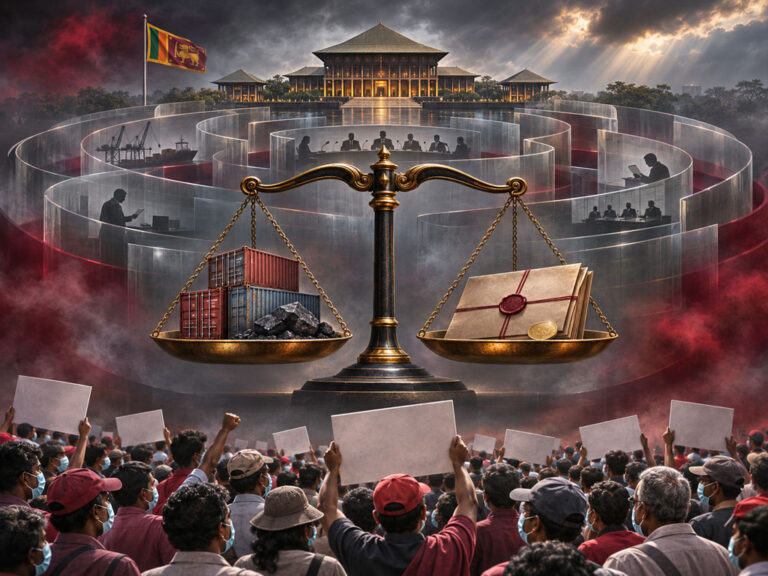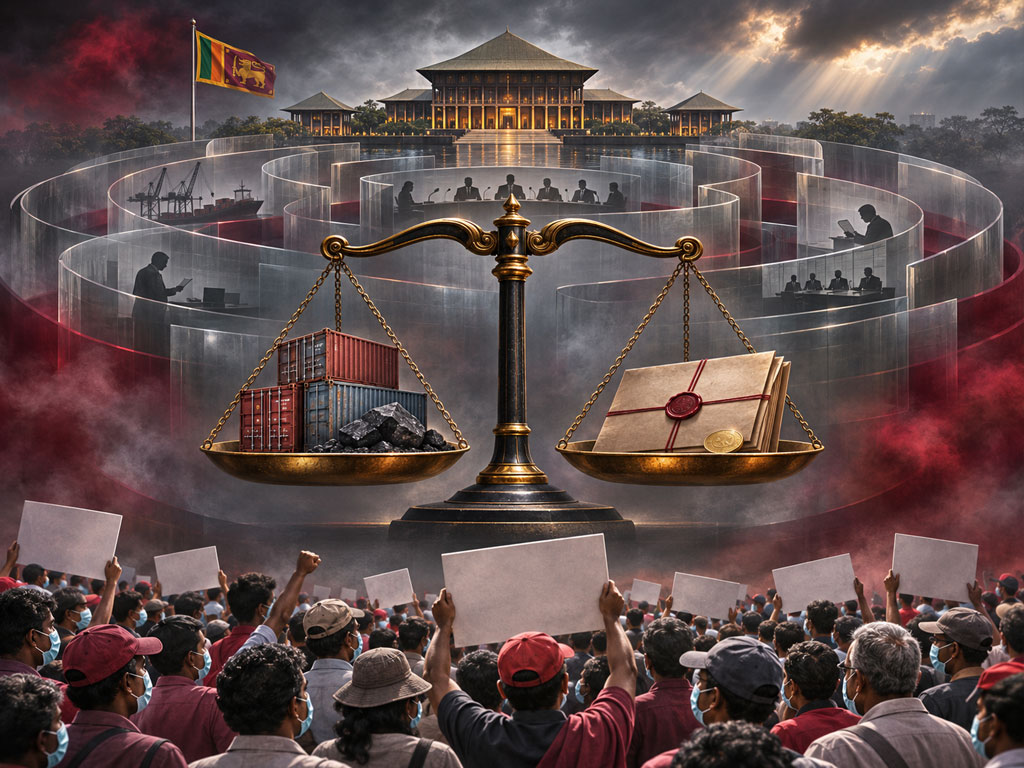
COLOMBO — From the release of 323 containers at Colombo Port and the multibillion-rupee coal procurement controversy to a fraudulent US$2.5 million Treasury payment and allegations against the Speaker, the ruling party faces a test of the accountability standards it promised to uphold.
The Janatha Vimukthi Peramuna-led National People’s Power (JVP-NPP) government came to office promising a fundamental break from Sri Lanka’s political past. Yet, two years after its 2024 electoral victories, its handling of several major controversies has invited comparisons with the administrations it once condemned.
The release of 323 containers from Colombo Port without mandatory physical inspection, disputes surrounding the procurement of substandard coal, a fraudulent US$2.5 million Treasury transaction and allegations against Speaker Dr. Jagath Wickramaratne have placed the administration’s commitment to transparency under scrutiny.
At the centre of this examination is a familiar question: whether commissions and parliamentary committees are being used to establish accountability or, as critics contend, to contain political pressure while decisive action is delayed.
Successive governments before the 2022 Aragalaya protest movement relied extensively on Presidential Commissions of Inquiry (PCoIs), Parliamentary Select Committees (PSCs) and specially appointed investigative bodies when confronted with politically sensitive controversies.
Although several inquiries produced substantial findings, their recommendations were not always implemented. Critics have long argued that the creation of investigative mechanisms sometimes provided governments with temporary political relief without delivering the institutional reforms or enforcement action that the public expected.
These exercises also involved public expenditure. A comprehensive parliamentary assessment of the costs of commissions and special committees appointed since 1977, together with their outcomes and implementation records, would help establish whether taxpayers received value from them.
The Committee on Public Enterprises (COPE) and other parliamentary oversight mechanisms have an important constitutional and institutional role. Their effectiveness, however, ultimately depends on how their findings are addressed.
The Presidential Commission appointed by former President Maithripala Sirisena in late 2019 to investigate the Easter Sunday attacks provides an important example of the controversy surrounding implementation.
Former President Gotabaya Rajapaksa received its recommendations in February 2021. The perceived failure to act adequately on significant findings contributed to dissatisfaction among the Catholic community and became part of the wider criticism directed at his administration before his departure in 2022.
Against that background, the JVP-NPP’s approach to its own investigations deserves equally close examination.

Colombo Port Container Inquiry Faces Questions Over Delays
The controversy surrounding the release of 323 containers from Colombo Port in January 2025 remains one of the most prominent tests of the government’s transparency commitments.
The containers were released without mandatory physical inspection, reportedly as part of measures to address congestion at the port. The circumstances prompted objections and demands for an independent investigation.
A Parliamentary Select Committee chaired by Justice and National Integration Minister Harshana Nanayakkara was subsequently appointed to examine the matter and recommend appropriate action.
The inquiry was established months after the original controversy. Its prolonged proceedings have since attracted criticism from Opposition representatives.
Responding to a question from the writer, committee member and Samagi Jana Balawegaya (SJB) Kalutara District MP Ajith P. Perera said the evidence-gathering process had been completed.
“We are now awaiting the first draft of the PSC recommendations from its head, Minister Nanayakkara.”
Perera alleged that the committee had not met for approximately three months and suggested that the preparation of its recommendations had been unnecessarily delayed.
The former United National Party parliamentarian described the government’s handling of the container controversy as deeply disappointing.
His allegation of deliberate delay must, however, be distinguished from an established finding of misconduct.
Minister Nanayakkara has publicly rejected claims that the committee’s documentation went missing, stating that the relevant records remained secure.
Parliament has also extended the committee’s reporting deadline until December 21, 2026.
The inquiry’s eventual conclusions will therefore be essential to determining whether the release procedures were justified, whether any legal or administrative breaches occurred and whether disciplinary or other corrective action is warranted.
Until those findings are presented, criticism of the process must remain separate from any definitive judgment about individual culpability.
Coal Procurement Controversy Deepens Political Pressure
Questions surrounding coal procurement have presented a separate challenge to the administration.
Frontline Socialist Party (FSP) figure Pubudu Jayagoda raised concerns about procurement arrangements in August 2025.
The FSP’s intervention carried particular political significance because the organisation emerged from a faction that broke away from the JVP in 2011 and was formally launched in April 2012.
The SJB subsequently became increasingly prominent in challenging the government’s handling of both the port container controversy and the coal procurement dispute.
Other Opposition parties, including the New Democratic Front (NDF) and Sri Lanka Podujana Peramuna (SLPP), were less prominent during the early stages of these controversies.
By January 2026, concerns about the quality and procurement of coal supplied for electricity generation had become a major political issue.
The National Audit Office’s findings intensified scrutiny of the Energy Ministry and the government’s response.
Then Energy Minister Kumara Jayakody faced mounting pressure over the procurement controversy while separately confronting a corruption prosecution relating to an earlier position at a state-owned fertiliser company.
The government nevertheless defeated an SJB-backed no-confidence motion against Jayakody in April 2026.
He subsequently resigned as Energy Minister, as did Ministry Secretary Professor Udayanga Hemapala.
Jayakody’s resignation did not amount to a finding of criminal wrongdoing in the coal procurement controversy. Nevertheless, the sequence of events invited questions about the government’s initial defence of his ministerial position.
President Anura Kumara Dissanayake also appointed a Special Presidential Commission of Inquiry in April 2026 to investigate coal procurement dating back to 2009.
The commission’s mandate was subsequently extended until December 2026.
The relevant question is whether this investigation will produce findings that lead to measurable administrative improvements and, where evidence supports them, appropriate enforcement action.
Separate Corruption Case Against Former Energy Minister
Jayakody’s earlier corruption proceedings require separate consideration from the coal procurement dispute.
The Commission to Investigate Allegations of Bribery or Corruption (CIABOC) indicted him before the Colombo High Court over procurement activities involving the Lanka Fertiliser Company.
The prosecution alleges that, while serving as procurement manager, he improperly influenced arrangements connected to carpeting work at the company’s Hunupitiya warehouse complex.
According to the allegations, the procurement process conferred an undue financial advantage on a private company and caused a loss of Rs. 8,859,708 to the State.
The relevant procurement activities date to the period between 2014 and 2016, with the alleged offence linked to Jayakody’s responsibilities in 2016.
Jayakody has denied wrongdoing.
The proceedings remain a criminal prosecution in which the allegations must be established before a competent court. An indictment does not constitute a conviction.
Opposition representatives have questioned why Jayakody was granted bail rather than remanded for a prolonged period, drawing comparisons with the treatment of other individuals facing corruption-related proceedings.
Such comparisons require consideration of the facts, applicable legal provisions and judicial decisions in each case. Differences in bail outcomes do not, by themselves, establish political favouritism.
The broader political question concerns the standards applied when appointing or retaining ministers who face serious allegations, particularly by a party that made anti-corruption reform central to its electoral appeal.
Parliamentary Findings and Estimates of Coal Losses
A further parliamentary investigation, led by SJB Colombo District MP S. M. Marikkar, examined financial losses and environmental consequences associated with substandard coal procured from South Africa through Trident Chemiphar Ltd., an Indian company.
Questions were also raised about the supplier’s eligibility under the relevant tender requirements.
The committee’s report, dated October 7, 2026, examined the effects of inferior coal on electricity generation and related expenditure.
Marikkar subsequently argued that the financial consequences exceeded the estimates presented by the government.
He referred to losses approaching Rs. 20 billion, while Energy Minister Anura Karunatilaka and former Minister Jayakody cited estimates exceeding Rs. 15 billion.
The different calculations reflected disputes over which financial components should be included when assessing the overall cost.
Marikkar contended that parts of the parliamentary report had been overlooked when the lower figures were presented.
The findings also raised concerns about possible environmental consequences and damage associated with the operation of the Norochcholai coal-fired power plant.
Government representatives maintained that financial losses could be recovered and sought to reassure the public about the extent of environmental damage.
Those positions must be assessed against the evidence contained in the audit and parliamentary reports.
The findings are politically consequential because the NPP’s electoral success rested in part on its promise to introduce stricter standards in public procurement.
Yet political embarrassment is not proof of criminal corruption. Establishing responsibility requires a clear distinction between procurement failures, financial losses, administrative negligence and criminal misconduct.
That distinction should apply equally to the incumbent administration and its predecessors.
Fraudulent US$2.5 Million Treasury Payment
The government’s accountability record has also come under scrutiny following a fraudulent US$2.5 million transaction involving Sri Lanka’s Department of External Resources (ERD).
The department handles matters involving foreign financing and external debt obligations.
Investigations established that payments intended for a legitimate recipient had been transferred to a fraudulent entity.
Parliament’s Committee on Public Finance (CoPF), chaired by SJB MP Dr. Harsha de Silva, examined the transaction and criticised weaknesses in financial controls.
The case raised concerns about verification procedures and the handling of instructions concerning international payments.
Assistant Director Ranga Nishantha Rajapaksha, who had been suspended in connection with the matter, was subsequently found dead.
Police reported that a panel of judicial medical specialists concluded that his death was a suicide.
His death is a separate matter from determining individual criminal responsibility for the fraudulent transfer. Neither his suspension nor his death establishes that he committed the fraud.
Investigators also submitted information concerning the transaction to the Colombo Fort Magistrate’s Court.
Responding to a question from the writer, de Silva argued that the financial burden could ultimately fall on taxpayers if the money was not recovered.
That concern highlights the importance of determining whether recovery is possible and whether failures in institutional safeguards contributed to the loss.
The International Monetary Fund has also referred to the transaction.
A separate controversy emerged over a US$625,000 payment associated with Sri Lanka Post and the United States Postal Service.
Government representatives acknowledged that funds had been remitted but had not reached the intended recipient.
The two incidents raised additional questions about the safeguards governing international transactions involving public institutions.
Their occurrence, however, does not establish that they were connected or that the same individuals or methods were involved.
The public interest lies in obtaining verified findings, recovering funds where possible and preventing similar failures.
Speaker’s No-Confidence Motion Presents Another Test
A separate political controversy concerns the no-confidence motion submitted by the SJB-led Opposition against Speaker Dr. Jagath Wickramaratne.
The motion contains allegations relating to his conduct in office, the use of official residences, public expenditure and the administration of parliamentary resources.
Wickramaratne, the Polonnaruwa District MP who succeeded Asoka Ranwala as Speaker in December 2024, occupies one of the country’s most senior constitutional positions.
The allegations have therefore attracted particular attention because they concern the office responsible for presiding over Parliament and maintaining its institutional integrity.
The NPP commands a two-thirds parliamentary majority and possesses the numbers to defeat a no-confidence motion if its members vote together.
The government previously demonstrated its parliamentary strength by defeating the motion against former Energy Minister Jayakody.
However, the numerical outcome of a parliamentary vote is not the same as a determination of the allegations underlying it.
Government and Opposition representatives have disagreed over procedural questions surrounding the motion against Wickramaratne, including requests for amendments.
The motion was not debated on November 3 as previously anticipated.
A separate legal dispute involving former Deputy Secretary-General and Chief of Staff of Parliament Chaminda Kularatne, who challenged his dismissal, has added to the controversy.
Kularatne’s case and the allegations against the Speaker have become subjects of wider debate concerning parliamentary administration and institutional accountability.
No conclusion concerning criminal misconduct can properly be drawn solely from the presentation of a no-confidence motion or the existence of related legal proceedings.
Allegations Concerning Official Residences
Among the allegations contained in the Opposition’s motion are questions about the allocation and use of official accommodation.
Three matters deserve particular examination:
1. Additional official residence: The Opposition alleges that Wickramaratne obtained official accommodation at No. 8-1, Lauries Lane, Colombo 4, in January 2025, despite already having access to the Speaker’s official residence at Rajamalwatta, Battaramulla. Opposition representatives contend that this arrangement contravened applicable administrative requirements and have alleged a breach of the Anti-Corruption Act, No. 9 of 2023.
2. Staff and expenditure: The motion alleges that eight employees continued to be assigned to the official residence at Rajamalwatta while the Speaker occupied the Lauries Lane accommodation. The Opposition places their combined monthly salaries and allowances at approximately Rs. 760,000, excluding expenditure on utilities.
3. Accommodation for the private secretary: Opposition MPs further allege that official accommodation at No. 4-3, Lauries Lane, was allocated for the Speaker’s private secretary.
On the basis of these and other allegations, the Opposition has accused the Speaker of criminal misappropriation and criminal breach of trust.
These are accusations contained in a political motion, not judicial findings. Determining whether any criminal offence occurred would require the relevant evidence to be examined under the law.
Nevertheless, the circumstances surrounding the allocation of public accommodation and expenditure warrant a transparent explanation.
Such scrutiny is especially important for an administration that has repeatedly emphasised the responsible management of State resources.
Parliamentary Standards and Political Consistency
The Speaker’s position carries responsibilities extending beyond the conduct of parliamentary debates.
Under the Constitution, the Speaker chairs the 10-member Constitutional Council, which plays an important role in appointments to independent institutions and in maintaining checks on executive authority.
The Prime Minister, Speaker and Leader of the Opposition serve as ex officio members.
Allegations affecting the office therefore have implications for public confidence in institutional governance, irrespective of the party holding power.
The controversy has also revived comparisons with the JVP’s earlier approach to internal party discipline.
During the period following the 2004 parliamentary election, JVP parliamentarian Anuruddha Polgampola faced allegations concerning the facilitation of an individual’s unlawful entry into Japan.
Under Somawansa Amarasinghe’s leadership, the JVP demanded Polgampola’s resignation rather than waiting for the conclusion of possible criminal proceedings.
At the time, the party had 39 members elected to Parliament through the United People’s Freedom Alliance.
That intervention was widely presented as an example of the party’s willingness to enforce internal standards.
Polgampola was later accommodated by the Sri Lanka Freedom Party under Maithripala Sirisena.
The historical comparison raises a legitimate question about the consistency of political disciplinary standards, although the circumstances of the two cases are not identical.
Previous Speakers have also faced criticism.
Former Speaker Mahinda Yapa Abeywardena was accused of employing relatives on his parliamentary staff, while his tenure attracted legal and political challenges.
NPP parliamentarians supported an earlier no-confidence motion against him.
Consistency requires that allegations involving the present Speaker receive the same degree of scrutiny demanded of previous officeholders.
Electoral monitoring organisations, including the People’s Action for Free and Fair Elections (PAFFREL), may also have a role in encouraging broader discussion of ethical standards in elected office, provided their interventions remain within their institutional mandates.
Parliamentary initiatives designed to promote democratic participation, including student parliament programmes, can retain public credibility only when the institution itself demonstrates a commitment to accountability.
The 22nd Amendment and Parliamentary Authority
The NPP government’s passage of the 22nd Amendment to the Constitution has supplied another point of comparison for critics of its approach to parliamentary power.
The amendment was enacted in September 2026 with a special parliamentary majority despite objections from political and other groups.
Its passage demonstrated the ruling party’s ability to advance legislation through Parliament even in the face of substantial opposition.
A parliamentary majority provides the authority to legislate within constitutional limits. It does not remove the obligation to consider objections, explain policy decisions or maintain public confidence.
The distinction is particularly important when constitutional and institutional reforms affect the balance of power among branches of government.
Anti-Terrorism Legislation Raises Questions Over Expert Advice
Concerns about the government’s use of advisory committees extend beyond corruption investigations.
Former Bar Association of Sri Lanka (BASL) President Saliya Pieris, PC, has questioned changes made to proposed legislation intended to replace the Prevention of Terrorism Act (PTA).
Pieris participated in the expert committee that examined provisions of the proposed Protection of the State from Terrorism Act (PSTA).
He expressed reservations about three principal aspects of the proposed framework:
1. Definition of terrorism: Pieris considered the proposed definition excessively broad and potentially vulnerable to misuse.
2. Administrative detention: He argued that decisions concerning detention should rest with judicial officers rather than the Secretary to a ministry.
3. Proscription of organisations: Pieris maintained that powers to prohibit organisations should be subject to judicial authority.
He also raised concerns about substantial changes to provisions on bail and the extension of detention after the committee had completed its deliberations.
According to Pieris, committee members had reached agreement on several safeguards, including limitations on detention periods and provisions enabling magistrates to grant bail when insufficient evidence existed against a suspect.
He stated that the Bill subsequently presented to Parliament departed from those recommendations.
Pieris said:
“When I examined the Bill, tabled before Parliament, I observed that there have been major deviations from what was agreed on at the Committee, especially relating to the bail provisions and the process of extending detention.”
He further stated:
“The Committee was never made aware of these changes or of the reasons for the changes.”
According to Pieris, he wrote to the committee chairman identifying the discrepancies and seeking an explanation.
The committee included representatives of the Attorney-General’s Department, the Ministry of Justice, the Police, the armed forces, President’s Counsel, attorneys-at-law and a parliamentarian.
Pieris warned that the legislation, if enacted without adequate safeguards, could allow prolonged detention and require magistrates to remand suspects even when the available material did not justify continued custody.
In his assessment, such provisions risked reproducing abuses associated with the existing PTA.
Government representatives have acknowledged differences between the expert committee’s recommendations and the legislation subsequently presented to Parliament.
Foreign Minister Vijitha Herath explained that changes had been made through the Cabinet process.
Legislative proposals are not automatically required to reproduce every recommendation made by an advisory committee. Nevertheless, significant departures from expert consensus, particularly where fundamental rights are concerned, require clear justification.
The Real Test Is Implementation
Sri Lanka’s experience with commissions, parliamentary investigations and expert committees presents a recurring institutional challenge.
The appointment of an investigative body is only the beginning of an accountability process.
Its effectiveness must ultimately be judged by the quality of its findings, the independence of its work, the implementation of recommendations and the willingness of relevant authorities to pursue corrective action.
The controversies involving Colombo Port, coal procurement, fraudulent international payments and allegations against the Speaker are not identical.
Each involves different institutions, evidence, legal standards and potential responsibilities.
They should not be treated as proof of a single conspiracy or collective criminal wrongdoing.
Taken together, however, they represent a substantial test of the government’s promise to depart from the political practices that characterised earlier administrations.
The JVP-NPP’s anti-corruption platform created expectations that investigations would proceed promptly, public expenditure would be justified and allegations against government figures would receive scrutiny irrespective of political affiliation.
The administration still has an opportunity to demonstrate those principles through transparent reporting, independent investigations and lawful enforcement.
Its parliamentary majority cannot substitute for those outcomes.
For a government elected on a promise of political transformation, the decisive question is no longer how strongly it condemns the failures of its predecessors. It is whether it applies the standards it advocated when accountability becomes politically uncomfortable.