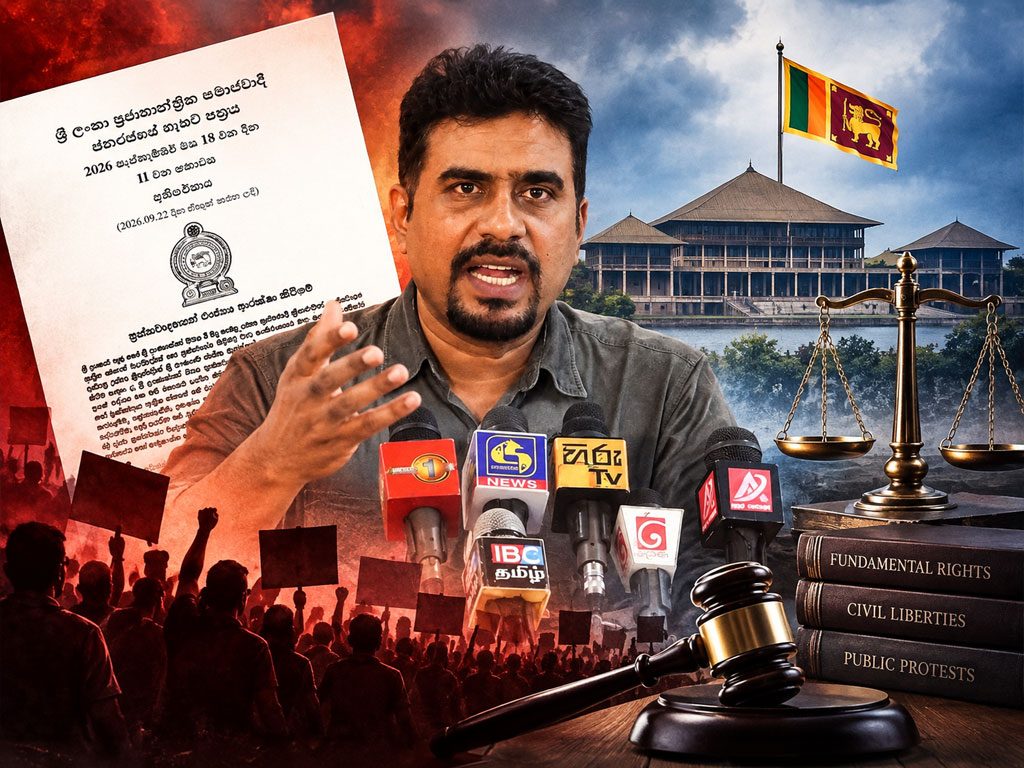
The Protection of the State from Terrorism Bill faces criticism from Duminda Nagamuwa, who says its provisions could threaten fundamental rights.
COLOMBO — People’s Struggle Alliance National Executive Council member Duminda Nagamuwa has strongly criticised Sri Lanka’s newly gazetted Protection of the State from Terrorism Bill, describing the proposed legislation as “extremely repressive” and warning that some of its provisions could threaten fundamental rights and legitimate political dissent.
Addressing a media conference in Nugegoda, Nagamuwa accused the government of abandoning previous commitments to abolish the Prevention of Terrorism (Temporary Provisions) Act, commonly known as the PTA, and replacing it with legislation that he argued could impose wider restrictions on civil liberties.
The Government gazetted the Protection of the State from Terrorism Bill this week as its proposed replacement for the PTA, which has been in force since 1979.
If enacted, the legislation would repeal the existing PTA and establish a new framework governing terrorism-related offences, arrests, searches, detention, investigations and prosecutions.
Nagamuwa argued that replacing the PTA with another national security law did not, in itself, fulfil previous commitments to reform Sri Lanka’s counter-terrorism framework.

Nagamuwa Questions Definition of Terrorism
A central element of Nagamuwa’s criticism concerns the proposed definition of terrorism and circumstances in which conduct intended to compel a government or international organisation to act, or refrain from acting, could fall within the legislation.
“If someone tells the government to reduce the tax burden, or raises a voice against the conditions of the International Monetary Fund (IMF), there is a risk here of turning even that legitimate protest into a terrorist act. The provisions of the Public Property Act, which have so far been used to suppress ordinary protests and demonstrations, have also been included in this new draft, labelling them as terrorist offences,” he said.
The Bill’s provisions, however, contain qualifications that are important to that debate.
Under the proposed framework, participation in protests, advocacy, dissent, strikes, lockouts and certain other activities would not, by itself, be sufficient to infer the intention required for a terrorism offence.
The legislation also provides protections relating to journalism, academic and scientific research, civil society activity, legal representation, artistic expression, satire, political criticism and peaceful expressions of opinion or dissent, subject to the conditions contained in the Bill.
The scope and practical application of those safeguards are likely to form part of the wider legal and political debate as the legislation proceeds through Parliament.
Detention and Security Powers Under Scrutiny
Nagamuwa also criticised provisions allowing detention orders to be issued through the executive branch, arguing that such powers should be subject to stronger judicial control.
Under the gazetted Bill, an arrested person must generally be produced before a magistrate within 48 hours.
Where investigators seek further detention, however, the Secretary to the relevant ministry may issue a detention order following an application by the Inspector General of Police or an authorised Deputy Inspector General.
A detention order may remain in force for up to two months at a time, while the total detention period cannot exceed one year from the initial order. Extensions beyond the first two months would require High Court approval.
The proposed legislation also establishes an Independent Review Committee comprising a retired Supreme Court or Court of Appeal judge and two other members with relevant expertise. That body would review detention orders and make recommendations on whether they should continue, be amended or be revoked.
Additional safeguards include judicial monitoring of detainees, access by authorised Human Rights Commission officers to approved detention facilities and provisions governing access to lawyers and relatives.
Nagamuwa nevertheless argued that the overall detention framework gives the executive excessive authority.
He also raised concerns about powers available to the security forces, restrictions on organisations and provisions that he believes could be used against political protest.
Economic Policies Enter Political Debate
Nagamuwa sought to link the proposed legislation with the Government’s economic programme, alleging that stronger national security laws were being prepared to contain potential public opposition to taxation and other economic pressures.
That assertion represents his political interpretation of the Government’s motives rather than an established purpose stated in the Bill.
He argued that public resistance would ultimately be necessary to prevent the legislation from being enacted and said the Bill was unsuitable for presentation to Parliament.
Nagamuwa also criticised what he described as insufficient opposition from traditional political parties to the proposed law.
Government Says Bill Balances Security and Rights
The Government’s stated position is different.
Authorities say the proposed legislation is intended to replace the PTA with a modern framework capable of responding to contemporary national security threats while incorporating human rights protections and additional safeguards.
Cabinet approval for publication of the Bill followed work by a technical expert committee, preparation by the Legal Draftsman’s Department and clearance from the Attorney General.
The proposed legislation covers terrorism-related offences committed within and outside Sri Lanka and provides procedures governing arrest, detention, investigation, prosecution and punishment.
It also introduces judicial and independent review mechanisms that were not reflected in Nagamuwa’s criticism as presented in the source material.
Concerns over the broader reform process are not confined to the People’s Struggle Alliance. Earlier assessments of drafts of the proposed legislation by Sri Lankan civil society organisations and United Nations human rights experts raised concerns over definitions, executive powers, detention and the potential impact on fundamental rights, while also acknowledging safeguards and improvements contained in the proposed framework.
The Bill has now been gazetted but has not become law. It must proceed through Sri Lanka’s parliamentary legislative process before it can replace the PTA.
Debate is therefore likely to focus not only on whether Sri Lanka should replace the 1979 law, but on whether the safeguards in the proposed replacement are sufficient to prevent counter-terrorism powers from being used against legitimate dissent.