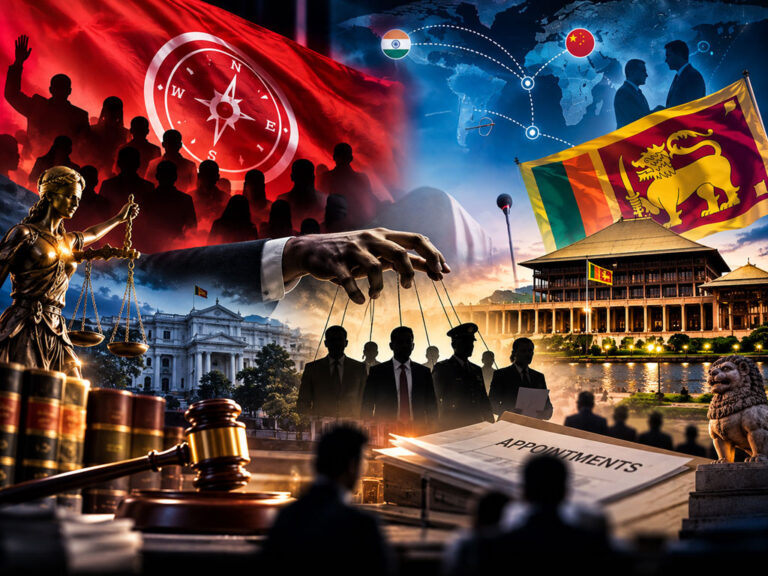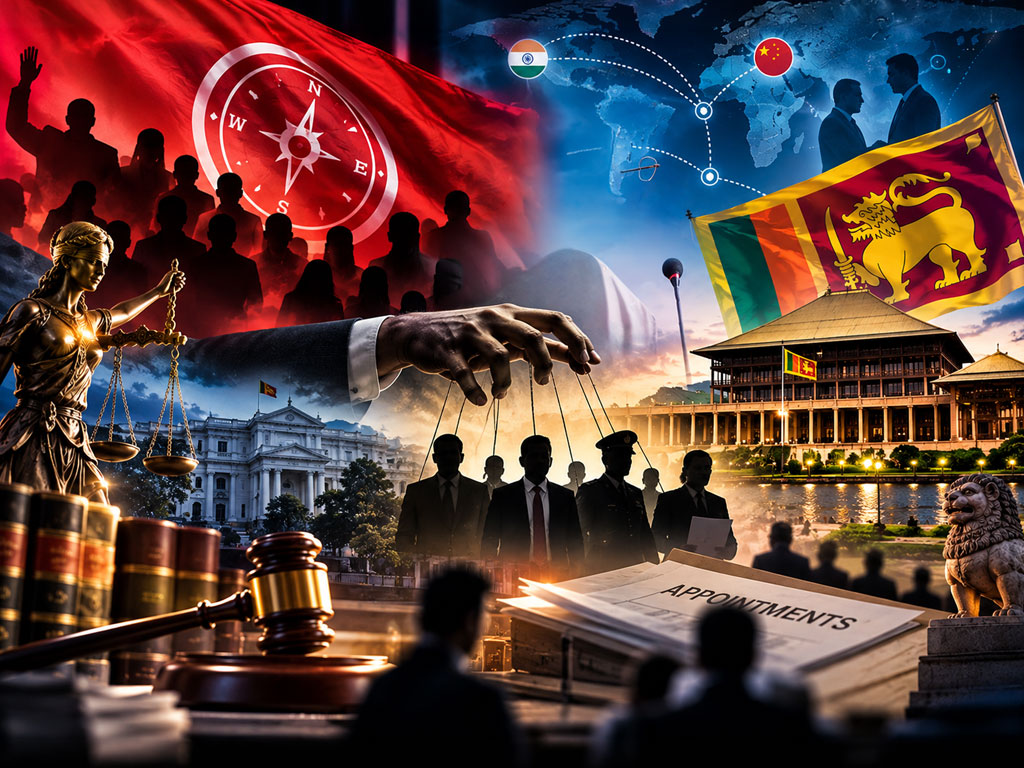
JVP state influence is under scrutiny as Sri Lanka debates the boundary between governing-party structures and independent state institutions.
COLOMBO — For years, Sri Lanka’s political debate has included claims of a “deep state” operating behind formal institutions, particularly in arguments surrounding the 2019 Easter Sunday attacks. Today, a different question deserves examination: how clearly is the boundary being maintained between the governing political movement and the institutions of the state?
That question does not establish the existence of a “deep state”, nor does the available evidence justify describing the JVP-led National People’s Power administration as one. It does, however, provide a legitimate basis for examining how political parties interact with government institutions, how influence is exercised outside elected office and whether formal lines of accountability remain clear.
The distinction matters in any parliamentary democracy. Governments exercise authority through the Constitution, Parliament, Cabinet, the public service, security institutions and the law. Political parties organise, campaign, formulate policy and seek electoral power.
Those functions inevitably overlap when a party forms a government. The democratic question is whether that relationship remains transparent and constitutionally accountable.

The Old “Deep State” Debate
The term “deep state” has featured prominently in public arguments over the Easter Sunday attacks.
Academic and human rights activist Rajan Hoole and journalist and activist Sunanda Deshapriya have written about alleged hidden structures and political interests operating within or around state institutions. Archbishop of Colombo Cardinal Malcolm Ranjith has also repeatedly called for further investigation into the attacks and possible obstruction of efforts to establish the full truth.
As recently as April 2026, Cardinal Ranjith alleged that officials belonging to what he called the “deep state” were obstructing the investigation into the Easter attacks. That remains his allegation rather than an established judicial finding.
The criminal proceedings have meanwhile produced important findings.
On September 22, the Colombo Permanent High Court Trial-at-Bar convicted 15 defendants over their involvement in the 2019 attacks, while nine were acquitted. The prosecution had brought more than 23,000 charges, and the trial heard evidence from 2,309 prosecution witnesses.
Those convictions establish criminal responsibility for offences connected with the attacks. They do not necessarily resolve every separate question concerning intelligence failures, prior warnings, alleged obstruction or claims of a wider conspiracy.
Equally, unresolved questions cannot themselves be treated as proof that a hidden state apparatus planned the bombings.
The distinction between evidence, allegation and political interpretation remains essential.
A Different Question for the NPP Government
Sri Lanka’s present political circumstances create a separate debate about the relationship between party organisation and state power.
The National People’s Power secured 159 of Parliament’s 225 seats at the November 2024 general election, giving the governing alliance a two-thirds parliamentary majority. Official results show the NPP received 61.56% of the national vote.
That mandate is constitutionally legitimate. A large parliamentary majority is not evidence of institutional capture, nor is party discipline unusual in parliamentary politics.
But the scale of the majority makes transparency and institutional independence particularly important because the government faces fewer parliamentary constraints than administrations dependent on coalitions or narrow majorities.
The relevant questions are therefore concrete ones. Are public officials exercising their statutory responsibilities independently? Are appointments made through lawful procedures? Do ministers retain responsibility for their departments? Are regulators, police, intelligence agencies and other institutions operating within their legal mandates?
Those questions can be investigated through evidence without adopting the politically loaded conclusion that a “deep state” exists.
Tilvin Silva and the Role of Party Headquarters
JVP General Secretary Tilvin Silva provides an important example of why the distinction between party and government has attracted attention.
Silva is a senior figure within the JVP but is not a Member of Parliament or Cabinet minister. Yet foreign diplomats have held meetings with him and other JVP representatives at the party’s headquarters in Pelawatte.
On August 11, Indian High Commissioner Santosh Jha met Silva at the JVP headquarters for discussions covering bilateral and cultural relations, Sri Lanka’s political environment and Indian assistance.
New Chinese Ambassador Wei Huaxiang subsequently met Silva at the same headquarters, with discussions covering Sri Lanka-China relations, investment, anti-corruption initiatives and poverty alleviation. The JVP itself reported the meeting.
Silva also travelled to India in February under the Indian Council for Cultural Relations’ Distinguished Visitors Programme and met senior Indian officials, including External Affairs Minister S. Jaishankar and Deputy National Security Adviser Pavan Kapoor.
None of those engagements, individually or collectively, establishes that Silva exercises unconstitutional government authority. Party-to-party diplomacy and engagement with senior figures in governing political organisations are not inherently improper.
The more useful question is whether policy decisions affecting the state are ultimately taken through the institutions constitutionally responsible for making them.
That distinction should be capable of being demonstrated rather than merely assumed.
Allegations of Party Networks Need Evidence
The source article raises a more serious concern: that ministers and deputy ministers may be surrounded by assistants, drivers and advisers selected through party networks, potentially giving the political organisation influence over information reaching elected officials.
That assertion requires evidence.
No documentary material supplied with the article establishes a systematic JVP mechanism for placing party operatives throughout ministries or directing public institutions through an informal chain of command. It would therefore be inappropriate to present such a structure as an established fact.
The underlying governance question is nevertheless legitimate.
Who appoints ministerial staff? Under what authority are appointments made? What functions do those appointees perform? To whom are they accountable? Are politically appointed personnel influencing decisions reserved for career public officials?
Those questions can be answered through appointment records, ministry structures, official directives and evidence from the institutions concerned.
If such evidence demonstrates ordinary political staffing within the law, the allegation of institutional capture would require reconsideration. If evidence demonstrates an informal party hierarchy directing state functions outside established constitutional channels, that would warrant serious scrutiny.
The conclusion must follow the evidence, not precede it.
JVP History Requires Context
The JVP’s history is also relevant, but it should not be used as evidence of how the present government operates.
The movement led two armed insurrections, in 1971 and from 1987 to 1989. Academic historical research records both episodes as major insurgencies against the Sri Lankan state, with the second involving assassinations and violence against political opponents and civilians as well as brutal counter-insurgency by the state.
Modern JVP participation in electoral politics, however, must be assessed on present-day conduct and evidence. Historical violence does not establish that today’s party is secretly directing state institutions, just as its current democratic mandate does not place its exercise of power beyond scrutiny.
Those are separate questions.
Parliamentary Majority Brings Greater Responsibility
Similar care is necessary when examining the NPP’s parliamentary majority.
With 159 MPs, the government possesses sufficient seats to exercise substantial legislative power.
Party discipline, however, should not automatically be described as evidence that parliamentarians lack independent judgment. Political parties throughout parliamentary systems organise voting around agreed programmes and government legislation.
A stronger test would examine how MPs use parliamentary committees, whether government legislation receives meaningful scrutiny, how dissent is handled within the governing alliance and whether constitutional checks remain effective.
A two-thirds majority can enable significant reform. It can also reduce the government’s dependence on opposition support. Neither outcome, by itself, determines whether democratic accountability has weakened.
Investigations Must Be Judged by Evidence
The article also raises concerns about investigations and prosecutions involving opposition politicians, including Namal Rajapaksa and Basil Rajapaksa.
Here, the standard should be straightforward.
Political office must not provide immunity from investigation where credible evidence of wrongdoing exists. At the same time, criminal justice institutions should not be used selectively against political opponents.
The existence of investigations involving opposition figures does not prove selective enforcement. Establishing political misuse would require evidence showing improper intervention, discriminatory treatment, fabricated cases or other departures from lawful procedure.
Likewise, allegations against opposition politicians cannot be dismissed merely because they arise while their political rivals control the government.
Both propositions can be true: corruption allegations require investigation, and the independence of those conducting the investigations requires protection.
IMF Policy Should Be Separated From Political Speculation
Economic policy presents another area where speculation should be distinguished from established government decisions.
The source article refers to reports that the government could abandon or radically alter Sri Lanka’s IMF programme for electoral reasons.
Current evidence does not establish that conclusion.
The IMF completed the combined Fifth and Sixth Reviews of Sri Lanka’s Extended Fund Facility in May 2026 and said programme performance had been generally strong. The government has committed to returning to a primary balance target of 2.3% of GDP from 2027.
IMF Mission Chief Evan Papageorgiou has also said there have been no discussions about a new programme after the present arrangement ends, with any future request being a decision for the Sri Lankan authorities.
Any future departure from existing economic commitments should therefore be assessed when policy changes are actually announced, rather than attributed in advance to an electoral strategy.
JVP State Influence Must Be Tested, Not Assumed
The central democratic issue is ultimately narrower and more measurable than the phrase “deep state” suggests.
Where does legitimate party influence end and the independent authority of the state begin?
Sri Lanka does not need to decide in advance that the NPP or JVP is constructing a hidden state in order to examine that boundary. Nor should past allegations about other governments be dismissed simply because some remain unproved.
Instead, scrutiny should focus on evidence.
Who makes appointments? Under what law? Who gives instructions to public officials? Which decisions are made at party level and which belong to Cabinet? How independently do police, prosecutors, regulators and intelligence institutions operate? Are parliamentary oversight mechanisms functioning? Can public servants resist unlawful political instructions? Are investigations pursued according to consistent evidentiary standards?
Those questions apply not only to the present administration but to every Sri Lankan government.
The country’s experience with concentrated political power, institutional interference and failures of accountability makes them particularly important.
Calling something a “deep state” does not prove that it exists. Rejecting the label does not prove that institutions are independent either.
The stronger democratic safeguard is more demanding: trace authority, examine appointments, scrutinise decisions and follow the evidence until it establishes where party power ends and state power begins.