By Roy Denish
The Ceylon pearl divers of the Gulf of Mannar risked their lives in one of the Indian Ocean’s oldest and most lucrative maritime trades.
Inside the Lost World of Ceylon’s Pearl Divers
For centuries, the Gulf of Mannar supported one of the Indian Ocean’s most celebrated and unpredictable pearl fisheries, drawing merchants, divers, labourers and colonial administrators to Sri Lanka’s northwestern coast.
When a pearl fishery was declared, otherwise quiet coastal areas could be transformed almost overnight.
Temporary settlements emerged near fishing grounds, bringing traders, speculators, labourers, officials and mariners together around the promise of natural pearls harvested from the oyster beds beneath the gulf.
Marichchukkaddi became one of the locations associated with these seasonal fisheries.
The gatherings could swell dramatically during successful fishing seasons, producing temporary communities supported by markets, administrative offices and services for the thousands of people connected to the trade.

Diving for Oysters
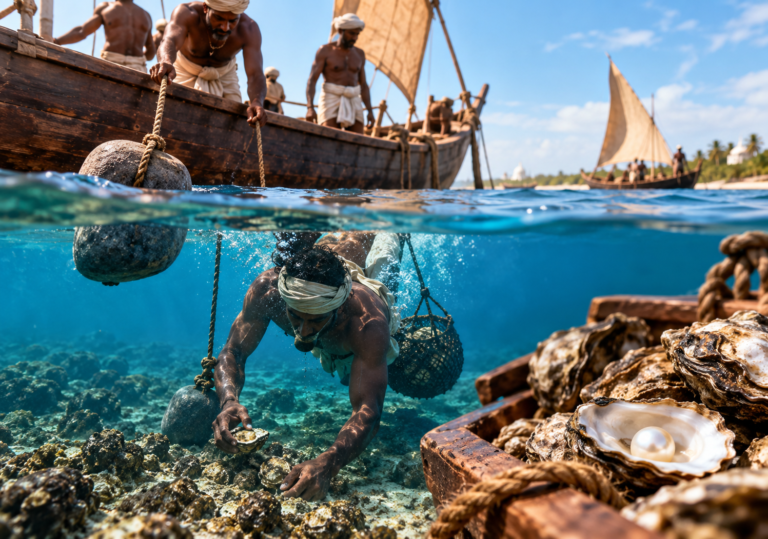
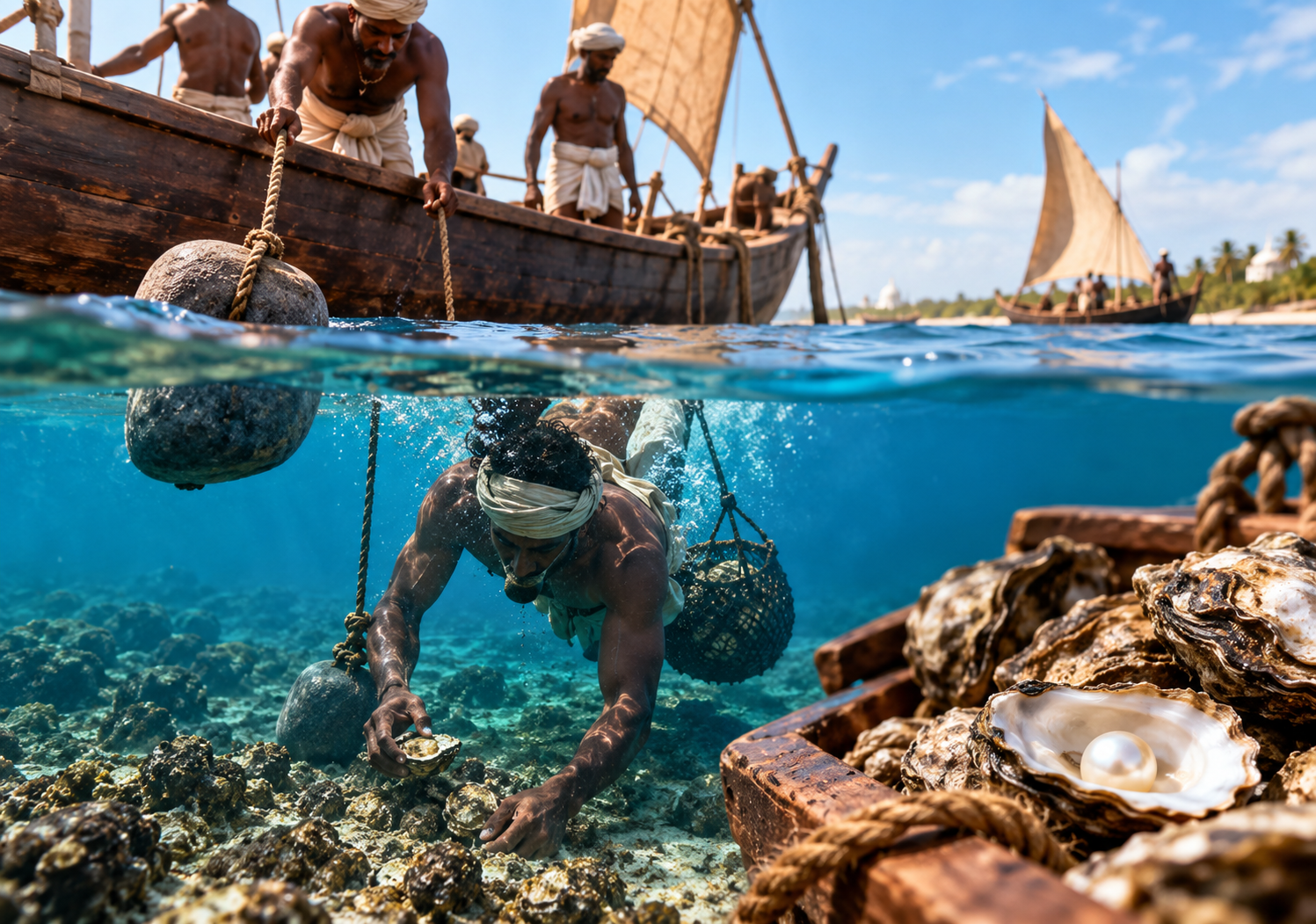
At the centre of the industry were freedivers who descended without modern breathing apparatus.
Traditional divers used weighted stones to accelerate their descent towards oyster beds known as paars.
Once underwater, they had only a limited period in which to collect oysters and place them into baskets or nets before returning to the surface.
The work was physically demanding.
Divers faced pressure changes, exhaustion, dangerous currents and marine life while repeatedly descending into the gulf.
Their skill was the product of experience passed down across generations of fishing communities on both sides of the Palk Strait and Gulf of Mannar.
Shark Charmers and Maritime Belief
The fisheries also developed distinctive ritual traditions.
Historical accounts describe the presence of shark charmers, sometimes referred to as kadal-katti, who were believed to protect divers from shark attacks through rituals and incantations.
Whether viewed as spiritual practice, occupational tradition or psychological reassurance, the role reflected the dangers faced by men descending into open water with little protection.
The pearl fishery therefore combined commerce, maritime skill and belief in ways that became closely associated with the culture of the Gulf of Mannar.
Oysters Left to Decompose
Once brought ashore, the oysters were stored in enclosed areas and allowed to decompose before being processed.
The method was unpleasant but practical.
Workers later washed and sifted through the remains to locate pearls hidden inside the shells.
Only a fraction of oysters yielded pearls of significant quality.
That uncertainty created much of the speculation surrounding the industry, with entire catches capable of producing either substantial returns or disappointment.
Colonial Powers Control the Trade
Successive Portuguese, Dutch and British administrations attempted to control and profit from the fisheries.
Under British rule, officials increasingly employed surveys and scientific observation to assess the health of oyster beds and determine whether fishing should be permitted.
Yet the fisheries remained highly unpredictable.
Oyster populations could collapse or disappear from traditional beds for years at a time because of environmental changes, natural mortality and fluctuations in recruitment.
The arrival of cultured pearls in international markets during the 20th century further reduced the commercial importance of traditional wild pearl fisheries.
Today, the Gulf of Mannar’s pearl industry survives largely in historical records and coastal memory.
Its story remains one of the most remarkable chapters in Sri Lanka’s maritime history, built on dangerous underwater labour, global luxury markets and the uncertain biology of the pearl oyster.