Three women journalists allege sexual harassment by Delhi Police during protests over India’s voter-roll revision. The Crime Branch is investigating.
NEW DELHI — Three women journalists have accused Delhi Police personnel of sexual harassment while they were covering protests demanding the resignation of India’s Chief Election Commissioner Gyanesh Kumar, prompting authorities to transfer the complaints to the Crime Branch for investigation.
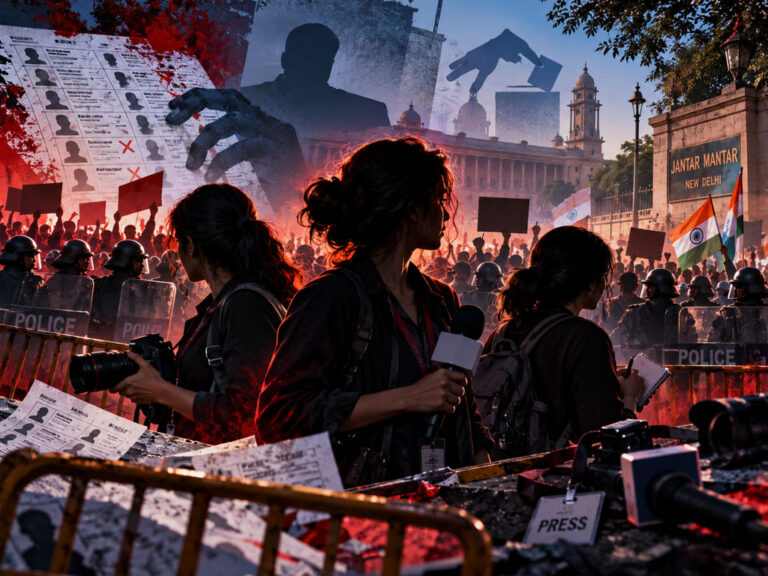
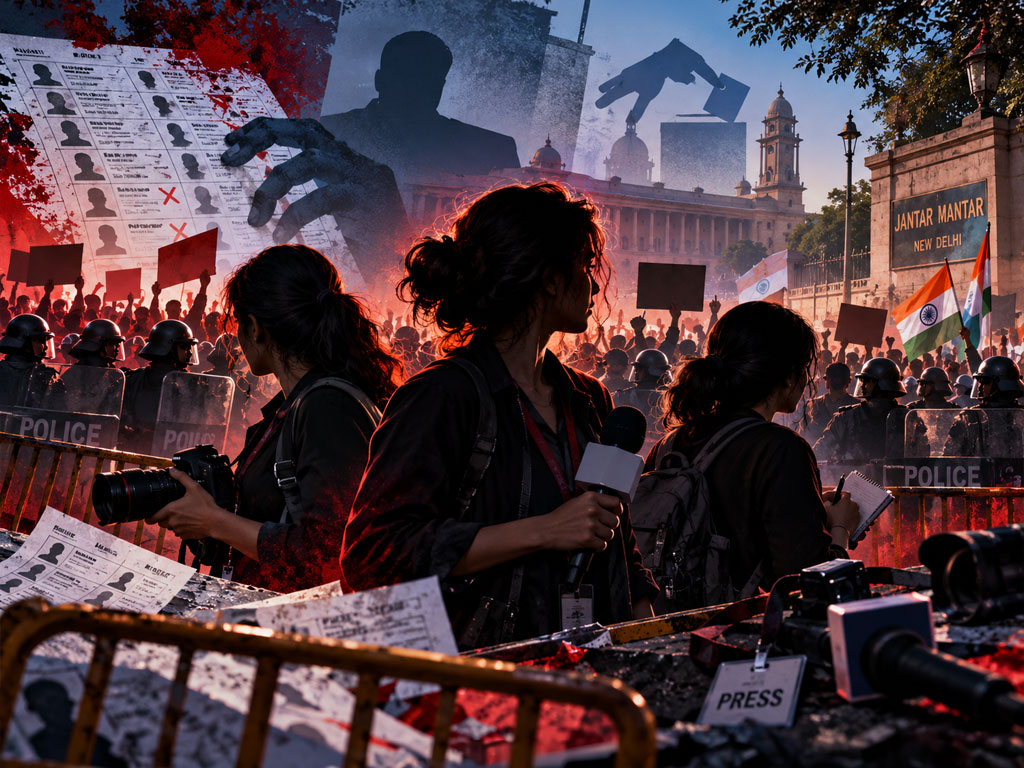
The allegations relate to demonstrations near Jantar Mantar on October 3, when police detained protesters opposing the Election Commission’s Special Intensive Revision of electoral rolls.
Delhi Police said the New Delhi district had received complaints from three women journalists and transferred them to the Crime Branch for what it described as a “fair and impartial” inquiry.
The complaints include allegations of inappropriate touching and physical mistreatment during police action at the protest.
No finding of wrongdoing has yet been made against the officers concerned, and the allegations remain under investigation.

Journalists Allege Harassment During Police Action
Footage circulating online shows protesters being physically removed from the Jantar Mantar area as police sought to disperse gatherings held without permission.
One independent journalist alleged that an Assistant Commissioner of Police assaulted her while she was filming the detention of a protester.
Other women journalists also submitted complaints alleging sexual harassment by police officers during the demonstrations.
Authorities have said CCTV footage and other available video material will be examined as part of the Crime Branch inquiry.
Police also said the complainants had undergone medical examinations and that statements would be recorded as the investigation proceeds.
The allegations have placed additional scrutiny on the conduct of officers deployed to control demonstrations that had already become politically sensitive because of the controversy surrounding India’s voter lists.
Press Club Demands Immediate Action
The Press Club of India said it was “shocked and deeply concerned” by the treatment of journalists covering the protests.
It called for immediate action on the complaints and stressed that journalists must be able to report public demonstrations without fear of aggression or intimidation.
“Behaviour of this kind cannot be normalised in a democracy. Journalists must be allowed to work freely, without fear, and document those who gather to raise various issues,” the organisation said.
The Press Club also criticised restrictions affecting journalists working in and around the protest area.
Its intervention has shifted part of the debate beyond the immediate allegations of harassment to broader questions about press freedom and the treatment of reporters covering politically contentious demonstrations.
Rahul Gandhi Demands Answers From Home Ministry
Opposition Leader Rahul Gandhi also criticised the handling of the protests and called on Union Home Minister Amit Shah to respond.
Delhi Police falls under the Union Ministry of Home Affairs rather than the Delhi state government.
Gandhi referred to allegations that women protesters had been mistreated, cameras taken from journalists and reporters dragged during police action.
He questioned why a First Information Report had not immediately been registered in response to the complaint made by a woman journalist.
“Delhi Police comes under the Ministry of Home Affairs. Amit Shah ji, where are you? You have to answer for this,” Gandhi wrote in a social media post.
His comments are political criticism and do not constitute a finding against the police officers accused.
Student Activist Says Police Dragged Her by the Hair
The allegations against police are not limited to journalists.
Aahna Singh, a student and activist at Jawaharlal Nehru University, told Reuters that police dragged her by the hair during the demonstration.
She described the police response as “brutal”.
Student groups have also alleged that female protesters, journalists and lawyers were manhandled by male police personnel.
Delhi Police, for its part, has said officers were acting to enforce restrictions on unauthorised public gatherings and maintain law and order.
Section 163 of the Bharatiya Nagarik Suraksha Sanhita had been imposed in parts of central Delhi, restricting assemblies.
More than 150 people were detained on October 3 after attempting to gather or return to the Jantar Mantar area.
Protesters Demand Election Chief’s Resignation
The protests are centred on Chief Election Commissioner Gyanesh Kumar and the Election Commission’s Special Intensive Revision, or SIR, of electoral rolls.
Demonstrators allege that the exercise has resulted in the removal of millions of legitimate voters and could benefit Prime Minister Narendra Modi’s Bharatiya Janata Party.
Both the BJP and the Election Commission reject accusations that the revision has been politically manipulated.
The Election Commission says the exercise is intended to identify duplicate, deceased, ineligible or incorrectly registered voters while ensuring eligible citizens remain on the rolls.
More than 130 million names have been removed from draft electoral rolls during the nationwide exercise across multiple states and territories.
That figure does not necessarily mean all 130 million people have permanently lost voting rights. The revision process includes claims, objections and mechanisms for eligible voters to be restored or newly registered.
Internal Election Commission Dissent Fuels Controversy
The political dispute intensified following an investigation by The Indian Express into the internal functioning of the Election Commission.
Election Commissioners Sukhbir Singh Sandhu and Vivek Joshi formally raised objections at least 14 times over a 10-month period to decisions and orders they said had been issued without their knowledge or approval.
Their concerns reportedly involved voter additions and deletions, changes to registration procedures, electoral-roll appeals and the centralisation of voter data.
In some instances, the commissioners described certain actions as “unauthorised” or “illegal”, according to the newspaper’s investigation.
The Election Commission acknowledged the existence of differing views but maintained that such disagreements formed part of its normal internal decision-making process and said final decisions had been unanimous.
The disclosures have nevertheless strengthened demands from opposition parties and youth groups for Kumar to resign.
Cockroach Janta Party Returns to the Streets
Among the groups driving the protests is the youth-led Cockroach Janta Party, or CJP.
The movement began as a satirical online campaign before developing into a significant youth pressure group.
It gained national attention earlier this year during demonstrations over education policy and examination-paper leaks.
Those protests culminated in the resignation of then Education Minister Dharmendra Pradhan in July.
CJP has since shifted its focus to the Election Commission and the electoral-roll revision.
Protests involving CJP supporters, opposition groups, students and civil-society activists have taken place in both Delhi and Mumbai.
Thousands gathered on Sunday for a third consecutive day of demonstrations demanding Kumar’s resignation.
The movement has also announced plans for further protests.
Election Commission Rejects Claims of Political Bias
Opposition groups argue that the SIR could disproportionately remove voters less likely to support the BJP.
The Election Commission strongly denies that allegation.
It says updating the electoral rolls is necessary because the last comparable intensive revision in many areas was conducted decades ago and voter databases contain people who have died, moved permanently, emigrated or registered in more than one location.
Commission officials maintain that differing opinions among commissioners do not demonstrate improper conduct and that the final decisions of the Commission were unanimous.
Legal challenges to the SIR and to aspects of the Election Commission’s functioning have also reached India’s Supreme Court.
The Court has sought explanations from the Government and Election Commission over elements of the voter-roll exercise, adding a judicial dimension to an already heated political controversy.
Police Investigation Now Becomes a Separate Test
Whatever the outcome of the wider dispute over India’s voter lists, the allegations made by the three women journalists require a separate and independent examination.
The electoral controversy does not determine whether individual police officers acted improperly.
Likewise, the enforcement of restrictions on public demonstrations does not remove journalists’ right to work without sexual harassment or unnecessary physical interference.
The Crime Branch inquiry will now need to examine video footage, witness statements, medical evidence and the accounts of the officers involved before conclusions can be drawn.
For Delhi Police, the credibility of that investigation will be important not only because of the seriousness of the allegations, but because journalists were documenting police conduct at a protest already under intense national scrutiny.