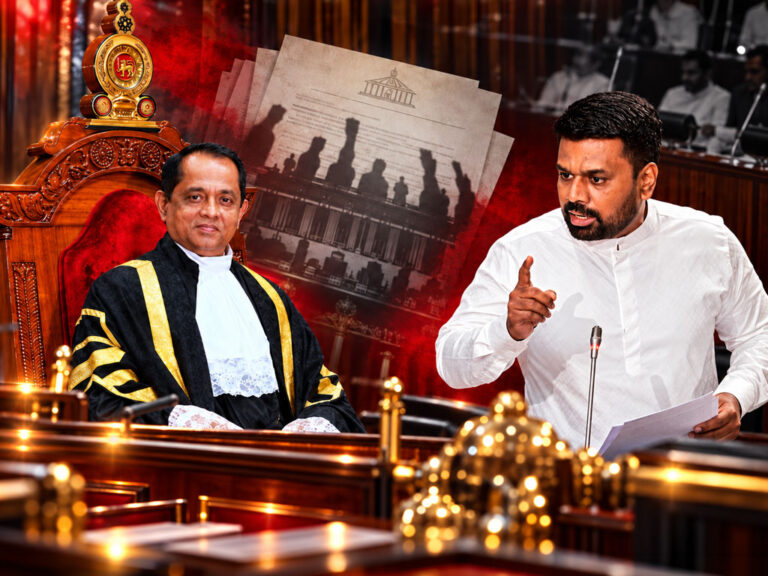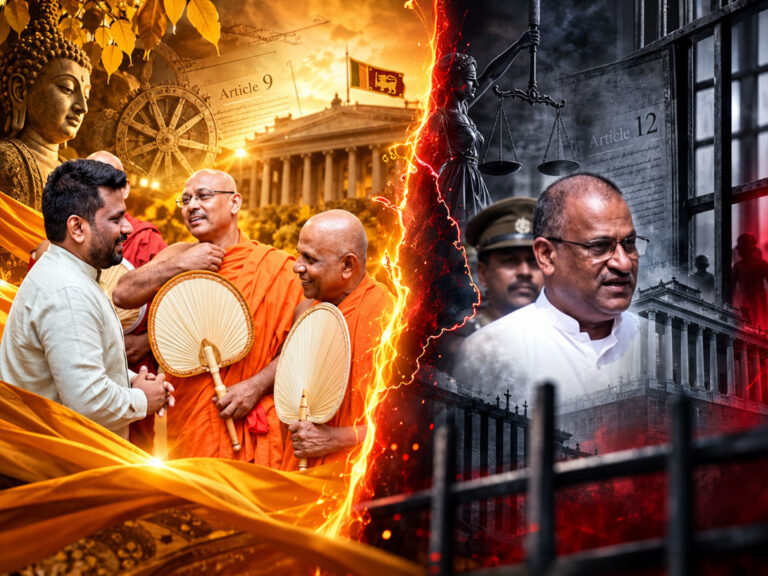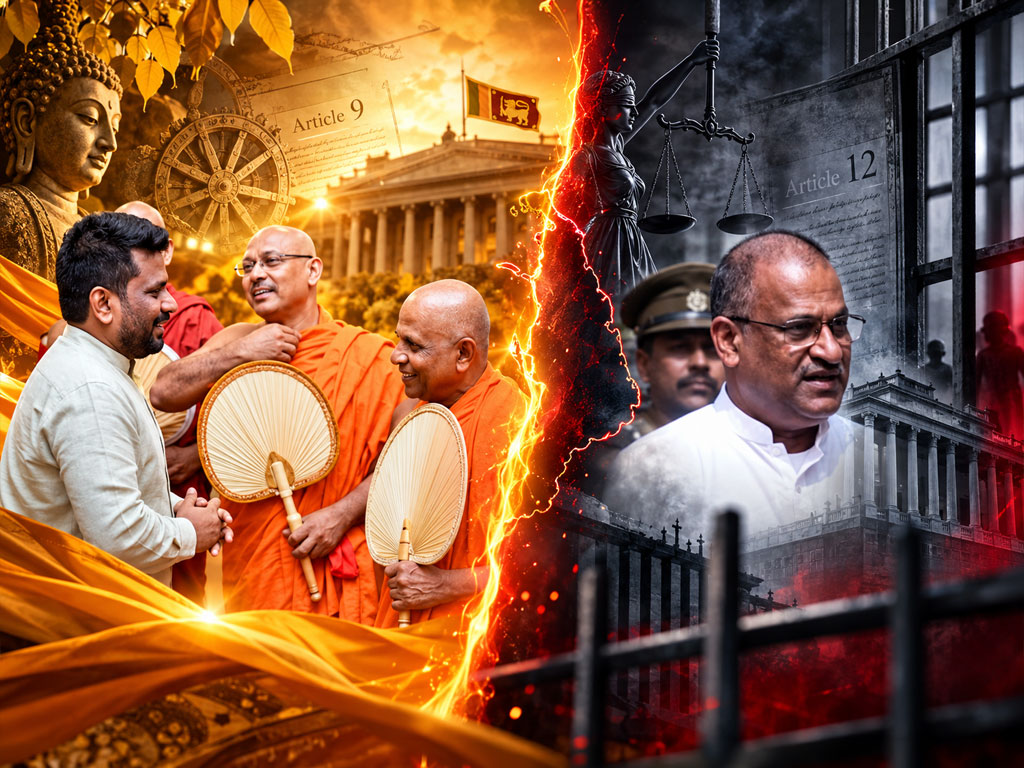
Article 9 vs Article 12 comes into focus as Sri Lanka reviews prison rules governing Buddhist monks following the Gnanasara Thero robe controversy.
COLOMBO — A dispute over whether an imprisoned Buddhist monk should be permitted to retain his robe has evolved into a wider constitutional debate over two fundamental principles: the State’s duty to protect and foster Buddhism under Article 9 and the guarantee of equality before the law under Article 12.
The debate intensified after Ven. Galagodaaththe Gnanasara Thero was produced before court in lay clothing following the removal of his robe under existing prison regulations.
Senior members of the Maha Sangha subsequently raised objections, prompting President Anura Kumara Dissanayake to meet the Tri-Nikaya Maha Sangha at the Presidential Secretariat on October 8.
At the heart of the discussion was not simply the treatment of one imprisoned monk, but a broader question with implications for the Constitution, the prison system and the relationship between civil law and Buddhist ecclesiastical tradition.
Can the State recognise the special religious status of the Buddhist robe without creating one law for monks and another for other citizens?
That is the constitutional balance the Government is now attempting to address.

Article 9: The State’s Duty Towards Buddhism
Article 9 of Sri Lanka’s Constitution gives Buddhism the foremost place and places a duty on the State to protect and foster the Buddha Sasana.
For the Maha Sangha, the robe is not merely clothing.
It signifies ordination and a monk’s status within the Sangha. According to the position communicated by the Mahanayake Theros, civil authorities should not remove the robe of an ordained monk unless the appropriate Sangha authority has first determined that he has committed a parajika offence warranting loss of monastic status.
That position creates a direct religious dimension to what prison authorities may otherwise regard as an administrative matter.
From the perspective advanced by the Maha Sangha, forcing an ordained monk into lay clothing while his monastic status remains intact risks disregarding the State’s constitutional responsibility towards the Buddha Sasana.
The controversy surrounding Gnanasara Thero therefore raises a larger question about what Article 9 requires in practice when ordinary State regulations intersect with the internal disciplinary traditions of Buddhism.
Article 12: Equality Before the Law
Running alongside Article 9 is Article 12, which establishes equality before the law and equal protection of the law.
President Dissanayake placed particular emphasis on this principle during his meeting with senior monks.
He rejected the possibility of issuing an executive instruction applying specifically to Gnanasara Thero while leaving existing rules unchanged for every other prisoner.
“In ordinary politics it is said that law is the ruler’s wish. But I am by no means prepared to make my wish into law,” the President said.
He also warned against allowing personal preference to determine how laws are enforced.
“If the law becomes my wish, then the law begins to be interpreted according to what I like and dislike. That is by no means an appropriate situation.”
The President’s argument was that executive discretion should not be used to create an exception for one individual merely because his case has attracted significant public and religious attention.
Sixty-three Buddhist monks, he said, are already imprisoned under the same legal framework in connection with various offences.
Creating one arrangement for Gnanasara Thero and another for those monks would therefore raise its own equality concerns.
An 1877 Law Meets a Modern Constitutional Problem
Much of the present difficulty appears to originate in legislation considerably older than the Constitution itself.
The discussion focused on the Prisons Ordinance enacted in 1877, together with subsequent ministerial regulations and standing orders.
Those rules were primarily designed for ordinary prisoners and contain only limited provisions addressing the particular circumstances of ordained Buddhist monks.
Under the existing framework, a prisoner sentenced to rigorous imprisonment is required to wear clothing issued by the prison.
Officials therefore applied the rules to Gnanasara Thero as they would to other prisoners serving comparable sentences.
Dissanayake told the Maha Sangha that officials should not be blamed for complying with the written law.
The problem, in his assessment, lies in whether that law remains appropriate when applied to ordained clergy whose religious status carries obligations and symbolism not contemplated adequately in legislation dating from the colonial period.
The Robe Is More Than Prison Clothing
The disagreement becomes particularly sensitive because the Buddhist robe carries religious meaning well beyond its practical function as clothing.
The Mahanayake Theros have taken the position that an ordained monk does not cease to be a monk merely because he has been convicted of an offence under civil law.
Under the interpretation presented at the meeting, loss of monastic status involves the disciplinary authority of the Sangha and cannot simply be imposed administratively by prison officials.
For Buddhist devotees, seeing a monk previously known publicly in robes appear before court dressed as a layman can therefore carry implications extending far beyond prison regulations.
President Dissanayake acknowledged that concern.
He said he understood the deep shock that could be caused among Buddhists and the Maha Sangha when a monk respected in robes appears before the public in ordinary clothing.
Significantly, he identified the most sensitive point as the monk’s appearance outside prison, particularly when being brought before court where journalists and members of the public are present.
Is Article 9 in Conflict With Article 12?
The controversy may appear at first glance to pit Article 9 against Article 12.
That framing, however, risks oversimplifying the constitutional problem.
Article 9 requires the State to give Buddhism the foremost place and protect and foster the Buddha Sasana.
Article 12 requires equality before the law.
The challenge is not necessarily to choose one provision over the other, but to determine whether a legal framework can respect both.
A rule recognising the religious status of all properly ordained Buddhist monks in custody would be different from an executive exception created solely for one politically prominent monk.
That distinction is central to the President’s approach.
Rather than directing officials to treat Gnanasara Thero differently, the Government intends to consider whether prison law itself should be amended to establish a general rule applicable to the entire Sangha.
If such a framework were developed consistently, the Government could argue that it was recognising a constitutionally relevant religious status without granting a personal privilege based on political intervention.
Special Committee Given Two Weeks
To address the problem, the President has ordered the appointment of a special committee to examine the existing legal framework.
It includes representatives from:
- the Attorney General’s Department
- the Ministry of Justice
- the Ministry of Public Administration
- the Ministry of Buddhasasana
- the Department of Prisons
The committee has been instructed to submit proposed amendments within two weeks.
Its recommendations are then expected to be discussed with the Maha Sangha before a revised legal framework is prepared.
According to the source material, senior monks welcomed the decision and expressed appreciation for the President’s preference for a general legal amendment rather than a temporary intervention benefiting one prisoner.
“Rule of Law” Rather Than “Ruler’s Wish”
The political importance of the President’s position lies in the distinction he drew between changing the law and circumventing it.
Dissanayake did not argue that the existing regulations must remain unchanged.
His position was that if the law is unsuitable, the answer is to change the law through established procedures.
That approach seeks to avoid two competing risks.
The first is treating religious tradition as irrelevant simply because a century-old prison regulation exists.
The second is allowing the Executive to ignore the law whenever a politically or religiously sensitive case arises.
Both could create significant problems.
If religious status is ignored entirely, Article 9 obligations may become difficult to reconcile with State practice.
If individual exemptions are granted according to political pressure, Article 12 and the principle of equal application of the law could be weakened.
The Real Constitutional Test
The Gnanasara Thero controversy has therefore moved beyond the individual monk.
It has exposed an unresolved question within Sri Lanka’s legal architecture: how should a modern constitutional State treat Buddhist clergy who enter the criminal justice system?
The answer cannot rest solely on the symbolism of the robe.
Nor can it rest solely on a prison regulation written without sufficiently accounting for the ecclesiastical status of Buddhist monks.
A durable solution would need to define clearly whether ordained monks retain particular religious rights while imprisoned, what role Sangha authorities have in determining monastic status, and how those rights can operate consistently within a system committed to equality before the law.
The committee now has two weeks to begin answering those questions.
Its eventual proposals will reveal whether Sri Lanka can reconcile Article 9 and Article 12 without weakening either the State’s constitutional responsibilities towards Buddhism or the principle that the law must apply consistently to all.