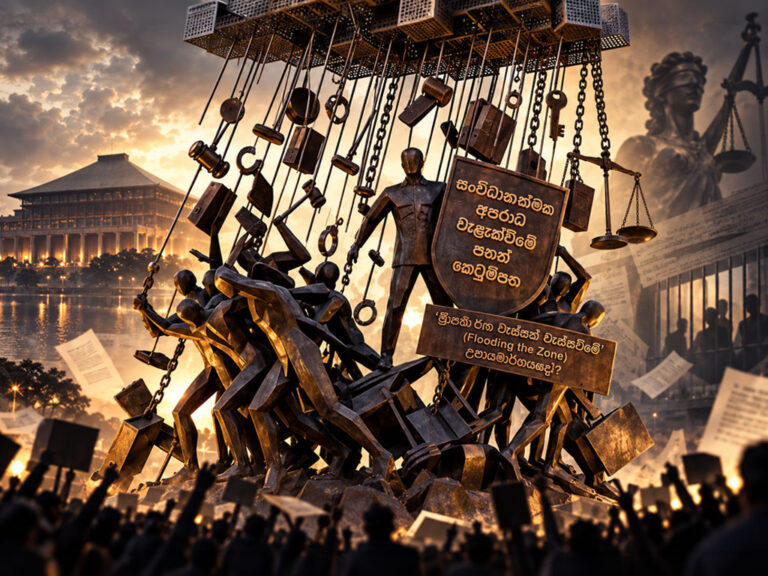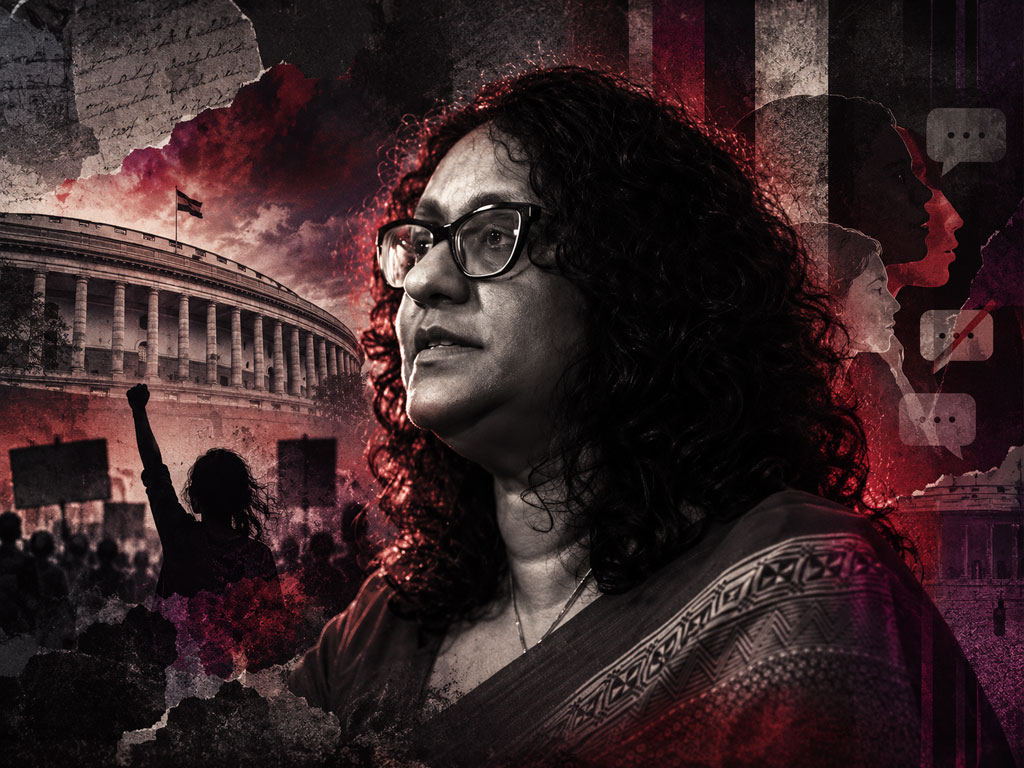
COLOMBO — The reported sexualised ridicule of a woman associated with an opposition protest raises a difficult question for Sri Lanka’s political establishment: do principles of gender equality apply equally to political opponents?
Allegations of sexualised mockery directed at a woman associated with the Viharamahadevi Park protest have placed an uncomfortable question before Sri Lanka’s political establishment: does a woman’s right to dignity depend on her political allegiance?
The controversy concerns a woman’s account of an incident in which a letter was allegedly placed inside her blouse during activities connected to the protest at Viharamahadevi Park.
According to the commentary surrounding the incident, the woman’s remarks subsequently became the subject of sexualised ridicule, with writer and public commentator Upul Shantha Sannasgala and individuals sympathetic to the Government named among those accused of participating in or encouraging the mockery.
The precise statements attributed to Sannasgala and the circumstances of the original incident have not been independently established in the material available for this article. Those allegations should therefore be assessed against the original recordings and responses of those concerned.
Nevertheless, the underlying question is legitimate and extends beyond the individuals involved.
When a woman’s body becomes the focus of political ridicule, her arguments risk being displaced by insinuations about her sexuality, appearance or personal dignity.
Such conduct deserves scrutiny irrespective of the woman’s political affiliation or the views she expresses.
The controversy also raises questions about the consistency of politicians and activists who have previously championed women’s rights, particularly when criticism is directed towards figures regarded as sympathetic to their own political camp.

Harini Amarasuriya’s Advocacy and the Question of Silence
Prime Minister Dr. Harini Amarasuriya occupies a distinctive position within Sri Lankan politics because of her academic and professional background.
Before entering Parliament, she was associated with research and advocacy concerning human rights, social justice, marginalised communities, women and children.
Her doctoral thesis, Guardians of Childhood: State, Class and Morality in a Sri Lankan Bureaucracy, examined the practices and relationships within Sri Lanka’s child protection bureaucracy, including the influence of state institutions, class, morality and social policy.
Completed through the University of Edinburgh and Queen Margaret University, the research reflected a wider academic interest in the relationship between state power and social institutions.
Amarasuriya also served on the boards of organisations involved in women’s research, community health and legal advocacy.
That background makes her a particularly relevant figure in debates concerning the treatment of women in political life.
The original commentary argues that the Prime Minister and progressive voices associated with the ruling National People’s Power (NPP) have failed to condemn the alleged mockery.
No specific public intervention by Amarasuriya concerning this incident was identified in the reporting reviewed. That does not establish that she has never addressed the matter privately or publicly through a statement not captured by those sources.
The criticism is therefore best framed as a question of public political accountability rather than a definitive finding of deliberate silence.
Why should women who disagree with a governing party expect anything less than the protection and respect demanded for women who support it?
Political Opportunism and the Selective Defence of Women’s Rights
The first concern raised by the incident is the possibility of selective commitment to gender equality.
Before assuming power, political movements frequently demand accountability for harassment, discriminatory language and the treatment of women in public life.
Such commitments acquire greater significance when those movements enter government.
The responsibility then shifts from criticising those in power to demonstrating that the same principles apply to allies, supporters and political opponents.
If sexualised ridicule is condemned when directed at a woman aligned with the Government but overlooked when directed at an opposition supporter, the credibility of that commitment is weakened.
This can be understood through the idea of ideological conformity: the tendency to align public conduct with the interests and expectations of a political group, sometimes at the expense of principles previously defended.
It does not follow that every failure to comment publicly constitutes hypocrisy or that all members of a political movement approve of offensive remarks made by individual supporters.
Nevertheless, political consistency requires more than declarations of principle.
Those who champion women’s rights must be prepared to challenge degrading behaviour even when the individual responsible is politically sympathetic to them.
Otherwise, the defence of dignity risks becoming conditional upon political loyalty.
How Sexualised Mockery Marginalises Women in Politics
The second concern is the use of a woman’s body or sexuality to diminish her credibility in public debate.
Political disagreement is a legitimate feature of democracy.
A woman who participates in an opposition demonstration can be challenged over her statements, evidence, political loyalties and arguments.
Her gender, clothing or body should not become substitutes for that debate.
Sexualised mockery redirects attention away from what a woman says towards suggestions intended to embarrass or humiliate her.
When this happens repeatedly, it can discourage women from participating in public life or expressing unpopular views.
Such behaviour may contribute to a wider pattern of gender-based harassment. Whether particular remarks satisfy the legal definition of harassment or another offence would depend on their content, context and applicable law.
The broader social problem is not limited to overt threats or physical violence.
Humiliation, hostile commentary and the circulation of degrading material can also shape the environment in which women participate in politics.
A commitment to gender equality that ignores these practices among one’s own supporters remains incomplete.
Patriarchal Attitudes and Structural Violence
The third issue concerns the relationship between political ridicule and the deeper social structures that permit it.
Patriarchal attitudes do not disappear simply because a political organisation describes itself as progressive.
They may remain visible in everyday language, social expectations and the unequal standards applied to men and women.
A male political activist may be criticised primarily for his views or actions, while a female activist may find her appearance, sexuality or personal life drawn into the dispute.
When political audiences treat such differences as harmless entertainment, they can help normalise an unequal environment.
The concept of structural violence offers one framework for examining these dynamics. It considers how established social arrangements and practices can disadvantage people without requiring every instance to involve a direct physical assault.
However, the concept should not be used to imply that every offensive comment is automatically a criminal act.
Its relevance lies in understanding how repeated humiliation and unequal treatment can restrict participation and reinforce existing power imbalances.
The responsibility to confront such attitudes extends to politicians, journalists, artists, educators, civil society organisations and the wider public.
No party or ideological movement is exempt.
Women’s Dignity Cannot Depend on Party Allegiance
The Viharamahadevi Park controversy provides a useful test of an elementary democratic principle.
Women do not surrender their right to dignity when they support an unpopular political movement.
Their arguments remain open to criticism, and their conduct remains subject to the same legal standards as anyone else’s.
Neither political disagreement nor criticism of a protest justifies degrading a participant through sexual insinuation.
Equally, accusations against named commentators must be supported by evidence, and those accused should have an opportunity to respond.
For Prime Minister Amarasuriya and other public figures associated with progressive politics, the broader challenge is to demonstrate that commitments to equality are not limited by partisan considerations.
Condemning discriminatory conduct is most meaningful when doing so carries a political cost.
The same standard should apply to activists outside government who defend women selectively according to their political preferences.
Sri Lanka’s public debate would benefit from a consistent rejection of sexualised humiliation, whether its target is a supporter of the NPP, the opposition or any other political organisation.
The question is not whether every politician must respond personally to every offensive statement.
It is whether the principles they profess remain visible when those principles are tested by the conduct of people on their own side.
That is the measure by which claims of political progress deserve to be judged.