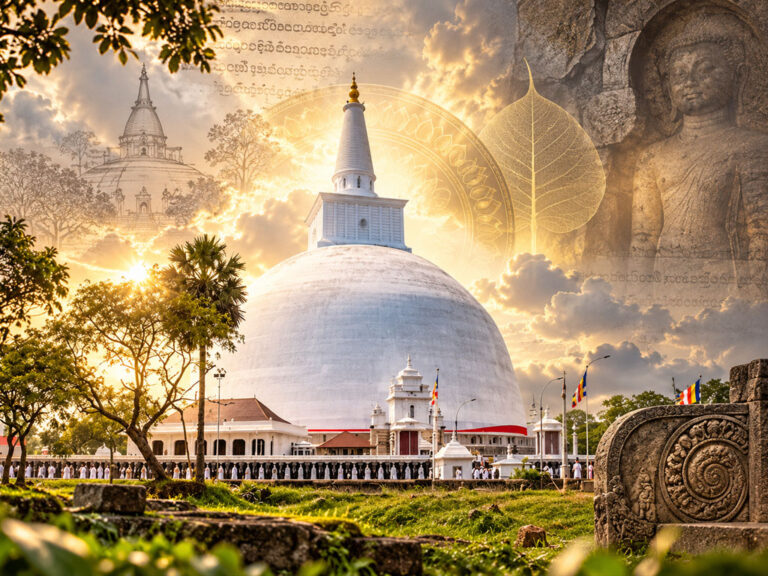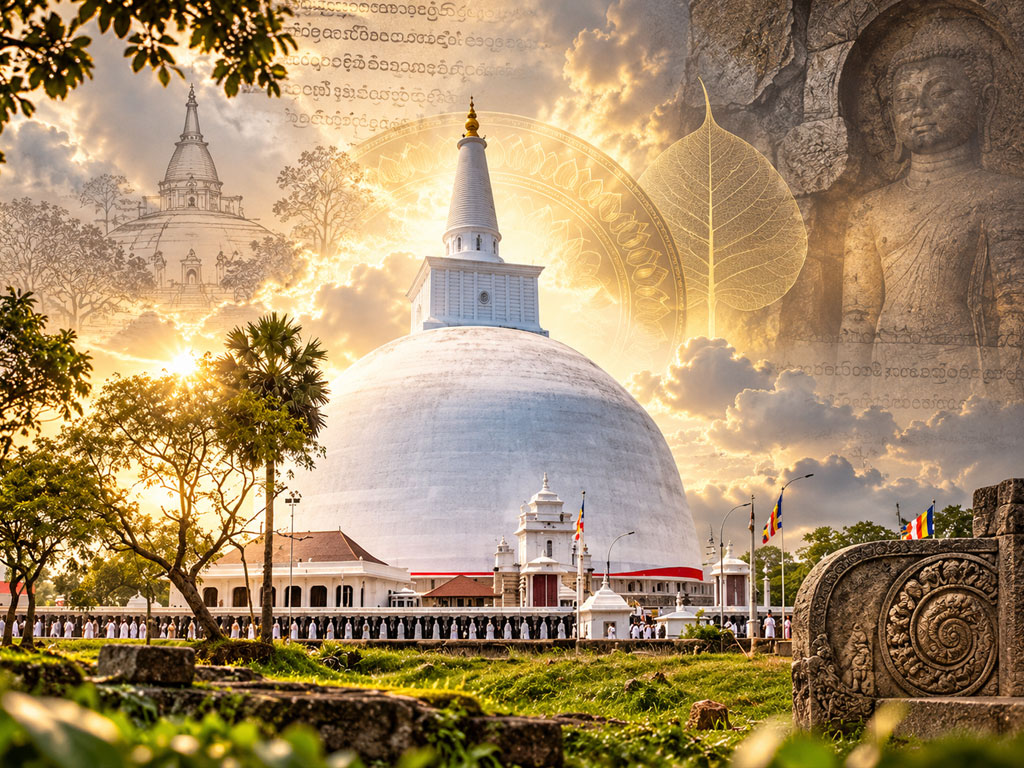
ANURADHAPURA — The dispute over one word reveals a deeper question about how Sri Lanka’s institutions should describe sacred Buddhist heritage without reducing its religious significance to archaeological classification.
The debate over whether the Ruwanweli Maha Seya should be described as a “monument (smārakaya)” extends far beyond the meaning of a single word. It concerns the relationship between Sri Lanka’s Buddhist heritage, national cultural identity and the language used by public institutions and political authorities.
From an archaeological and legal perspective, the Ruwanweli Maha Seya can be classified as a monument. Such terminology serves an established purpose in identifying, documenting and protecting structures of historical importance.
For Buddhists, however, the sacred stupa is much more than an ancient architectural achievement.
It remains an active place of worship, closely associated with the Buddha’s relics and regarded with profound reverence by generations of devotees.
Within the Sinhala Buddhist tradition, its sacredness is not confined to a distant historical period. The Ruwanweli Maha Seya continues to occupy an important place in the spiritual lives of worshippers.
That distinction explains why the terminology used to describe it can provoke strong reactions.
A legal description may be technically correct yet still be regarded by devotees as inadequate when used without acknowledgment of the site’s religious identity.
The difficulty arises when public authorities respond to those sensitivities exclusively through dictionary definitions or legal classifications, rather than recognising the cultural meaning that the site continues to hold.

The Meaning of Monument and Smārakaya
The English word monument entered the language through Old French from the Latin monumentum, associated with monere, meaning to remind, warn or bring something to mind.
Its linguistic ancestry is commonly connected with the idea of remembrance.
The Indo-European root men-, associated with thought and mental activity, is also relevant to comparisons with words belonging to the wider historical vocabulary of memory and mind.
The Sinhala term smārakaya has a comparable association with remembrance through Sanskrit smṛ, meaning to remember.
Related Sanskrit-derived words include ‘smaranaya’, referring to remembrance, and ‘smruthiya’, associated with memory.
These similarities help explain why the term became suitable for historical and commemorative structures.
In ordinary usage, monuments frequently fall into three broad categories:
1. Tombs and burial structures: Memorials associated with deceased individuals, including tombs and burial mounds.
2. Secular commemorative structures: Statues, pillars, arches and memorials honouring historical events, military victories, political leaders or those who have died.
3. Historical and archaeological structures: Buildings and sites preserved for their architectural, cultural or historical importance, including ruins associated with earlier civilisations.
Examples range from the Washington Monument to Stonehenge and the Colosseum.
Yet the meaning of monument is not restricted to these categories.
In archaeological and heritage terminology, active religious buildings can also be described as monuments.
A church, temple or sacred structure does not cease to be religious merely because it receives a legal classification intended to secure its preservation.
The concern, therefore, is not necessarily that the word is linguistically incorrect. It is that using it alone may communicate an incomplete understanding of a sacred place.
Was Smārakaya Part of Classical Sinhala Usage?
The historical development of smārakaya deserves closer examination.
The original linguistic argument maintains that the word does not appear in early Sinhala inscriptions or prominent classical literary works such as Amavatura, Butsarana, Pujavaliya, Saddharmaratnavaliya and the Sinhala Thupavamsa.
Those claims require confirmation through a systematic examination of inscriptions, historical dictionaries and manuscript traditions.
The absence of a word from selected surviving works would not, by itself, establish that it was entirely unknown in earlier Sinhala usage.
Nevertheless, the argument raises a reasonable question about the distinction between traditional religious terminology and the technical vocabulary used in modern archaeology.
One possibility is that ‘smārakaya’ acquired greater prominence as an administrative and archaeological term during the late colonial period and the development of formal heritage-protection laws.
Establishing precisely when it entered official Sinhala usage would require linguistic and documentary research.
The wider distinction remains important: modern administrative terminology and the language inherited through centuries of religious practice do not always express the same range of meanings.
Why Sacred Places Are Named Differently
Religious language frequently identifies a place through its spiritual function rather than its architectural classification.
The Taj Mahal in India, built as a mausoleum for Mumtaz Mahal, is widely recognised as both a tomb and an architectural monument.
Terms such as smarak, maqbara and yadgar express different aspects of commemoration, burial and remembrance in South Asian languages.
An actively worshipped religious site, by contrast, is ordinarily identified through a designation reflecting its sacred character.
The Kashi Vishwanath Temple in Varanasi is known as a mandir, while the Mahabodhi Temple at Bodh Gaya is recognised through terminology associated with Buddhist worship and pilgrimage.
These examples illustrate how ordinary religious usage may differ from institutional heritage classification.
They do not establish that a sacred temple can never be called a monument.
Rather, they demonstrate why religious communities may prefer terminology that recognises the site’s continuing devotional significance.
Maha Seya, Chaitya and Stupa in Buddhist Tradition
The Sinhala Buddhist terms Maha Seya, Chaitya, Stupa and Dagaba carry meanings that extend beyond the identification of a physical structure.
They belong to a religious vocabulary shaped by Buddhist doctrine, the veneration of relics and centuries of worship.
Chaitya and Seya
The Sanskrit chaitya, corresponding to Pali cetiya, is associated with objects and places worthy of veneration.
Within Buddhist tradition, the concept is broader than a structure built merely to commemorate a person or event.
The traditional threefold classification includes:
- Saririka cetiya, associated with the bodily relics of the Buddha.
- Paribhogika cetiya, associated with objects or places used by the Buddha.
- Uddesika cetiya, associated with representations of the Buddha.
The Jaya Sri Maha Bodhi is significant within this wider tradition of sacred veneration.
The Sinhala word seya is historically related to forms of cetiya, although the precise phonological stages proposed in some traditional explanations should be assessed against historical linguistic evidence.
The Buddhist commentarial understanding of cetiya emphasises an object worthy of reverence.
The original argument cites the Pali expression “Chittakaraneeyattena Chethiyan” “චිත්තීකරණීයට්ඨේන චේතියං” to illustrate that devotional significance.
This tradition helps explain why chaitya or seya conveys more to a Buddhist worshipper than an archaeological label alone.
Stupa and Thupa
The Sanskrit term stupa, rendered thupa in Pali, is closely associated with Buddhist relic veneration.
Its development through Sanskrit, Pali and Sinhala reflects a long history of religious and linguistic exchange.
The Mahaparinibbana Sutta discusses persons considered worthy of a stupa, using the concept of thuparaha.
In Theravada Buddhist tradition, a stupa enshrining the Buddha’s relics is not regarded simply as a tomb belonging to a completed past.
For devotees, the presence of the relics sustains a continuing relationship with the Buddha and his teachings.
The original commentary invokes the devotional formulation “Daathusu Tithasu Buddho Tithowa Hothi” “ධාතූසු ඨිතාසු බුද්ධෝ ඨිතෝව හෝති”, expressing the belief that the Buddha remains present in a sacred sense through his relics.
This is a religious interpretation rather than a claim that archaeological terminology must be abandoned.
It explains why reducing a sacred stupa to a physical memorial can appear inadequate to those who worship there.
Historical Names of the Ruwanweli Maha Seya
Sri Lanka’s Buddhist chronicles and religious traditions preserve several names for the Ruwanweli Maha Seya.
Among them are:
- Mahathupa or Maha Thupa
- Suvarnamali Mahachetiya
- Swarnamali Maha Dagaba
- Ruwanweli Maha Seya
- Rathnamali or Ratnamali Stupa
The source also identifies historical forms such as Mahathuba, Mahacheta and Hemamali Chetiya, whose specific occurrences and dating in inscriptions or manuscripts warrant specialist verification.
The Mahavamsa associates the construction of the great stupa with King Dutugemunu during the Anuradhapura period.
In Sri Lankan Buddhist practice, the Ruwanweli Maha Seya is also addressed with expressions of profound reverence, including Sä Rajanan Vahanse.
Such an honorific reflects the relationship between worshippers and the sacred site.
These names are not interchangeable with the language used to classify monuments under a conservation law.
They represent an inherited religious tradition in which the structure is understood as an object of continuing veneration.
Legal Classification Does Not Remove Sacred Status
Sri Lanka’s Antiquities Ordinance uses the term monument within a legal framework intended to protect historic buildings, structures and places.
Its definitions encompass religious structures, including temples and churches.
The Ordinance also establishes procedures governing the identification, conservation and protection of ancient monuments.
Accordingly, describing the Ruwanweli Maha Seya as an archaeological monument is not inherently inaccurate.
Nor does that classification legally deprive the site of its Buddhist identity.
The difficulty emerges when terminology intended for conservation is treated as though it provides an exhaustive description of a place’s meaning.
A site may simultaneously possess archaeological, architectural, historical and religious importance.
Those characteristics are complementary, not mutually exclusive.
From a linguistic perspective, the original criticism can be understood as an objection to the reduction of a complex cultural identity to one dimension of meaning.
The author describes this as semantic narrowing,
Strictly speaking, semantic narrowing is a technical linguistic concept concerning changes in a word’s meaning. The present dispute is more accurately understood as a question of descriptive adequacy and cultural context.
Nevertheless, the underlying concern remains understandable.
The repeated use of a purely administrative designation in religious communication may fail to express the respect that worshippers associate with the sacred site.
Heritage Protection Must Recognise Living Worship
The place of Sinhala Buddhist heritage in Sri Lanka’s national cultural identity cannot reasonably be overlooked.
Acknowledging that heritage need not diminish the importance of Hindu, Islamic, Christian or other religious traditions.
Indeed, the same principle of culturally appropriate language should apply to every community.
A historic church may be protected as a monument while remaining a place of Christian worship. A Hindu temple may possess archaeological significance without losing its religious identity.
The issue is therefore not whether the State should abandon heritage terminology.
It is whether government institutions should distinguish clearly between legal classification and the language used when addressing religious communities.
A colonial-era legal framework may remain useful for protecting historic sites, but its vocabulary need not dictate every aspect of public communication.
Conservation authorities can acknowledge the legal status of a place while using terms that accurately reflect its living religious function.
Towards More Appropriate Public Terminology
A practical response would distinguish technical descriptions from language intended for general public communication.
Depending on the context, authorities could use terms such as:
- Archaeological Heritage Site
- Historical Heritage Site
- Sacred Buddhist Heritage Site
- Maha Seya, Chaitya or Stupa
For legal and conservation purposes, monument may remain entirely appropriate.
When addressing worshippers, describing religious ceremonies or discussing the sacred identity of the Ruwanweli Maha Seya, its traditional Buddhist names may convey the intended meaning more precisely.
The question of whether existing legal definitions should be amended is separate from the question of how public officials should communicate.
Any proposal to change statutory terminology would require consultation with linguists, archaeologists, legal specialists, Buddhist religious authorities and relevant state institutions.
The objective should not be to prohibit a word simply because it has a technical meaning.
It should be to ensure that terminology is suited to the circumstances in which it is used.
The Question Beyond a Single Word
Determining whether the Ruwanweli Maha Seya is a monument requires more than a dictionary definition.
History, archaeology, Buddhist philosophy, linguistic development and contemporary religious practice all contribute to its meaning.
The word monument can correctly identify the stupa’s historical and architectural importance.
Yet that designation alone cannot capture its significance to generations of Buddhists who continue to worship there.
For those devotees, the Ruwanweli Maha Seya is not merely an ancient structure preserving memories of the past.
It is a living sacred place, deeply connected to religious belief and spiritual practice.
Protecting its archaeological fabric and honouring its religious identity are not competing responsibilities.
A culturally informed approach to public language would recognise both.
The more productive question is therefore not whether one technically valid term should defeat another. It is whether Sri Lanka’s institutions can describe a sacred heritage site in language that protects its history while respecting the people for whom it remains spiritually alive.
SOURCE:- PRAJA.LK