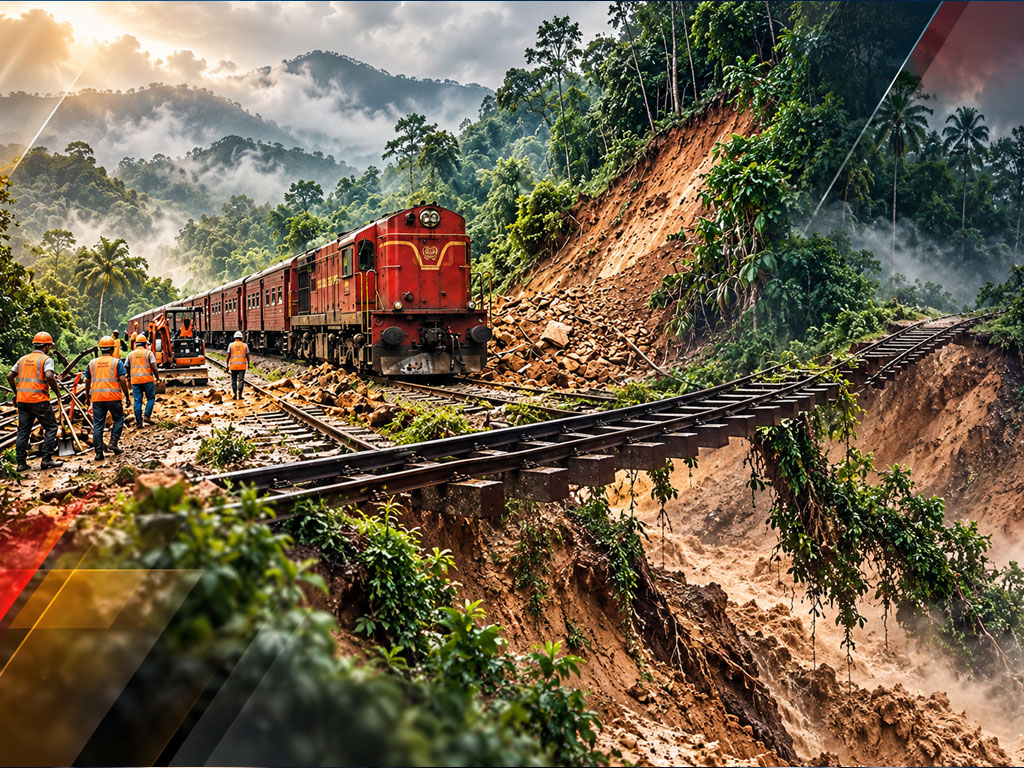
COLOMBO — Repeated slope failures following the restoration of the Upcountry railway line have highlighted the need for geotechnical assessments, drainage inspections and clear safety criteria before passenger services resume.
The renewed suspension of train services between Rambukkana, Peradeniya and Gampola following landslide activity near Kadigamuwa has highlighted a critical engineering concern: whether restoring damaged railway tracks is sufficient to guarantee passenger safety when the surrounding terrain remains vulnerable to collapse.
Sri Lanka Railways suspended services on the affected section from midnight on October 25, 2026, after continued heavy rainfall caused soil to wash onto the tracks near Kadigamuwa Railway Station.
The decision followed emergency repairs carried out on October 24 and 25. Although work had been undertaken to clear the obstruction, railway authorities warned that further earth slips remained possible because of persistent rainfall.
The latest disruption occurred just over three weeks after the affected section reopened on October 2 following extensive damage caused by Cyclone Ditwah in late 2025.
A passenger train derailed near Kadigamuwa on October 5 after striking fallen soil and rocks, raising concerns about the vulnerability of the restored line.
These incidents underline the distinction between repairing visible railway damage and establishing that the surrounding slopes, foundations and drainage systems are sufficiently stable to support continued operations.

Emergency Suspension Near Kadigamuwa
The Railway Department initially announced the suspension of services between Rambukkana, Peradeniya and Gampola for October 24 and 25 to facilitate emergency repairs near Kadigamuwa.
Heavy rainfall had caused soil to move onto the tracks, creating a hazard to trains travelling through the section.
Despite the repair work, the authorities subsequently extended the suspension indefinitely from midnight on October 25 because the risk of further landslides remained high.
Passengers holding reserved tickets for cancelled services were informed that they could obtain full refunds from railway stations.
The suspension inevitably affected commuters, travellers and businesses dependent on the route. Alternative transport arrangements also impose additional costs and delays.
Nevertheless, temporarily closing a railway section when its safety cannot be assured is a necessary precaution, particularly where trains travel alongside steep embankments and mountain cuttings.
The more important question is what engineering evidence should be required before the line is reopened.
October 5 Derailment Exposed Continuing Risks
The latest landslide activity follows an earlier accident on October 5, when a passenger train travelling from Peradeniya Junction to Colombo Fort struck a mound of earth and rocks that had fallen onto the tracks.
The derailment occurred in the section between Gangoda, Kadigamuwa and Ihala Kotte railway stations at approximately 4.35 a.m.
The locomotive and one carriage reportedly left the rails, while the front section of the train sustained damage.
No passenger injuries were reported.
The train was operating shortly after the restored section reopened on October 2 following a prolonged suspension caused by Cyclone Ditwah.
Services were temporarily interrupted while railway personnel cleared the obstruction and completed re-railing work.
Although train operations subsequently resumed, the incident demonstrated how quickly conditions can change along a railway exposed to unstable slopes.
An unobstructed track during one inspection does not necessarily establish that nearby soil and rock formations will remain secure during subsequent rainfall.
The question is not simply whether the debris can be removed, but whether the conditions that caused it to fall have been adequately assessed.
Cyclone Ditwah Damaged 103 Locations
The Upcountry railway has faced substantial engineering challenges since Cyclone Ditwah caused widespread damage in late 2025.
According to figures released during the restoration programme, 103 locations between Rambukkana and Gampola were affected.
The damage included:
- 36 major landslides.
- 67 incidents involving earth slips, slope failures and railway washouts.
Repair operations continued over several months before regular passenger services between Colombo Fort, Peradeniya and Gampola were restored on October 2.
At the time, the Government reported that approximately 75% of the Upcountry railway system had become operational.
However, services between Peradeniya and Kandy remained suspended because restoration work on the Peradeniya Black Bridge had not been completed.
Other sections of the hill-country network were also undergoing repairs.
The subsequent derailment on October 5 and the renewed landslides near Kadigamuwa demonstrate the difficulty of restoring railway operations in terrain that has experienced extensive ground disturbance.
These incidents do not, by themselves, establish that the earlier engineering repairs were defective or that reopening the line was an improper decision.
They do, however, justify examining whether the restoration programme adequately considered the potential for renewed slope movement during heavy rainfall.
Why Railway Tracks Can Be Repaired While Slopes Remain Unsafe
Railway restoration following a landslide ordinarily begins with removing fallen earth and rocks, inspecting the tracks and repairing damaged infrastructure.
Rails and sleepers can be repositioned, ballast replaced and the railway formation restored to its required alignment.
Such work is essential but does not necessarily resolve instability in adjacent slopes.
In mountainous terrain, rainfall can penetrate the ground and increase the water pressure within soil and fractured rock formations.
As pore-water pressure rises, the effective strength of the ground may decrease, making slopes more susceptible to movement.
The process can become particularly dangerous where drainage channels are blocked, retaining structures have been damaged or the base of a slope has weakened.
Mountain cuttings create additional engineering challenges because excavation changes the natural support of the surrounding ground.
Rock layers, soil composition, drainage patterns and the angle of a slope all influence its stability.
In some circumstances, a relatively small amount of visible debris may indicate a larger area of unstable material above or beneath the track.
Restoring rails to their original position may therefore address the immediate obstruction without eliminating the conditions that caused the landslide.
For safe railway operation, engineers must consider not only the track itself but also the ground supporting it and the terrain surrounding it.
Geotechnical Assessments Must Extend Beyond Surface Repairs
A comprehensive safety assessment of landslide-prone railway sections should examine several interconnected elements.
These include the condition of the ballast, embankments, track foundations, slope-support structures and drainage systems.
Engineers may also need to investigate cracks in the terrain, groundwater accumulation, changes in slope geometry and signs of gradual ground movement.
Where conditions warrant it, instruments capable of monitoring ground displacement and groundwater pressure can provide information that cannot be obtained through visual inspection alone.
Slope-stability calculations can then help determine whether protective measures are necessary.
Depending on the site, such measures could include improved drainage, retaining structures, reinforced slopes, rockfall protection or continued monitoring.
The appropriate engineering response cannot be determined without examining the specific conditions at each location.
At Kadigamuwa, repeated soil movement makes the condition of the surrounding terrain particularly important.
A technical assessment should establish whether the latest failures are isolated events or symptoms of a wider zone of instability requiring longer-term intervention.
NBRI Investigates Recurring Kadigamuwa Landslides
The National Building Research Institute (NBRI), formerly the National Building Research Organisation, has an important role in landslide-risk assessment and geotechnical investigations in Sri Lanka.
On October 16, NBRI Senior Scientist Wasantha Senadheera confirmed that the institution had launched an investigation into renewed slope failures near Kadigamuwa.
He explained that slopes destabilised by Cyclone Ditwah could become active again when exposed to further rainfall.
NBRI had provided designs for reconstructing railway sections damaged during the cyclone, and those sections had subsequently been restored.
However, the institution cautioned that completing reconstruction did not guarantee that further slope movement would not occur.
The investigation was intended to identify possible long-term measures to reduce recurring landslide risks.
This provides important context for the debate over railway safety.
The fact that a repaired section experiences another landslide does not necessarily mean the engineering work was incorrectly designed or executed.
Slope instability can persist after major weather events, particularly where the ground has undergone significant disturbance.
The findings of NBRI’s investigation, together with assessments by railway engineers, will therefore be important in determining the measures required before operations can safely resume.
The final conclusions and site-specific recommendations from that investigation have not been independently established for this article.
Weather Warnings Alone Cannot Guarantee Track Safety
Effective risk management also requires coordination between the Department of Railways, NBRI and the Department of Meteorology.
Weather forecasts can identify periods of heavy rainfall, while landslide warnings provide information about broader regional risks.
Neither system, however, should be treated as a substitute for inspecting vulnerable railway slopes.
Groundwater pressure may remain elevated even after rainfall temporarily subsides.
Similarly, the absence of a general landslide warning does not establish that every slope along a railway alignment is stable.
A more comprehensive approach combines meteorological information, geotechnical assessments, historical incident records and direct inspections.
During periods of sustained rainfall, railway authorities may need to increase monitoring, restrict train movements or suspend services where conditions become unsafe.
Reopening decisions should be based on documented criteria appropriate to the risk at each location.
Such recommendations do not imply that railway officials are currently ignoring these responsibilities.
Rather, the recurring disruptions demonstrate the importance of clear and consistently applied procedures, supported by appropriate technical evidence.
Public Safety Must Take Priority Over Political Celebrations
The Upcountry railway is more than a transport corridor.
It is an important part of Sri Lanka’s engineering heritage, connecting communities, supporting economic activity and contributing to the country’s tourism industry.
Restoring services after prolonged disruption is therefore a substantial achievement for railway engineers and the institutions responsible for reconstruction.
However, reopening a line should not be treated primarily as a political accomplishment if questions remain about the long-term stability of the surrounding terrain.
Ceremonies, public celebrations and the restoration of published timetables cannot replace technical safety assessments.
Passengers have a legitimate interest in understanding how damaged sections were repaired and what inspections were conducted before services resumed.
Publicly available explanations of geotechnical findings, drainage improvements, remaining risks and monitoring arrangements would strengthen confidence in the restoration programme.
Such transparency would also help distinguish unavoidable weather-related incidents from deficiencies that could be addressed through engineering intervention.
The October 5 derailment and subsequent Kadigamuwa landslides do not establish that all restoration work was inadequate.
They do, however, reinforce the need for continued assessment in areas where the ground remains vulnerable.
Passenger Lives Must Come Before Railway Timetables
The decision to suspend services near Kadigamuwa should therefore be viewed as more than a temporary transport disruption.
It highlights the long-term challenge of operating railway infrastructure through mountainous terrain exposed to prolonged rainfall and recurring landslides.
Before services resume, railway authorities must be satisfied that the repaired track and its supporting ground can withstand the expected operating conditions.
Where necessary, that assessment should incorporate specialist geotechnical advice, monitoring information and recommendations from institutions such as NBRI.
Clear communication about those findings would give passengers greater assurance that decisions are being made on engineering grounds rather than political or operational pressure.
Restoring a railway timetable may relieve the immediate inconvenience faced by commuters, but the consequences of reopening an unsafe section could be far more serious.
Ultimately, railway safety depends on more than the alignment of two steel rails. The ground beneath them, the slopes beside them and the systems that control water movement must also remain stable.
Passengers may lose time when a train is delayed. That inconvenience cannot outweigh the responsibility to prevent an avoidable accident.