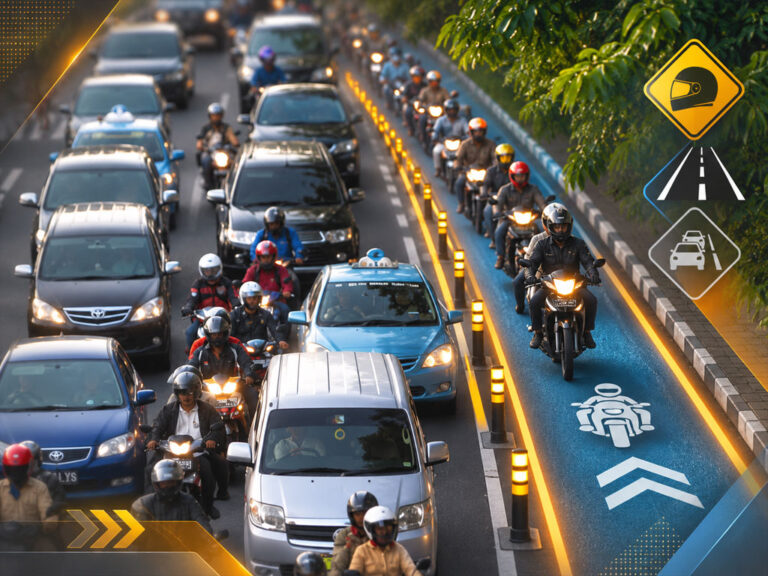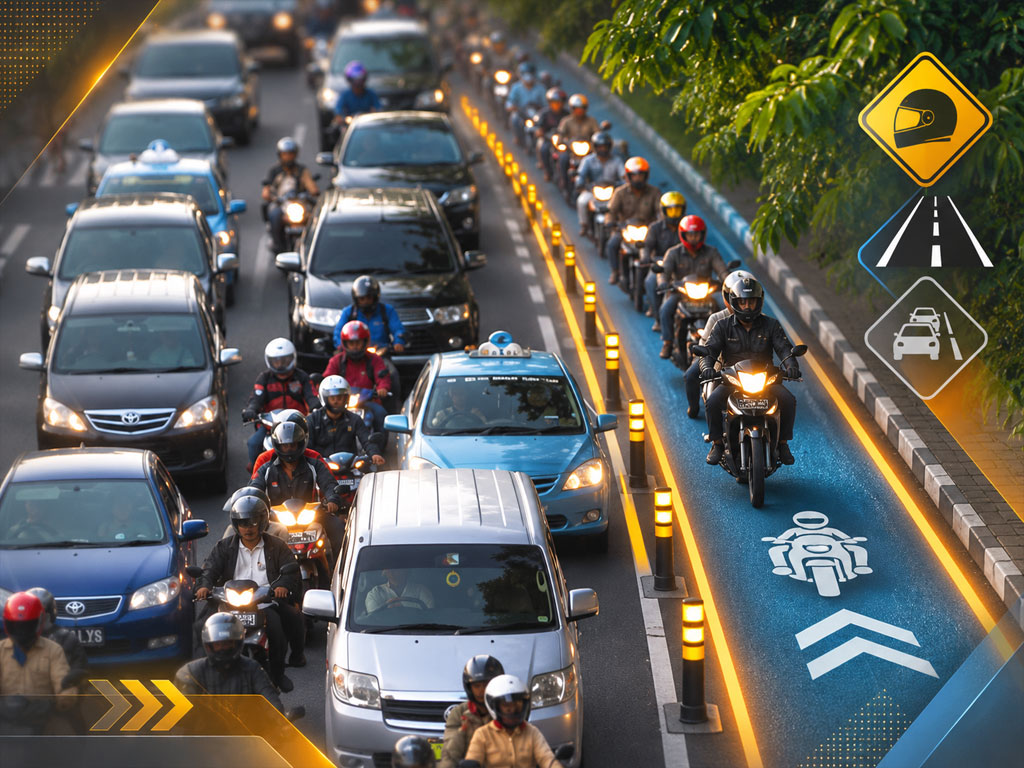
COLOMBO, November 21, 2026 — Sri Lanka motorcycle lanes could improve rider safety under a proposal by Minister Bimal Ratnayake. However, limited road space, congestion and enforcement challenges raise concerns over whether the system can work without worsening traffic.
Minister of Transport, Highways and Urban Development Bimal Ratnayake has proposed reserving approximately two metres of road space for motorcyclists, drawing on Malaysia’s experience of separating motorcycles from heavier vehicles.
The initiative is intended to reduce the risks faced by riders travelling alongside buses, lorries and other vehicles, particularly on roads where mixed traffic and unsafe overtaking contribute to serious accidents.
Sri Lanka’s motorcycle fatalities remain a major public safety concern. Motorcyclists account for the largest category of road deaths, making effective interventions an urgent national priority.
The Minister’s willingness to explore alternative traffic management systems represents a potentially valuable step towards improving road safety.
However, introducing motorcycle lanes across the existing road network presents considerable engineering, operational and enforcement challenges that require careful assessment before wider implementation.

Malaysia’s Motorcycle Lane Success and Sri Lanka’s Road Conditions
The proposal draws on Malaysia’s experience with dedicated motorcycle infrastructure, where physical separation from general traffic has delivered measurable safety improvements.
A Malaysian road safety study reported a 74% reduction in motorcyclist fatalities associated with exclusive motorcycle lanes, highlighting the potential benefits of separating vulnerable riders from heavier and faster-moving vehicles.
These findings provide an encouraging basis for examining similar arrangements in Sri Lanka.
However, Malaysia’s dedicated motorcycle infrastructure includes physically separated routes and purpose-built facilities that differ substantially from simply marking additional lanes on existing roads.
The distinction is particularly important because many of Sri Lanka’s roads were not designed to accommodate separate streams of motorcycle and general traffic.
Roads that already struggle to accommodate buses, lorries and other vehicles may not have sufficient space to introduce dedicated motorcycle lanes without reducing the width available to existing traffic.
A successful Malaysian model therefore cannot automatically be expected to produce identical results under different road conditions.
The effectiveness of any Sri Lankan system will depend on the design of the lanes, traffic volumes, road widths, junction arrangements and the behaviour of road users.
Narrow Roads Could Create New Congestion Problems
One of the most significant concerns is the limited width of Sri Lanka’s existing road network.
If approximately two metres were reserved on each side of a conventional two-way road, a total of four metres would be allocated to motorcycle traffic.
Unless the road were widened, this would reduce the space available to buses, lorries, cars and other vehicles.
On roads where heavy vehicles already occupy much of the available carriageway, the introduction of additional lane restrictions could create bottlenecks and increase delays.
The possibility of more severe congestion cannot be dismissed, although the extent of any increase would need to be established through traffic modelling rather than assumed in advance.
Overtaking and Head-On Collision Risks
Narrower general traffic lanes could also create additional hazards when vehicles attempt to overtake buses, lorries or slower-moving traffic.
Where adequate passing space is unavailable, drivers may be tempted to cross into opposing traffic or undertake dangerous manoeuvres.
Such behaviour could introduce new collision risks even while the dedicated motorcycle lanes reduce certain dangers faced by riders.
Physical barriers could improve separation, but they would also require sufficient space for turning movements, access to adjoining properties and emergency vehicle passage.
The design must therefore consider the safety of every road user rather than motorcyclists alone.
Rural Roads Present a Different Engineering Challenge
Ratnayake has acknowledged that introducing dedicated motorcycle lanes would be difficult in heavily congested urban areas, including Colombo.
The government’s approach has consequently placed greater emphasis on roads outside major cities, where suitable space may be available.
However, the distinction between urban and rural roads requires careful definition.
Many rural roads are narrower than the principal roads serving major cities. In some locations, two buses already struggle to pass safely.
Introducing a dedicated motorcycle lane on such roads without additional construction could prove impractical.
If the intended locations are wider interprovincial highways and selected A- and B-class roads outside urban centres, those criteria should be clearly established.
A programme based on available road width and existing traffic conditions would be more practical than applying a uniform design to every road classified as rural.
Roadside Parking, Pedestrians and Junctions Complicate the Plan
The challenges extend beyond the width of the carriageway.
On many rural and semi-urban roads, pedestrians walk along road edges because proper pavements are unavailable.
Cyclists, three-wheelers and vehicles stopping or parking beside the road also occupy space that might otherwise be designated for motorcycle traffic.
These conditions could undermine the safety benefits of dedicated lanes unless suitable arrangements are introduced for other road users.
Junctions and turning points present another important challenge.
Motorcyclists must be able to enter and leave dedicated lanes safely when turning into side roads, accessing properties or avoiding stationary vehicles.
Poorly designed entry and exit points could create conflict between motorcycles and vehicles crossing their paths.
The government must also determine how lane restrictions would apply to three-wheelers, bicycles and emergency vehicles, particularly where road conditions leave little room for manoeuvring.
Clear regulations, appropriate road markings and carefully designed junctions will be essential.
Enforcement Cannot Depend on Road Markings Alone
Another major challenge concerns compliance with traffic regulations.
The proposed system would require motorcyclists to remain within their designated lanes while preventing other vehicles from entering those spaces.
Such restrictions could be difficult to enforce consistently without physical separation, effective monitoring and appropriate penalties.
Sri Lanka’s previous experience with bus priority lanes demonstrates the practical difficulties of maintaining lane discipline where different categories of vehicles share limited road space.
Painted lines alone cannot guarantee compliance.
At the same time, physical barriers may not be suitable for every location, particularly where roads contain frequent junctions, roadside businesses and access points.
Enforcement must therefore be considered alongside engineering design rather than introduced as an afterthought.
A successful system would require cooperation among traffic police, road development authorities, transport planners and road users.
Feasibility Study Essential Before Wider Implementation
The government’s effort to identify new ways of reducing motorcycle fatalities deserves serious consideration.
Sri Lanka cannot afford to ignore road safety interventions that have demonstrated positive results internationally, particularly when motorcycle accidents continue to claim large numbers of lives.
However, policies intended to improve safety must be designed around the conditions in which they will operate.
Before introducing dedicated motorcycle lanes across the country, a comprehensive feasibility study should examine the suitability of different road categories, the availability of space and the potential effects on existing traffic.
Traffic engineers and road safety specialists should evaluate whether the proposed lane widths can be accommodated without compromising the safe movement of other vehicles.
A carefully monitored pilot project on selected wider roads would provide an opportunity to test the proposal under actual Sri Lankan conditions.
Such a programme should assess:
- Changes in motorcycle accidents, fatalities and serious injuries.
- Effects on congestion, travel times and traffic flow.
- Compliance with motorcycle lane restrictions.
- Safety at junctions, turning points and roadside access areas.
- Interactions with pedestrians, cyclists and three-wheelers.
- The practicality of physical barriers and other separation measures.
- Construction, maintenance and enforcement costs.
The findings would help determine whether the system should be expanded, modified or restricted to particular types of roads.
Ratnayake’s proposal could become an important improvement in Sri Lanka’s road safety arrangements if implemented through sound engineering, proper planning and reliable enforcement.
Yet the success of the initiative will depend not simply on allocating two metres of road space to motorcyclists, but on demonstrating that the resulting road layout is safer and more efficient for everyone.
A properly designed pilot, followed by an independent assessment of its results, offers the most practical route towards establishing whether dedicated motorcycle lanes can deliver the safety improvements Sri Lanka urgently needs.