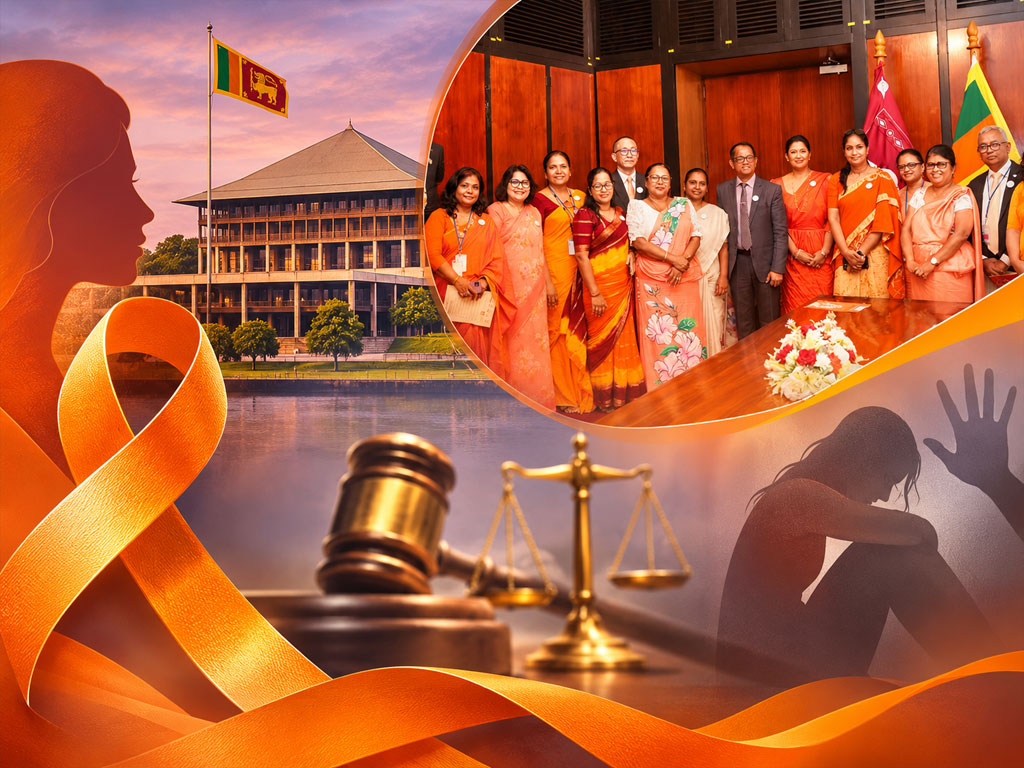
COLOMBO, Sri Lanka, November 26, 2026 — Sri Lanka’s Parliament turned orange on November 25 as lawmakers and parliamentary staff joined the global 16 Days of Activism Against Gender-Based Violence campaign. While the display demonstrated political solidarity, it also invites a more difficult examination of whether public awareness campaigns are being matched by the legal, economic and institutional reforms needed to protect women and girls.
Parliament Turns Orange, but Will Women See Real Justice?
On November 25, Sri Lanka’s Parliament presented an unusual spectacle. Members of Parliament from both the government and opposition, together with parliamentary staff, wore orange or orange-themed clothing in support of the global 16 Days of Activism Against Gender-Based Violence campaign.
The initiative, organised by the Women Parliamentarians’ Caucus with the support of the United Nations Population Fund (UNFPA), included awareness activities and public messages highlighting women’s rights and protection from violence.
Sri Lanka’s campaign was promoted under the theme “This Is My Right”, alongside the national #JusticeIsMyRight initiative.
At first glance, the demonstration appeared to represent a progressive and compassionate political response to one of the country’s most persistent social problems.
Yet behind the carefully coordinated colours and public declarations lies a question that deserves considerably greater attention: can symbolic expressions of solidarity genuinely challenge gender-based violence when the structures that enable it remain largely unchanged?
There is little reason to believe that parliamentarians or the public genuinely expect violence against women to end because legislators wear orange clothing, promote hashtags or participate in awareness programmes.
That is precisely what makes the symbolism worthy of examination.
The concern is not that awareness campaigns are inherently meaningless. Public education can challenge harmful attitudes, encourage reporting and draw attention to neglected injustices.
Rather, the danger emerges when visible participation in such campaigns becomes a substitute for the more demanding work of changing institutions, enforcing laws and confronting entrenched inequalities.

When Political Symbolism Becomes a Substitute for Action
Modern political ideology does not necessarily depend on persuading people to believe something demonstrably false.
It can also operate through public rituals that allow institutions and individuals to feel they have fulfilled their responsibilities without substantially changing their behaviour.
By wearing a particular colour, sharing a campaign slogan or participating in a public ceremony, political leaders may acquire the appearance of moral engagement while avoiding the uncomfortable decisions required to address the underlying problem.
The phenomenon resembles the recorded laughter heard in television comedy programmes. The laughter provides an emotional response on behalf of the audience, creating an impression of amusement even when viewers themselves remain unmoved.
Similarly, political symbolism can perform the appearance of resistance on behalf of institutions that have yet to undertake meaningful reform.
In this interpretation, orange clothing becomes an external expression of political conscience. The institution appears to have taken a stand against violence, even if its legislative priorities, budgetary decisions and administrative practices remain unchanged.
Such criticism does not establish that the organisers intended to deceive the public or deliberately avoid reform. It identifies a risk inherent in political communication: the ease with which a visible gesture can be mistaken for measurable progress.
What matters is whether the gesture creates pressure for substantive change or merely provides reassurance that something is being done.
The Rise of Activism Without Structural Change
Modern consumer capitalism has developed a remarkable ability to remove the uncomfortable elements from products while preserving their appeal.
Coffee without caffeine, soft drinks without sugar and beer without alcohol illustrate how experiences can be repackaged to retain their familiar appearance while removing a defining characteristic.
Political activism can undergo a comparable transformation.
Campaigns may retain the language of resistance, justice and transformation while avoiding direct confrontation with the institutions and economic arrangements responsible for sustaining inequality.
The result is a form of activism that communicates concern without necessarily disturbing existing power relationships.
International campaigns, awareness days, colour codes, slogans and social media initiatives can become particularly attractive to political institutions because they offer highly visible participation at relatively little political cost.
Photographs circulate, speeches are delivered and public statements are issued. The institution appears active, compassionate and responsive.
Yet activity should not be confused with achievement.
The appropriate measure of a campaign is not how many legislators wore orange, how many photographs circulated online or how frequently a hashtag appeared.
It is whether the initiative contributes to improvements in reporting mechanisms, access to justice, survivor protection, institutional accountability and the prevention of violence.
Without those outcomes, political symbolism risks absorbing public pressure rather than converting it into reform.
Gender-Based Violence Extends Beyond Physical Assault
One of the limitations of narrowly designed awareness campaigns is their tendency to concentrate on direct, visible acts of violence committed by one individual against another.
Within that framework, gender-based violence becomes primarily a question of personal attitudes, individual conduct and insufficient awareness.
Public education is undoubtedly important. Challenging harmful beliefs and encouraging respectful behaviour can contribute to prevention.
But violence against women cannot be understood exclusively as a failure of individual morality.
Its causes and consequences also extend into economic dependence, unequal employment conditions, institutional discrimination, restricted access to justice and the distribution of political and social power.
Consider the circumstances of rural women trapped in cycles of microfinance debt, facing financial pressure and limited opportunities to escape exploitative arrangements.
Their vulnerability cannot necessarily be resolved by a public awareness recording or an annual campaign.
Women employed in garment factories and the plantation sector may confront low wages, insecure employment and economic pressures that restrict their ability to challenge harassment or exploitation.
Within households, substantial unpaid domestic and caregiving responsibilities can reinforce financial dependence, making it more difficult for women experiencing abuse to leave unsafe relationships.
These conditions are not all instances of gender-based violence in themselves. Nevertheless, they can create or intensify vulnerabilities that make violence more difficult to report, resist or escape.
A credible national strategy must therefore address not only individual behaviour but also the economic and institutional circumstances that influence women’s safety and independence.
Justice Delayed and the Responsibility of the State
Perhaps the most serious contradiction arises when institutions responsible for making and enforcing laws participate in campaigns advocating justice while significant weaknesses remain in the systems through which victims seek protection.
For a woman experiencing abuse, the decisive question is rarely whether Parliament has publicly acknowledged her suffering.
It is whether she can safely report an offence, receive an appropriate response from the police, obtain necessary protection and pursue justice without intimidation or unreasonable delay.
A woman who struggles to have her complaint properly recorded at a police station may find little reassurance in photographs of politicians participating in an awareness campaign.
Likewise, a survivor whose case remains unresolved for years requires functioning investigative and judicial institutions rather than symbolic expressions of sympathy.
Concerns about political influence, institutional failures and unequal access to legal remedies cannot be overcome through public declarations alone.
These are responsibilities belonging directly to the state.
Parliament determines legislation, approves public expenditure and exercises oversight over public institutions. Its members therefore possess opportunities to influence the very systems through which meaningful protection must be delivered.
That responsibility extends to adequate resources for investigative services, survivor support, legal assistance, shelters, prevention programmes and mechanisms capable of holding public officials accountable.
If lawmakers genuinely regard protection from gender-based violence as a national priority, their commitment should be visible in the decisions they make throughout the year.
Who Is the Real Audience for Political Awareness Campaigns?
Another question concerns the intended audience of highly visible political gestures.
International organisations, development partners, civil society institutions, journalists and social media audiences all pay attention to a country’s public commitment to human rights and gender equality.
That international scrutiny can be constructive. It can encourage reform, mobilise assistance and strengthen accountability.
Nevertheless, there is a danger that the presentation of progress becomes more important than progress itself.
A carefully organised parliamentary campaign can produce images of a modern, compassionate and politically united democracy.
Such images may strengthen institutional credibility, but they do not independently demonstrate that women and girls experience greater protection in their everyday lives.
The distinction matters.
International recognition should follow measurable improvements in the treatment of women and girls rather than serve as a substitute for them.
Nor should political institutions assume that the existence of public campaigns automatically demonstrates their effectiveness.
Meaningful accountability requires evidence of implementation, transparent reporting and independent scrutiny.
It requires asking what changed after the photographs were taken and the campaign activities concluded.
Sixteen Days of Awareness Must Lead to 365 Days of Accountability
The 16 Days of Activism Against Gender-Based Violence campaign runs from November 25, the International Day for the Elimination of Violence Against Women, to December 10, Human Rights Day.
Its international significance should not be dismissed. The campaign has provided a platform for survivors, advocates and institutions to bring attention to violence that has too often remained hidden.
The criticism, therefore, is not directed at the principle of collective activism.
It is directed at the possibility that institutions may embrace the most visible and politically convenient elements of activism while postponing the difficult reforms that would make it effective.
Real progress is not always attractive to television cameras.
It often involves confronting institutional resistance, reviewing inadequate legislation, allocating scarce public resources, investigating official misconduct and challenging the economic structures that leave vulnerable people without meaningful choices.
Such work is demanding, politically uncomfortable and rarely completed within the boundaries of an annual campaign.
But it is precisely this work that distinguishes genuine institutional commitment from public relations.
Sri Lanka’s Parliament should be judged not by whether its members wear orange during a particular week, but by whether their legislative, budgetary and oversight decisions improve protection for women and girls throughout the year.
The government and opposition share that responsibility.
Their political differences should not prevent cooperation on measures that improve access to justice, strengthen survivor protection and address the economic vulnerabilities that contribute to abuse.
Orange clothing can communicate solidarity. Awareness campaigns can encourage public discussion. Neither should be regarded as inherently worthless.
But neither can replace institutional accountability.
When the 16-day campaign concludes on December 10, the country’s laws, economic inequalities, social conditions and institutional weaknesses will remain.
The true measure of Parliament’s commitment will be what its members do about those problems after the campaign ends.
If political institutions continue to celebrate the appearance of reform without demonstrating its substance, the country risks repeating the same ritual year after year: changing the colour of the chamber while leaving the conditions that enable violence largely untouched.
Justice for women and girls must ultimately be measured by protection, accountability and meaningful change, not by the colour of Parliament’s clothing.