By Roshan Jayasinghe
A word can linger in us like an echo, shaping how we see the world long after it was spoken.
So it is with karma, reflection, and forgiveness, not distant ideas belonging only to sacred texts, but living movements that unfold in our everyday lives. If we pause long enough, we may notice that these words are not heavy doctrines but simple invitations to see how energy flows, how patterns form, and how freedom arrives when we let go.
When we hear the word karma, many of us imagine a hidden scale of justice, an invisible judge tallying our actions, rewarding the good and punishing the bad. It’s an image passed down in stories, religions, and culture, and for many it feels both comforting and threatening at once.
But pause for a moment. Is life really keeping score? Or is karma something far less fixed, and far more fluid , not a moral accounting system, but a flow of energy moving in its natural way?

Karma as Motion, Not Judgment
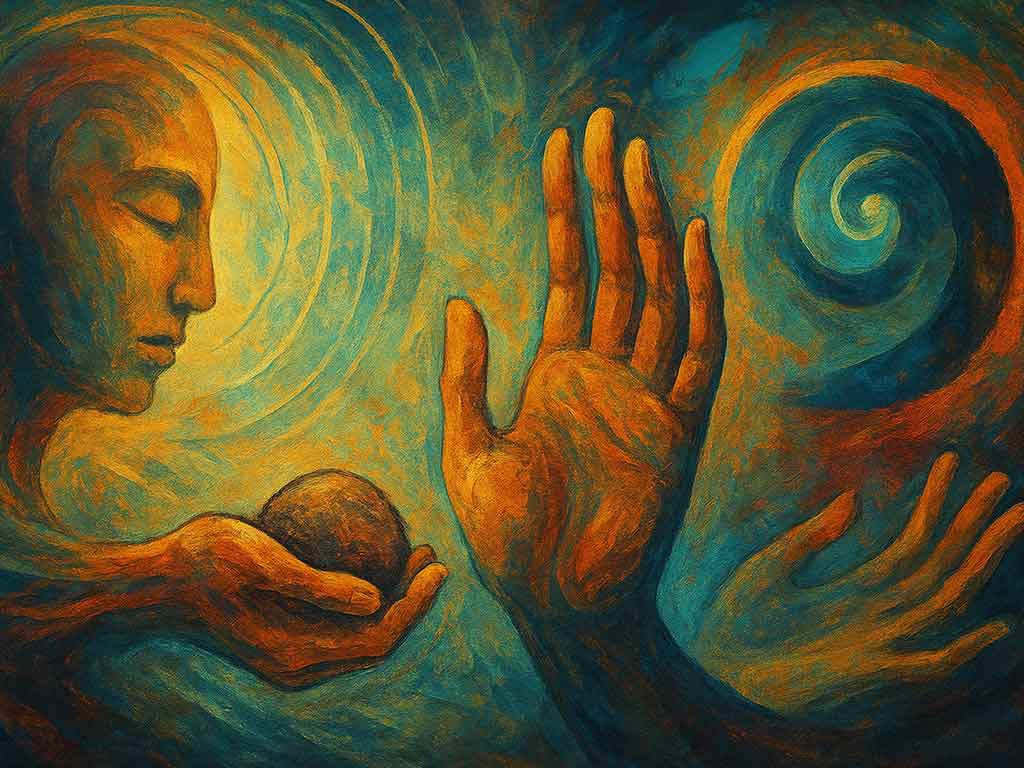
Think of a stone dropped into still water. The ripples spread outward, not because the water is punishing the stone, but simply because that is how water responds. In the same way, every thought, word, or action ripples into life. Karma may not be a divine verdict; it may simply be the echo of what we set in motion.
You’ve likely seen this in your own life. A kind word offered in passing has a way of returning to you in unexpected warmth. A harsh word spoken in haste can echo back long after the moment has passed. Karma, then, is not waiting in some distant future to judge us, it is already present, woven into the currents we ourselves create.
What if karma is not punishment or reward at all, but participation?
Reflection: Seeing Without Condemning
To reflect is not to sit in guilt, nor to endlessly replay what went wrong. Reflection is simply to pause, to notice the ripples, and to ask: What am I carrying that shapes the way life moves around me?
Regret freezes us in the past; reflection frees us in the present. When we reflect, we begin to see the subtle loops, how anger stirs more anger, how fear narrows our world, how generosity seems to multiply itself.
Take a moment here. Look at your own life: where have you seen patterns repeat? Are there echoes you recognize, not as fate, but as the natural rhythm of what you have been holding inside?
Forgiveness: The Release of the Stone
If karma is motion and reflection is recognition, forgiveness is release. Forgiveness is not about forgetting or excusing. It is about no longer clutching the stone in your hand.
When we hold on, we keep disturbing the water long after the initial drop. Forgiveness allows the ripples to settle. It doesn’t erase what happened, but it frees us from carrying its weight forward.
Ask yourself: What stones am I still holding? Who or what continues to live rent-free in my thoughts? When you let go, even slightly, you may notice a surprising lightness. That is forgiveness, not a gift to the other, but a gift to yourself.
Imagine setting down a heavy stone by the riverbank. You feel the release in your hand, but more than that, you notice how still the water becomes once you stop disturbing it. The stillness isn’t something you created, it was always there, waiting.
Forgiveness lives in that same stillness. It does not demand that we undo the past; it simply invites us to stop carrying it into the present.
The Infinite Invitation
Perhaps this is the quiet truth of karma: it isn’t a fixed rulebook waiting to trap us, but a living invitation to become more conscious of the energy we release into the world.
Reflection lets us notice. Forgiveness lets us soften. And together they remind us that life is not tallying points against us; it is simply showing us, again and again, the ripples of what we carry.
If nothing is certain, if everything is still unfolding, then karma is less a sentence and more a mirror. A mirror that asks: What will you choose to release, and what new ripples might you set in motion today
Editor’s Note
This essay continues Roshan Jayasinghe’s series of reflections on consciousness, thought, and the subtle patterns that shape human life. Here, he approaches karma not as moral judgment, but as energy in motion offering readers an invitation to reflect, release, and rediscover stillness.
About the Author
Roshan Jayasinghe writes about consciousness, nature, and the unfolding of human experience. His reflections invite readers to pause, question, and return to the quiet clarity within. He contributes regularly to Morning Telegraph.