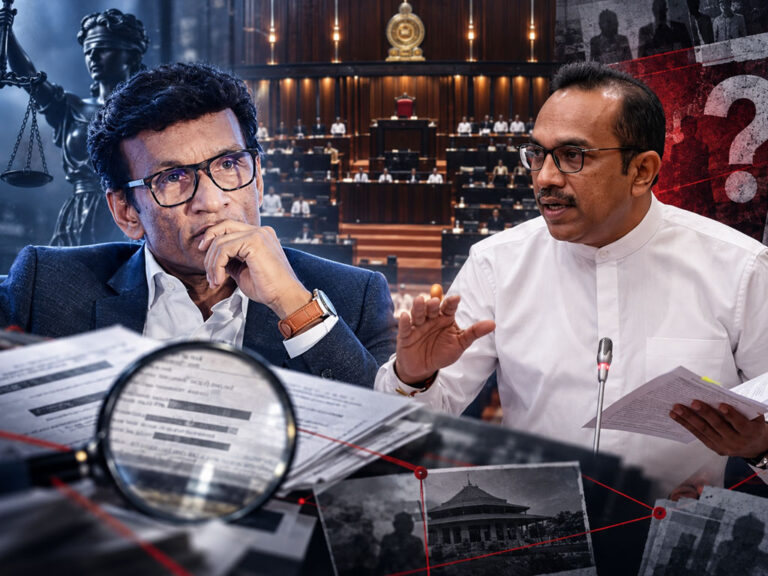
The freedom to challenge judicial decisions is not only a constitutional safeguard but a moral responsibility, ensuring courts remain transparent, accountable, and true to democratic ideals.
Power failures in a courtroom cannot be brushed aside as coincidence, particularly during proceedings involving a former head of state. When an accused is forced to endure health complications because of such failures, it raises suspicions of deliberate harm. This represents a grave violation of fundamental rights, including the right to health. It could also serve as a tactical delay to prolong hearings and appease hidden vendettas. Perhaps, too, it reflects the grudge of a single individual clinging to resentment from past political slights. Such possibilities reduce the solemnity of justice to the whims of ego and pride.
But the central question remains: do citizens possess the right to openly criticize judicial decisions? Which principles and precedents affirm this right, and why do some insecure political voices attempt to deny it? Why should individuals lacking both moral authority and dignity warn the public against critiquing judgments? Are we drifting toward a surveillance-style state where truth is silenced under the pretext of “respecting the judiciary”?

The people’s prerogative to engage with judicial determinations is firmly rooted in the democratic principle of free expression. Both Article 19(1)(a) of the Indian Constitution and the U.S. First Amendment protect the right to discuss, debate, and scrutinize government institutions, including the judiciary. Justice P.N. Bhagwati, in the landmark case S.P. Gupta v. Union of India (1981), declared that “public discussion on the functioning of judges and the judiciary is permissible, provided it does not scandalize the court or obstruct the administration of justice.” His words stress the fine balance between safeguarding judicial dignity and enabling civic critique.
For decades, judicial visionaries have insisted that criticism is the heartbeat of accountability. Justice V.R. Krishna Iyer observed that open debate on judgments reinforces the rule of law and keeps justice responsive to society’s needs. Justice H.R. Khanna, in his legendary Emergency-era dissent, warned that “there can be no greater indication of the decay in the rule of law than a docile Bar, a subservient judiciary and a society with a choked or coarsened conscience.” The lesson is stark: independence of the judiciary cannot mean insulation from reasoned scrutiny.
British jurist A.V. Dicey argued that the rule of law itself demands that the judiciary remain answerable to the citizenry. Constructive critique, he maintained, is not only permissible but vital as a check against judicial errors and institutional capture. Lord Denning echoed this, stating that criticism should focus on reasoning within judgments, not the personal character of judges, thereby preserving both dignity and transparency.
In In Re: Arundhati Roy (2002), the Indian Supreme Court reaffirmed that “constructive criticism of judicial decisions is a part of democratic discourse. Criticism intended to vilify or scandalize the court is impermissible.” This distinction ensures that critique is driven not by contempt but by a duty to preserve judicial integrity.
Similarly, in Pennekamp v. Florida (1946), the U.S. Supreme Court ruled that newspapers are constitutionally entitled to critique judicial decisions, as long as such commentary does not obstruct justice. Justice William Brennan later articulated that “the right to criticize government, including the judiciary, is the very essence of the First Amendment,” cementing public discourse as central to democracy.
Despite these protections, political actors often attempt to muzzle dissent. By threatening contempt charges or issuing injunctions against discussion, they monopolize the narrative and insulate judicial actions from scrutiny. Such moves are rarely about protecting justice, they are driven by ego, expedience, and political gain. It is precisely in such times that citizens must reaffirm their right, recognizing that factual, constructive criticism is not rebellion but an anchor of the rule of law.
Criticism of judicial decisions is not about hostility; it is about clarity. It identifies flaws, exposes interpretative errors, and strengthens accountability. As Justices Bhagwati and Krishna Iyer emphasized, the aim is not to scandalize the judiciary but to ensure that legal reasoning withstands the informed gaze of society. Engagement through academia, journalism, and civic debate elevates confidence in justice and reinforces its legitimacy.
Ultimately, the citizen’s right to critique judicial decisions is both a moral necessity and a democratic entitlement. Legal precedent, jurisprudence, and judicial commentary all affirm that while independence shields the judiciary, it does not place it beyond accountability. Citizens must, therefore, exercise this right with reason and responsibility, ensuring that justice remains transparent and aligned with democratic values. The alternative—a culture of fear, silence, or blind deference, ushers in authoritarian decay, eroding the very foundations of a free and just society.