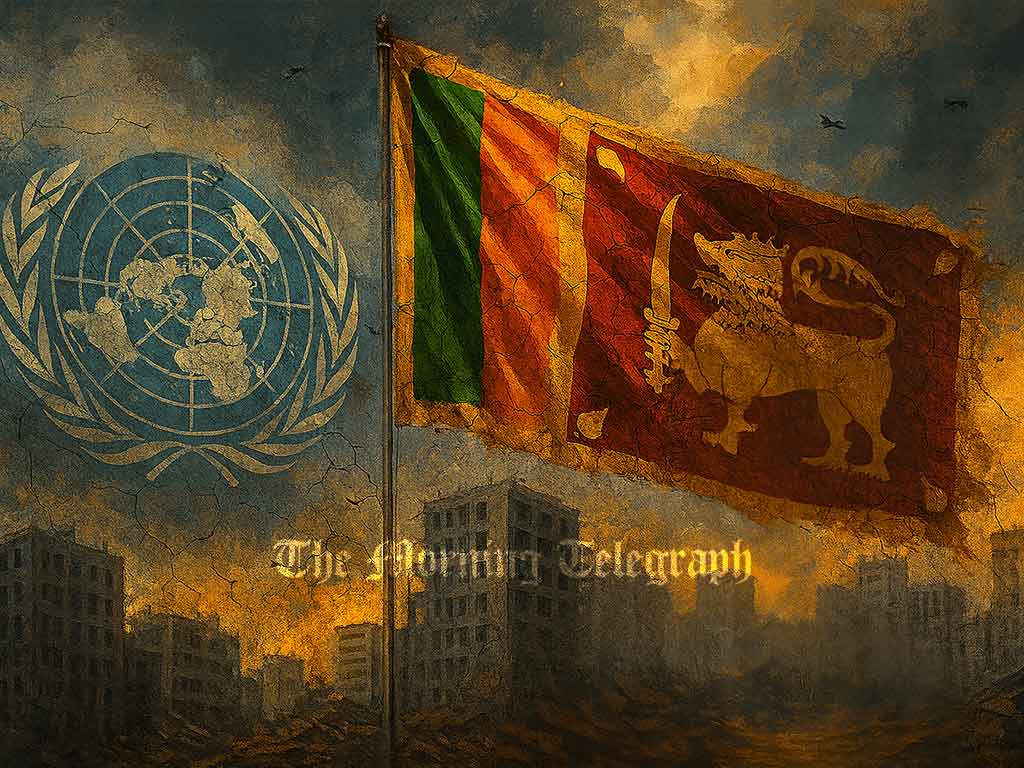
Sri Lanka faces one of its gravest diplomatic crises as the United Nations Human Rights Council resolution in Geneva exposes deep structural failures in Colombo’s foreign policy. With sovereignty slipping under international oversight until 2027, the country’s inability to defend its narrative has left it vulnerable, isolated, and in freefall.
Sri Lanka’s foreign policy has hit a critical breaking point after the latest United Nations Human Rights Council (UNHRC) resolution in Geneva. The resolution, passed without a single vote against and co-sponsored by more than two dozen powerful nations, extends international oversight over the country until 2027. Not one country stood in opposition. For Sri Lanka, this outcome is more than a diplomatic defeat; it is a devastating reminder of the nation’s eroding sovereignty and the collapse of its ability to defend itself on the global stage.

For over a decade, Sri Lanka has found itself perpetually on the defensive. Instead of taking proactive measures to challenge allegations, the government has responded with weak or delayed arguments that lack rigorous evidence-based rebuttals. Verified and well-documented analyses, which have consistently highlighted the methodological flaws in earlier UN reports, were never forcefully presented by Colombo. Instead, unverified claims such as exaggerated civilian casualty figures, anonymous testimonies, and selective narratives were left uncontested, slowly hardening into so-called “international truths.”
The reality on the ground paints a different picture. Civilian deaths during the final year of Sri Lanka’s war likely number around 3,000. Yet UN reports often repeated claims of tens of thousands killed. These inflated figures, repeated without challenge, have contributed to a distorted global perception of Sri Lanka’s history. The country’s diplomats and policymakers bear the responsibility for allowing these narratives to gain traction by failing to counter them effectively.
The collapse is not just tactical but deeply structural. Sri Lanka’s political authority, embassies, and foreign missions, institutions meant to safeguard national interests, have been reduced to ceremonial outposts. Many foreign service personnel are technically qualified, capable of passing exams and maintaining certifications, but they lack the skills and training required to engage in strategic diplomacy. Instead of defending Sri Lanka’s position with strength and clarity, too often they resort to bureaucratic routines, circulating petitions, or engaging in internal gossip. Loyalty and appearances have been rewarded over skill and results. The outcome has been predictable: Sri Lanka has become what critics describe as a “bygone country” in the arena of international politics.
The Geneva pressure is not merely procedural; it is a deliberate strategic trajectory. The UNHRC resolution aims to push Sri Lanka closer to external accountability mechanisms. If Sri Lanka refuses to sign the Rome Statute, the gateway to the International Criminal Court, the threat of an external tribunal looms large. Every call for constructive engagement, every demand to repeal or amend domestic laws, represents another step toward ceding judicial sovereignty to foreign powers.
The moral and intellectual failure of Colombo’s approach is equally stark. Verified evidence shows that civilian casualties during the conflict were neither deliberate nor disproportionate. The Sri Lankan armed forces acted decisively to end a brutal insurgency that claimed thousands of lives, restoring peace to the nation. Yet the international narrative continues to cast the state as the primary culprit, while the heroism and sacrifices of the soldiers are ignored. This one-sided story persists because Sri Lanka’s diplomats have failed to present counter-narratives with authority. Their silence, reactivity, and strategic ineffectiveness have allowed foreign critics to dominate the debate.
What Sri Lanka needs is not another round of ceremonial statements but urgent transformation. The solution lies in building a professional, empowered, and strategically trained foreign service. Officers must be equipped to defend facts, shape narratives, and safeguard sovereignty. Diplomatic posts should no longer serve as rewards for political loyalty or ceremonial positions. Instead, they must be staffed by experts in international law, negotiation, and strategic communication. Without such reform, every new UN resolution will further erode Sri Lanka’s dignity, sovereignty, and morale.
The sacrifices of Sri Lankan soldiers must also be recognized and defended. These soldiers fought a ruthless terrorist movement reminiscent of Nazi brutality. They deserve far more than empty praise at home. They deserve a government that will defend their honour globally, presenting their actions as part of a legitimate war effort to end terrorism, not as crimes of disproportionate violence. Failing to protect this truth dishonours their service and leaves Sri Lanka vulnerable to distorted historical narratives.
The people of Sri Lanka also deserve better. They deserve a government that does not gamble the country’s sovereignty on the roulette wheel of Geneva diplomacy. Every day of delay in strengthening the foreign service and reshaping Sri Lanka’s narrative brings the nation closer to being trapped in foreign-imposed legal frameworks. This outcome should have been preventable, but under current mismanagement, it appears inevitable.
Sri Lanka’s future in global politics depends on immediate change. A state that once crushed one of the world’s most ruthless insurgencies must now prove that it can defend itself in the halls of international diplomacy. The road ahead demands courage, competence, and a willingness to shed the culture of complacency that has left the nation vulnerable. Only then can Sri Lanka reassert its sovereignty and dignity on the world stage.