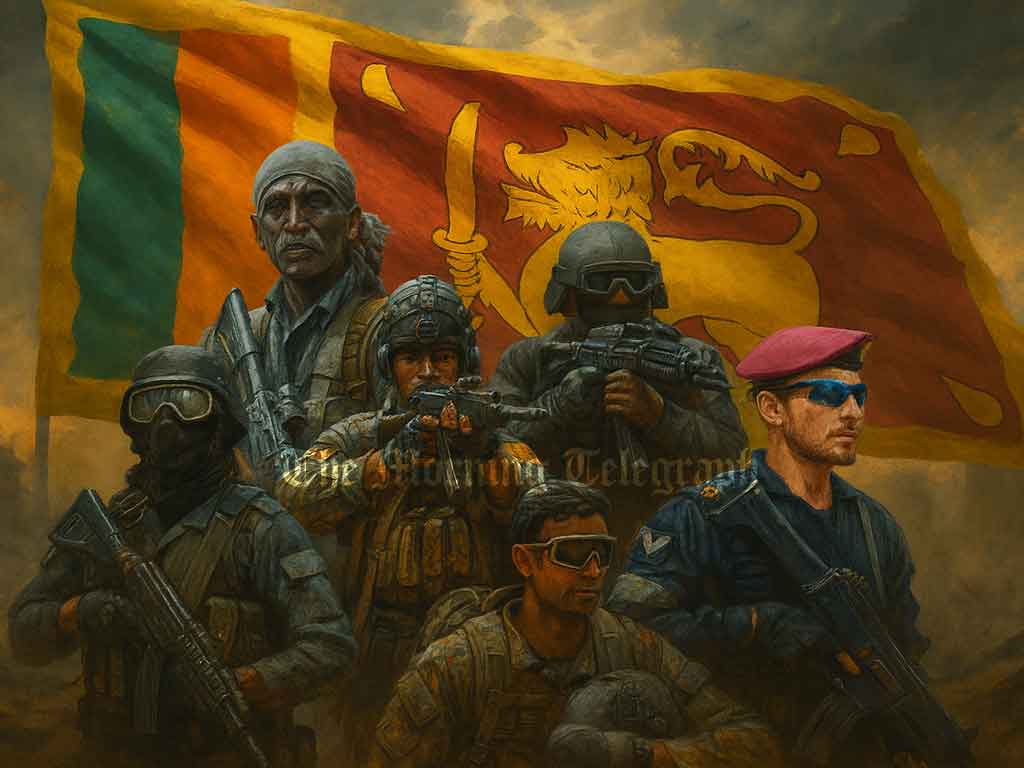
Sri Lanka’s military, once hailed for defeating one of the world’s most ruthless terrorist groups, now stands accused, abandoned, and internationally cornered. Decades of sacrifice and battlefield victories are overshadowed by political betrayal, weak diplomacy, and relentless foreign pressure, leaving the nation’s war heroes exposed and its sovereignty in jeopardy.
Sri Lanka’s Army, celebrated for ending three decades of terrorism, today faces relentless international pressure, political betrayal, and neglect. Its soldiers’ sacrifices, once hailed as heroic, are now overshadowed by allegations, sanctions, and weak diplomacy, leaving the nation’s war heroes abandoned in a battle for dignity and truth.

A Legacy of Sacrifice Overshadowed
Sri Lanka’s Army was not always a fighting machine. For decades after independence, it was seen largely as a ceremonial force, deployed for domestic emergencies but never truly tested in the crucible of modern warfare. That changed with the eruption of separatist terrorism and the emergence of the Liberation Tigers of Tamil Eelam, a group that grew into one of the world’s most ruthless terrorist organizations. The Army transformed through years of bloodshed, learning lessons in bitter defeats, clawing back lost ground, and eventually spearheading a combined military campaign that eliminated the LTTE by May 2009. That victory was historic, ending a conflict that had claimed more than 70,000 lives and scarred generations. Yet, more than a decade later, the same Army that delivered peace now finds itself cornered internationally, accused by global bodies, sanctioned by Western governments, and abandoned by its own political leadership.
The controversies surrounding the Directorate of Military Intelligence after the 2019 Easter Sunday attacks illustrate the Army’s vulnerability. Allegations surfaced that Brigadier Suresh Sally, who was stationed in Malaysia at the time, had secretly conspired to influence political outcomes by engineering the attacks. Sally firmly denied these accusations and later rose to become the head of the State Intelligence Service. His case was emblematic of a larger truth: the Army as an institution failed to defend its officers against false or politically motivated claims, leaving men who risked their lives to protect the country exposed to individual battles in foreign courts and hostile newsrooms. Similar injustices followed, such as the harassment of retired Maj. Gen. Nishantha Ekanayake on fabricated charges of treasure hunting, an absurd case that highlighted the erosion of respect for veterans who had once carried the burden of defending the nation.
The Army’s 76th anniversary should have been a moment of national pride. Instead, it is overshadowed by shadows cast on its war record by hostile narratives abroad and political betrayals at home. The victory over the LTTE, acknowledged even by the American FBI as one of the most difficult military triumphs over modern terrorism, is continually undermined by international allegations of war crimes. Successive governments, including the very administration that presided over the war victory, failed to mount a sustained and evidence-based defense of the soldiers who achieved it. Parliament’s handling of accountability issues has been lethargic at best, complicit at worst, and international bodies such as the UNHRC have capitalized on this weakness to tighten pressure on Sri Lanka.
This silence and neglect contrast sharply with the sacrifices of soldiers and officers. Nearly 6,300 soldiers died in the final three years of Eelam War IV, and another 30,000 were wounded. They fought in some of the bloodiest battles of modern times, from Elephant Pass to Anandapuram, and finally the Vanni campaigns of 2008 and 2009. Yet their sacrifices are now obscured by political cowardice and foreign accusations. The famous words of Tennyson’s Charge of the Light Brigade capture their plight: “Theirs not to make reply, Theirs not to reason why, Theirs but to do and die.” Sri Lanka’s soldiers carried out their duty, but when it came time for their leaders to defend them in the diplomatic arena, the silence was deafening.
Voices from within the military have spoken up. Maj. Gen. Chagie Gallage, a decorated veteran of the Gajaba Regiment, captured the disillusionment in his farewell speech in 2018. He lamented that although his regiment’s name was engraved in golden letters in Sri Lanka’s history, he retired carrying the stigma of being labeled a war criminal. Gallage himself faced visa bans, with Australia denying him entry in 2016, citing his command of the 59 Division during decisive operations in 2009. His words reflect the frustration of many soldiers who gave their lives to defeat terrorism, only to find themselves punished in retirement. The UK’s sanctioning of General Shavendra Silva, who commanded forces in critical battles and later rose to Army Commander, is another painful reminder of how Sri Lanka has failed to protect its heroes.
Betrayal After Victory
The military victory in 2009 should have been the foundation for a strong national defense in the diplomatic arena. Instead, the Army was undermined almost immediately by political infighting. General Sarath Fonseka, the war-winning Commander, fell out with President Mahinda Rajapaksa and contested against him in the 2010 presidential election. His controversial statements, including claims of field executions by his own divisions, were weaponized internationally. At the same time, the Rajapaksas further damaged military morale by arresting Fonseka in February 2010 and dismissing 35 senior officers, creating deep divisions in the armed forces. These political missteps gave international actors further ammunition to question the legitimacy of Sri Lanka’s war victory.
The betrayal deepened when the Sirisena-Wickremesinghe government co-sponsored a UNHRC resolution in 2015 calling for accountability against its own Army. This unprecedented act—no other country in the world has supported an international resolution against its own military—marked a low point in Sri Lanka’s diplomatic history. President Sirisena had promised the military that he would protect them, but failed to deliver. Prime Minister Ranil Wickremesinghe played a key role in this betrayal, cementing the Army’s isolation. It was not only an act of political weakness but a signal to the world that Sri Lanka itself was unwilling to defend its defenders.
Meanwhile, Western governments and NGOs continued to shape the narrative. Norway, during the final days of the war, had tried to broker an escape for LTTE leaders. The United States showed interest in similar proposals. Later, leaked US cables revealed that even international observers like the ICRC acknowledged that the Sri Lankan Army deliberately slowed offensives to minimize civilian casualties, even at great cost to soldiers. This crucial evidence could have dismantled accusations of genocide, but successive governments failed to use it effectively. Instead, silence allowed the allegations to harden into so-called truths, repeated endlessly in UNHRC sessions and foreign media.
Glorious Victories Forgotten
The Army’s earlier victories against the JVP in 1971 and again in the late 1980s show its long history of defending the state against insurrection. Yet those campaigns too are largely forgotten or politically distorted. Soldiers who defeated Marxist insurgents and then Tamil separatists are rarely recognized in a manner commensurate with their sacrifices. Instead, accusations and sanctions dominate the discourse, overshadowing decades of service.
Even today, while the Army is accused abroad, its troops are still called upon to serve in UN peacekeeping missions, a paradox that exposes the duplicity of international systems. If Sri Lanka’s Army is unfit and criminal, why does the UN continue to trust it in global deployments? The answer lies in political manipulation rather than fact. The Army is capable, disciplined, and professional, but its political masters have consistently failed to protect its honor.
The cost of these failures is more than symbolic. Blacklisted divisions, sanctioned officers, and damaged reputations limit Sri Lanka’s ability to defend its sovereignty. Every new UNHRC resolution chips away at national dignity. Every delay in responding with evidence strengthens the hand of those who seek to rewrite the history of the war. Soldiers who fought with courage at Anandapuram or held the line at Elephant Pass are remembered internationally not as liberators but as perpetrators, a tragic inversion born of political betrayal.
The Path Forward
The path forward requires urgent change. Sri Lanka must develop a professional, empowered, and strategically trained foreign service capable of defending facts, shaping narratives, and safeguarding sovereignty. Diplomacy cannot be left to ceremonial appointees or political loyalists. It requires experts in international law, negotiation, and strategic communication. The country must reclaim its story and assert the legitimacy of its war victory on the world stage.
At the same time, successive governments must stop using the Army as a political pawn. Whether it was the Rajapaksas arresting Fonseka, Wickremesinghe co-sponsoring resolutions, or Sirisena failing to deliver on promises, political leaders have treated the Army as expendable. The soldiers who gave their lives deserve more than hollow speeches on anniversaries. They deserve a government that will protect their honor and safeguard the sovereignty they fought to defend.
As Sri Lanka moves forward, the memory of its war-winning Army must not be allowed to fade under a cloud of accusations. The victory of 2009 was not only a military achievement but a national turning point. It ended terrorism reminiscent of Nazi brutality. To allow that victory to be rewritten as a crime is to betray not only the soldiers but the entire nation. Every day of silence, every act of political cowardice, pushes Sri Lanka closer to a future where its sovereignty is dictated by foreign powers and its heroes are remembered as villains. That outcome can still be prevented, but only if Sri Lanka has the courage to defend the truth.
The soldiers who died in Vanni, who marched at Elephant Pass, who fought in the jungles of the East, cannot speak for themselves. It is the duty of the living to carry their story forward. Sri Lanka must choose whether to honor them with truth or abandon them to silence. The world is watching, and history will judge.