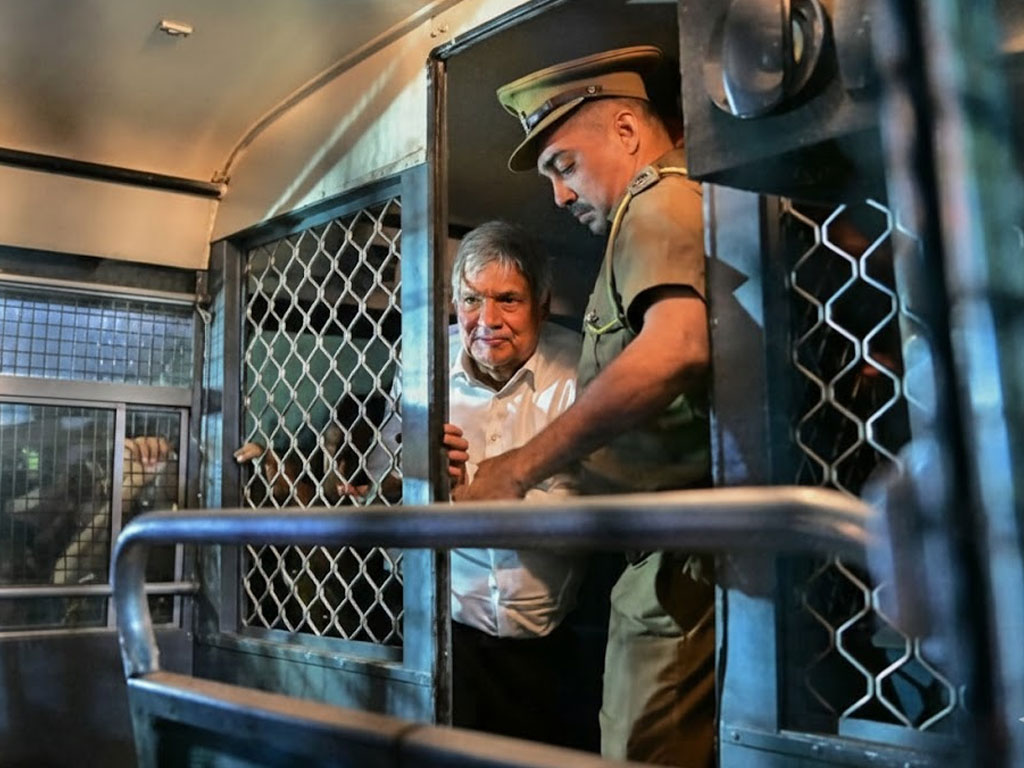
A high profile investigation has spiralled into an international spectacle, with Sri Lanka’s CID spending far more on overseas pursuits than the allegedly misused amount, raising fierce debate over political motives, public accountability, and the dangerous power of law enforcement operating without oversight.
Sri Lanka’s top investigative body is spending more chasing a former president across continents than the alleged sum he is accused of misusing, raising urgent questions about priorities, oversight, public trust, and the politicisation of law enforcement in the country’s fragile democratic landscape.
“Are we investigating the truth or manufacturing it?” That question should hang over the Criminal Investigation Department as it jets across continents to scrutinise a former president over a paltry Rs. 16.6 million. A five member CID team, led by a Deputy Inspector General and accompanied by senior officers, has flown to the UK without notifying the Attorney General, without instructions, and apparently without concern for the most basic protocols of legality, accountability, and institutional oversight. This is not diligence; this is spectacle disguised as justice, framed in a way that raises troubling doubts about intention and proportionality.

The fact that the CID embarked on this mission independently is shocking. Attorney General Parinda Ranasinghe and his top deputies were unaware of the trip. No instructions, no approval, no oversight. One cannot overstate how extraordinary this is: a state institution armed with coercive power acting on its own whim to target a former head of state. When the guardians of the law bypass the law itself, the very notion of justice collapses and the integrity of democratic institutions is shaken at their foundation.
And for what? The alleged offence is a two day visit to the UK costing Rs. 16.6 million, a fraction of what the CID will undoubtedly spend on travel, accommodation, personnel, and diplomatic logistics to verify an invitation letter. This is not investigation; this is the weaponisation of public resources to haunt a political figure, a practice that has troubled Sri Lanka’s political environment for decades. As Winston Churchill once said, “In wartime, truth is so precious that she should always be attended by a bodyguard of lies.” Here, the CID appears to have made the bodyguard the mission itself, chasing shadows while ignoring proportionality, basic legality, and common sense.
Saroja Sirisena, former High Commissioner to the UK, has been summoned to give a statement at the Sri Lankan High Commission in London. The optics are stark: an officer of the state summoned far from home in what amounts to a semi judicial performance orchestrated without the oversight of the very office constitutionally responsible for legal propriety. This is no longer about accountability; it is about intimidation, coercive symbolism, and the creation of political theatre under the guise of investigation.
The timing and scale of this operation suggest a political subtext. Wickremesinghe has already faced scrutiny, arrest, and bail in connection with this incident. Yet the CID persists, expending resources likely greater than the alleged misappropriation itself. The public is left to ask whether this investigation is motivated by justice or by the desire to send a message that no former leader is untouchable regardless of the law. Niccolò Machiavelli wrote that “the ends justify the means,” but the CID appears to have adopted only the spectacle and discarded the justice. The contrast between cost, purpose, and action places the entire process under a cloud of suspicion, prompting deeper concern over the role of law enforcement in political power struggles.
This is not the first time Sri Lanka has seen investigations weaponised for political effect. The selective targeting of one individual, bypassing institutional oversight, and deploying resources abroad for a trivial sum is reminiscent of past episodes where law enforcement became a theatre of power rather than a tool of justice. If the CID truly believed in proportionality and fairness, the investigation could have been conducted in Colombo, through official correspondence, or at the High Commission with full coordination. That they chose not to do so speaks volumes about priorities and the possible intent behind the action.
Beyond the procedural scandal, there is a broader institutional concern. The CID is meant to be an impartial body investigating wrongdoing with transparency and adherence to legal norms. Instead, this episode exposes a disturbing culture of autonomy without accountability, a pattern where performance replaces principle. When law enforcement bypasses its own constitutionally mandated oversight, it undermines not just the rule of law but public trust in the very institutions designed to uphold it. The health of a democratic nation depends on the credibility of its investigative bodies, and credibility is weakened every time due process is ignored for the sake of spectacle.
And let us be blunt: the numbers make the absurdity undeniable. Rs. 16.6 million, the alleged misuse, is paltry by state standards. Yet the investigation now involves international travel, senior officers, and diplomatic coordination. If the CID were serious about proportionality and efficiency, it would be investigating far larger breaches with far less fanfare. Instead, it is targeting a former president with meticulous, almost obsessive energy, while appearing unconcerned about the optics or legality of its own methods. The contradiction between cost and alleged wrongdoing highlights the disproportionate nature of the exercise.
The consequences are not just legal but political and moral. When an investigative body becomes a tool for harassment rather than accountability, it sets a precedent that every future political opponent can be pursued in the same fashion. This is not a safeguard of democracy; it is a template for abuse. As George Orwell noted in 1984, “In a time of universal deceit, telling the truth is a revolutionary act.” Here, the revolution has been inverted: the CID has made an investigation into a trivial allegation appear far more consequential than the truth itself, weaponising procedure to intimidate, haunt, and perform power. The chilling effect on future political actors becomes significant, casting a shadow over democratic participation.
Sri Lanka’s institutions must ask themselves hard questions. Who benefits from this spectacle? Who bears the cost, not only financial, but political, reputational, and diplomatic? And most importantly, at what point does an investigation into a minor expenditure cease to be about justice and become about power? The CID must be critically reviewed, not just for this incident but for the precedent it is setting: that law enforcement may operate independently of legal oversight, proportionality, or reason in pursuit of a narrative rather than truth. The long term implications for the justice system and public trust cannot be ignored.
At the end of the day, the public sees what this truly is: a powerful institution chasing a former leader across the globe, expending far more than the alleged misappropriation, with no oversight and no restraint. This is not investigation. It is harassment masquerading as accountability and it is a dangerous message about how power can be wielded in the name of justice. Sri Lanka’s democratic future depends heavily on preventing such distortions of institutional responsibility, ensuring that justice is never overshadowed by political ambition or institutional excess.