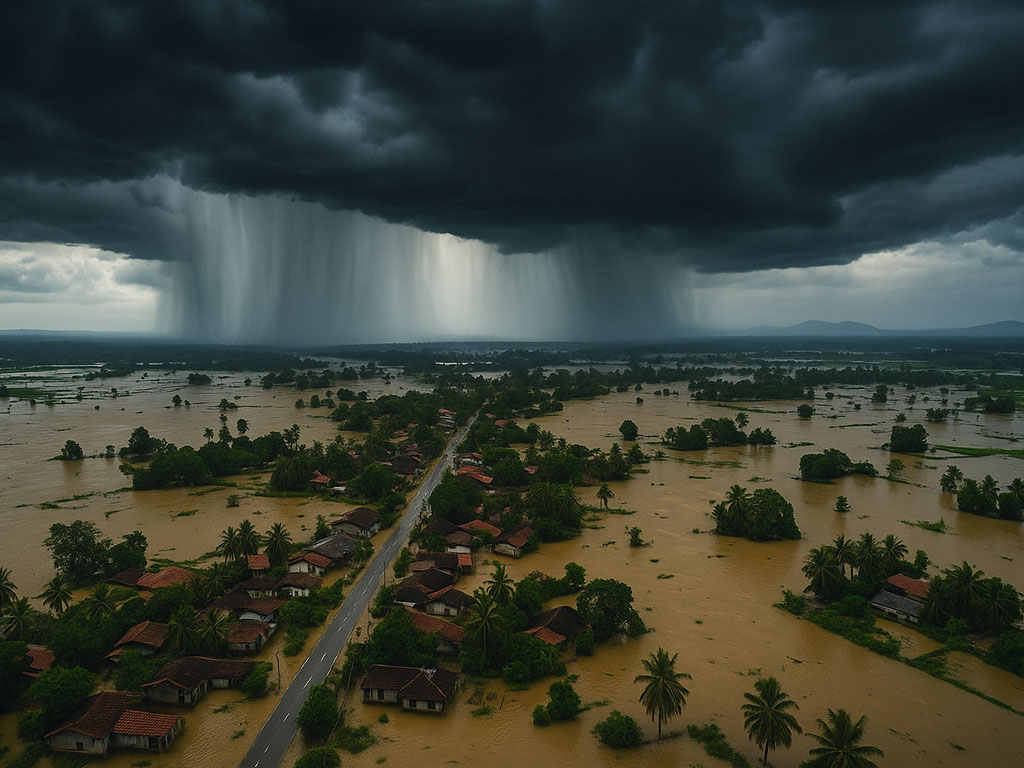
In a week defined by relentless rain, mass displacement, rising death tolls and unprecedented flooding, Sri Lanka confronts not only the immediate devastation of Cyclone Ditwah but also a deeper, more unsettling question: did climate change supercharge this catastrophe, and was the nation truly prepared for the scale of destruction that followed?
Overview of the Disaster
Over the past week, Sri Lanka has been battered by heavy rainfall that escalated rapidly as a low pressure system near the island transformed into Cyclone Ditwah and swept across the country. At its peak intensity, rain fell across virtually all regions, triggering a chain reaction of floods, landslides and widespread destruction. This rainfall pattern was severe enough to cause catastrophic flooding in every province except the southern province, and landslides destabilized many parts of the central highlands.

Many of the areas struck by this disaster had already experienced major flooding in the past, but experts and analysts agree that this event surpassed even the devastating levels seen in May 2016. This time, the flooding was not only more widespread but more damaging, breaking previous measurements and affecting landscapes thought to be resilient. Although Sri Lanka has endured several cyclones over the years, the scale of destruction caused by Cyclone Ditwah stands out. This disaster raises urgent questions about whether climate change intensified the storm, why the impact was so extreme and whether authorities recognized the signs early enough to respond effectively.
The investigation begins with understanding the behavior of the storm itself and the record-shattering rainfall that accompanied it.
Why the Rainfall Was So Extreme
One of the earliest signals that something unusual was unfolding came several days before the low pressure system intensified into a cyclone. Many regions across Sri Lanka reported rainfall exceeding 100 millimeters as early as November 21. In Matara district, Beralapanathara received 183.5 millimeters of rain, a number that continued to rise as the storm evolved. By November 26, Rugam in Batticaloa recorded 300.1 millimeters, and the following day Vavuniya experienced a staggering 375 millimeters. On November 28, Kilinochchi reported 295.9 millimeters, revealing that rainfall levels were intensifying across multiple regions simultaneously.
During these days of relentless downpours, several major rivers rose to alarming levels. The Mahaweli River overflowed to such an extent that the University of Peradeniya and the Royal Botanical Gardens experienced flooding for the first time in their long history. The Kelani River Valley faced flooding more severe than previous major flood events, leaving communities inundated beyond expectations. Rivers such as Malwathu Oya, Deduru Oya and the Mahaweli River itself surged past their banks, engulfing villages, farmland and urban centers and affecting the daily lives of thousands.
Hydrologist Dr. Lakshman Galagedara, a professor of hydrology and agro-geophysics at Memorial University in Canada, conducted a detailed analysis of the rainfall patterns during this crisis. According to his calculations, based on the rainfall received on November 28, Sri Lanka endured an extraordinary meteorological event. He estimated an average rainfall value of 307 millimeters for that day based on media reports and then adjusted the calculation for national variability by assuming that 200 millimeters fell uniformly across Sri Lanka.
Using Sri Lanka’s land area of 65,610 square kilometers, the professor calculated that the total rainfall received in a 24-hour period amounted to approximately thirteen billion cubic meters of water. He further analyzed the rate of rainfall per square kilometer per second, determining that Sri Lanka received 150,463 cubic meters of water every second during the height of the storm. Dr. Galagedara highlighted how extraordinary this figure is by comparing it to the outflow capacity of major reservoirs, which discharge significantly less water per second even under maximum release conditions.
Another startling conclusion from his analysis was that Sri Lanka received nearly ten percent of its entire annual rainfall within a single day. The nation’s average annual rainfall ranges between 1,900 and 2,100 millimeters, yet on November 28 alone the island received approximately 200 millimeters. And this did not include the heavy rains that fell both before and after this date, making the cumulative impact even greater.
The consequences of this extreme rainfall were tragic. Floods and landslides claimed lives in areas such as Kotmale, Gampola, Welimada, Ududumbara, Peradeniya, Sarasavigama and Alawathugoda. According to experts, the soil had already been saturated from days of continuous rain, meaning the ground was unable to absorb the additional water. As Dr. Galagedara explained, when the soil becomes saturated, surface flooding increases dramatically. The excess water flows along the land surface, generating rapid runoff that leads to flash floods in mountainous regions and severe flooding in the valleys below. Landslides also become more likely as waterlogged soil loses stability and hillside structures collapse under the weight.
To illustrate the magnitude of the rainfall, the professor compared the volume of water falling on Sri Lanka to the discharge of the Amazon River. Although the Amazon River has a catchment area of seven million square kilometers and carries an average flow of 220,000 cubic meters per second, the rainfall intensity in Sri Lanka per square kilometer far exceeded the Amazon’s discharge when adjusted for land area. According to Dr. Galagedara, the Amazon’s output equates to 0.032 cubic meters per second per square kilometer, while Sri Lanka’s rainfall intensity during Cyclone Ditwah equaled 2.32 cubic meters per second per square kilometer, highlighting the extraordinary scale of the event.
As Sri Lanka grapples with the impact of Cyclone Ditwah, experts warn that the storm must be viewed as a warning signal. Sri Lanka has faced numerous storms throughout its history, with significant cyclones recorded in 1964, 1957, 1978 and several others across the decades. During the 1960s, 1970s and 1980s, Sri Lanka typically encountered a cyclone once every five years. Some of these storms were devastating, including the 1964 cyclone that traveled from Trincomalee to Mannar and caused major damage.
A report by the Asian Disaster Reduction Center on natural disasters in Sri Lanka from 1900 to 2000 shows that the 1978 cyclone killed 740 people, while earlier storms in 1964 and 1957 caused 206 and 200 deaths respectively. Floods in 1986 and 1989 claimed additional lives, with 325 and 168 fatalities recorded in those years. More recently, in 2003, 374 people died due to natural disasters including floods, cyclones and strong winds. The 2016 floods and cyclone caused around 97 deaths.
Yet none of these historical disasters occurred in an age as technologically advanced as 2025. Despite sophisticated weather monitoring systems, satellite imagery, early warning mechanisms and rapid communication channels including social media, Sri Lanka still experienced one of its worst natural disasters in modern history. At the time of reporting, 481 people have died, and the number is expected to rise. More than 1.5 million people have been affected. Relief teams continue to reach previously inaccessible regions as destroyed roads are gradually reopened, and the search for missing persons is ongoing.
A new reality has emerged. Even with improved communication, advanced forecasting tools and coordinated rescue operations supported by international partners such as India and Pakistan, the devastation caused by Cyclone Ditwah surpassed major historic disasters that occurred decades ago when Sri Lanka had few technological resources.
This raises a difficult but unavoidable question. If technology has improved, forecasting has improved and communication has improved, then why has the destruction intensified?
The answer, according to several experts, lies in the growing influence of climate change.
As scientists analyzing Cyclone Ditwah point out, the storm’s unusual intensity appears to reflect a broader global trend. With rising ocean temperatures and atmospheric shifts associated with global warming, storms forming near the equator have begun exhibiting greater strength, unpredictability and destructive potential. Both Professor Charitha Pattiarachchi of the University of Western Australia and Dr. Lakshman Galagedara emphasize that global warming is reshaping weather systems in ways that make disasters like Ditwah increasingly likely.
Climate Change as a Driving Force
Professor Pattiarachchi, who specializes in oceanography, explained that the ocean surface temperature surrounding Sri Lanka in the days before and after the cyclone exceeded 30 degrees Celsius. Under normal circumstances, a temperature of around 27 degrees Celsius is necessary for a storm to form. When ocean temperatures rise above that level, the ocean contains significantly more energy that can fuel intense tropical systems. Professor Pattiarachchi noted that in earlier decades, such high temperatures were rare, but today they are increasingly common due to the cumulative effects of global warming.
He explained that cyclones draw their energy primarily from warm ocean water. As the storm moves over land, where heat and moisture are less abundant, it loses power. When ocean temperatures are unusually high, however, storms gain strength rapidly and maintain that intensity over longer distances. The warm waters feeding Cyclone Ditwah acted like fuel, increasing its energy and enabling it to generate heavy rainfall over vast areas of Sri Lanka. According to the professor, there is a clear connection between rising ocean temperatures and the increasing power of tropical storms
How the Storm Surpassed Historical Disasters.
Dr. Galagedara echoed this assessment. He explained that as global warming increases temperatures near the equator, evaporation from the sea intensifies. Warmer oceans release more moisture into the atmosphere, creating low pressure disturbances that can develop into storms. These disturbances grow stronger as warm, moist air rises and cooler air rushes in to fill the void. This dynamic creates the rotational movement characteristic of tropical storms. When wind speeds reach 69 kilometers per hour, the system is classified as a storm, and when speeds reach 119 kilometers per hour, it becomes a cyclone.
The professor explained further that storms can become larger and more destructive as a result of these temperature-driven changes. This means that what Sri Lanka experienced during Cyclone Ditwah is not an isolated event but part of a broader global pattern in which storms occur more often and with greater intensity.
Dr. Galagedara also observed that several countries in Southeast Asia, such as the Philippines and Thailand, have experienced multiple intense storms in a relatively short period. This trend indicates that climate change may be producing weather cycles that are more extreme than those observed in earlier decades. As he pointed out, past cycles of severe weather tended to occur over longer intervals. Today, however, the pattern appears compressed, with powerful storms emerging more frequently.
Experts warn that future natural disasters may be even more severe. When climate patterns shift rapidly, they create anomalies that overwhelm traditional forecasting models. What was once considered unusual may become increasingly common. The professor highlighted that the nature of the climate Sri Lankans are living in today is markedly different from the climate that shaped earlier weather events. The climate has warmed significantly, and this warming is magnifying the intensity of storms.
When examining historical data, it becomes clear that Cyclone Ditwah stands out not only for the scale of its destruction but also for the geographic reach of its impact. Storms that affected Sri Lanka in the past typically struck specific regions. In contrast, Ditwah affected 22 out of 25 administrative districts, according to an Extraordinary Gazette notification. This widespread impact reinforces the conclusion that the storm’s intensity was unusually high.
Satellite images confirmed that Sri Lanka was covered by the center of the cyclone and its cloud band. This is significant because storms that engulf an entire country at once are exceedingly rare. The satellite imagery showed that Ditwah’s structure was expansive, with dense cloud formations stretching across nearly the entire island. This provided a visual indication of why rainfall was so widespread and so intense across multiple districts at the same time.
To understand the broader context, it is important to examine why the storm caused so much damage despite Sri Lanka’s advancements in communication and disaster monitoring systems. Technology has improved dramatically compared to earlier decades. Early warning systems are more sophisticated, and information travels faster due to television, radio, mobile messaging and social media. Agencies such as the Department of Meteorology and the National Building Research Organization routinely issue alerts when dangerous conditions arise. With so many tools available, it would seem reasonable to expect that disasters today would result in fewer casualties.
However, the devastation brought by Cyclone Ditwah highlights a difficult reality. Even with advanced forecasting and communication, climate-induced weather patterns can overwhelm existing systems. Forecasts can predict rainfall and storm movement to some extent, but they cannot always capture the precise scale of an unprecedented event. When rainfall exceeds historical norms by such a large margin, the infrastructure designed for past events proves insufficient.
Furthermore, the professor noted that weather forecasts represent probabilities, not certainties. For example, when forecasts indicate a seventy five percent chance of rainfall, they acknowledge that a twenty five percent uncertainty remains. This margin of uncertainty reflects the inherent limitations of meteorological science. No country, regardless of its technological advancement, can predict weather with perfect accuracy.
This uncertainty underscores the importance of public responsiveness to warnings. Dr. Galagedara stressed that people must take early warnings seriously, especially those related to landslides. When the soil becomes saturated, the risk of landslides increases dramatically. Early evacuation from high risk zones can save lives. However, people sometimes underestimate risks or delay responding to warnings, which can increase vulnerability.
The professor also emphasized that societal habits and living patterns play a significant role in minimizing disaster impact. As population density increases, more people settle in areas that are not suitable for long term habitation. These include steep hillsides, flood plains and areas near unstable slopes. When communities expand into such vulnerable locations, natural disasters that would have caused minor damage in the past can now result in widespread loss of life and property.
Lifestyle changes are also necessary to mitigate disaster risks. For example, improper garbage disposal can clog drainage systems, contributing to urban flooding. Similarly, deforestation and land mismanagement can destabilize hillsides, increasing the risk of landslides. Adapting to the realities of climate change will require both large scale policy reforms and individual behavioral changes.
Lessons From the Destruction
Damage from Cyclone Ditwah also demonstrated how infrastructure limitations can magnify the consequences of extreme weather. Several major railways and highways, including the historic Kandyan Railway, were significantly damaged. Restoring these transportation routes is essential not only for public mobility but also for the delivery of relief supplies. Some major cities were nearly devastated, and the scale of reconstruction required is immense.
The storm’s impact on transportation networks also created delays in rescue operations. When roads are destroyed or obstructed, emergency teams struggle to reach isolated communities. Although air rescues were deployed in some areas, they could not cover the entire country. As a result, some communities endured prolonged isolation, waiting for assistance while floodwaters continued to rise or landslides blocked access routes.
In this context, experts argue that Sri Lanka must adopt a more proactive and long term approach to disaster preparedness. This includes enhancing early warning systems, strengthening infrastructure, enforcing land use regulations and developing community based disaster response strategies. Modernizing reservoir management, river embankments and urban drainage systems will be essential to reduce future flood risks. Experts consistently highlight the need for continuous investment in disaster mitigation rather than relying solely on emergency response after a crisis occurs.
Ultimately, the effects of Cyclone Ditwah reveal the consequences of facing a new climate reality with systems that were designed for the past. As climate change continues to intensify natural hazards, Sri Lanka must adapt quickly. Otherwise, future storms may bring even greater devastation.
As Sri Lanka reflects on the devastation caused by Cyclone Ditwah, the storm has become a powerful reminder that natural disasters cannot be prevented, but their damage can be reduced through preparedness, planning and public awareness. The widespread destruction across the island demonstrates that traditional assumptions about weather patterns can no longer be relied upon. Climate change has altered the scale and intensity of storms, and Sri Lanka must adapt urgently if it hopes to protect communities from future disasters of similar or greater magnitude.
Final Expert Assessment
One of the clearest lessons from the cyclone is that early warning systems must be strengthened and embraced not only by institutions but also by the public. Dr. Lakshman Galagedara emphasized that Sri Lankans must regularly pay attention to announcements issued by agencies such as the Department of Meteorology and the National Building Research Organization. These agencies gather information from both local and international sources, and the data they release is intended to help people prepare for hazardous conditions. Responding promptly to warnings can greatly reduce the risk of being caught in dangerous situations such as landslides or flash floods.
However, responding to disasters requires more than listening to forecasts. It also requires a shift in mindset about how weather predictions are interpreted. As the professor explained, weather forecasts are fundamentally probabilistic. Even the most advanced systems in technologically developed countries cannot predict rainfall with one hundred percent accuracy. When agencies predict a seventy five percent chance of heavy rain, this means that uncertainty remains. People must therefore treat warnings not as optional advisories but as signals that require immediate preparation and precautionary action.
Another key insight from the aftermath of Cyclone Ditwah is the need for Sri Lanka to address long standing issues related to land use. As the population continues to rise, more families have settled in areas that are unsuitable for safe living. These include flood prone zones, steep slopes and regions near unstable hillsides. When heavy rain saturates the soil, these areas become extremely vulnerable. Landslides can occur without warning, burying homes and infrastructure. Flood plains designed to carry excess water become inundated with settlements, creating avoidable hazards.
Experts argue that Sri Lanka must implement stronger land use regulations to prevent construction in high risk zones. Communities already living in such areas must receive support to relocate, and new settlements must be planned with consideration for environmental risks. These changes are not only protective but also essential for long term national resilience. Climate change is expected to intensify rainfall patterns, raise sea levels and increase the frequency of extreme weather events. Without proactive planning, disasters will continue to cause severe losses.
Environmental stewardship also plays an important role in reducing the vulnerability of communities. Deforestation, unplanned agriculture and unmanaged land development weaken natural protections. Forests stabilize soil, absorb rainfall and reduce runoff. When forests are removed, hillsides become unstable and rainfall flows rapidly over exposed ground, increasing the likelihood of landslides and flash floods. Reforesting degraded areas and protecting existing forests are therefore critical tasks for minimizing disaster risks.
Waste management is another area of concern. Improper garbage disposal frequently blocks urban drainage systems, causing streets and neighborhoods to flood during heavy rains. As storms increase in intensity, drainage systems must be expanded and modernized to handle larger volumes of water. However, even the most advanced systems will fail if people continue to discard waste in ways that obstruct water flow. Public behavior must evolve in parallel with infrastructure improvements.
The damage to transportation networks during Cyclone Ditwah further demonstrated how crucial infrastructure is to national resilience. Railways such as the iconic Kandyan Railway, along with several major highways, experienced significant destruction. These transportation arteries are vital for connecting communities, delivering goods and providing access to essential services. When they fail, emergency responders are unable to reach people in need. Restoring and reinforcing these systems against future climate threats will require thoughtful engineering and significant investment.
In addition to infrastructure, disaster response capacity must be distributed more widely. Centralized response systems are often too slow to reach peripheral regions during severe weather. Community based disaster preparedness programs can help bridge this gap. When local residents are trained in basic rescue, first aid and risk identification, they become the first line of defense until national teams can arrive. Building local resilience reduces vulnerability and empowers communities to act quickly during the critical early hours of a disaster.
The experience of Cyclone Ditwah also raises questions about reservoir and river basin management. As rainfall intensifies due to climate change, reservoirs must be managed proactively to create buffer zones for incoming water. Rivers must be dredged and maintained to ensure they can carry larger volumes without overflowing. Failure to adapt these systems to new climate realities will continue to expose communities to preventable flooding.
Furthermore, Sri Lanka must invest more in scientific research, climate modeling and risk mapping. Understanding how climate change affects rainfall distribution, wind patterns and ocean temperatures will allow authorities to anticipate future challenges more accurately. With comprehensive risk maps, urban planners can avoid high risk zones, and emergency teams can prioritize vulnerable areas. Data driven decision making strengthens national resilience and ensures that policies reflect current climate realities rather than outdated assumptions.
The role of international cooperation should not be overlooked. Countries such as India and Pakistan provided essential support during rescue operations, and their contributions highlight the importance of regional partnerships in disaster response. As climate change continues to affect South Asia, cooperation among neighboring nations will become even more critical. Shared weather monitoring systems, joint training exercises and coordinated disaster response frameworks can help save lives across the region.
Despite these opportunities for improvement, the devastation brought by Cyclone Ditwah also reflects a sobering reality. Even with the best planning, climate change may create disasters that exceed the capacity of existing systems. The storm demonstrated how quickly multiple regions can become overwhelmed when rainfall far surpasses historical norms. It also showed how disasters can strike in rapid succession, compounding damage and straining relief resources.
This new era of climate intensified storms demands that Sri Lanka adopt a long term perspective. Short term fixes will not protect the country from the scale of disasters expected in the coming decades. Instead, Sri Lanka must approach climate adaptation as a national priority. This includes rethinking urban development, transforming agricultural practices, reinforcing critical infrastructure and investing in renewable energy to limit further contributions to global warming.
A comprehensive national policy on climate resilience would integrate these elements into a unified strategy. Policymakers, scientists, community leaders and private sector representatives must collaborate to build a future in which Sri Lanka is better protected from extreme weather events. Public education campaigns can help create awareness about climate change and encourage individuals to adopt sustainable practices that reduce environmental impact.
Cyclone Ditwah must also serve as a reminder that climate adaptation is not only a technical challenge but also a humanitarian one. The storm displaced hundreds of thousands of people, destroyed homes and livelihoods and created significant psychological trauma. Support systems must be strengthened to help affected families recover, both physically and emotionally. Mental health resources, temporary shelter programs and long term rebuilding assistance are essential components of disaster recovery.
The social impact of natural disasters is often uneven. Vulnerable populations such as children, the elderly, the poor and those living in remote regions are disproportionately affected. Ensuring that recovery efforts meet the needs of these communities is essential for building a resilient and equitable society. Policymakers must consider how climate adaptation strategies can protect vulnerable groups and prevent inequality from widening after each disaster.
Ultimately, Sri Lanka cannot ignore the lessons of Cyclone Ditwah . The storm’s impact was shaped not only by intense rainfall and powerful winds but also by broader environmental changes linked to global warming. As Professor Pattiarachchi stated, the answer to whether climate change influenced this cyclone is yes. As Dr. Galagedara explained, global warming has increased ocean temperatures, making storms more frequent and more intense. These scientific insights reveal that Cyclone Ditva was not an isolated anomaly but part of a larger trend.
Sri Lanka now stands at a crossroads. The country can choose to view Ditwah as an unavoidable tragedy or as a critical warning that demands urgent and sustained action. The future will depend on how seriously the nation addresses the challenges revealed by this disaster. If Sri Lanka strengthens its early warning systems, improves land use planning, invests in infrastructure, embraces scientific research and promotes public awareness, it can reduce the impact of future storms. If not, the country may face even greater losses as climate change intensifies.
The devastation caused by Cyclone Ditwah will remain etched in the nation’s memory for years to come. But it can also be a turning point, inspiring Sri Lanka to build a safer and more resilient future. The choices made now will shape the country’s ability to withstand the storms of tomorrow.