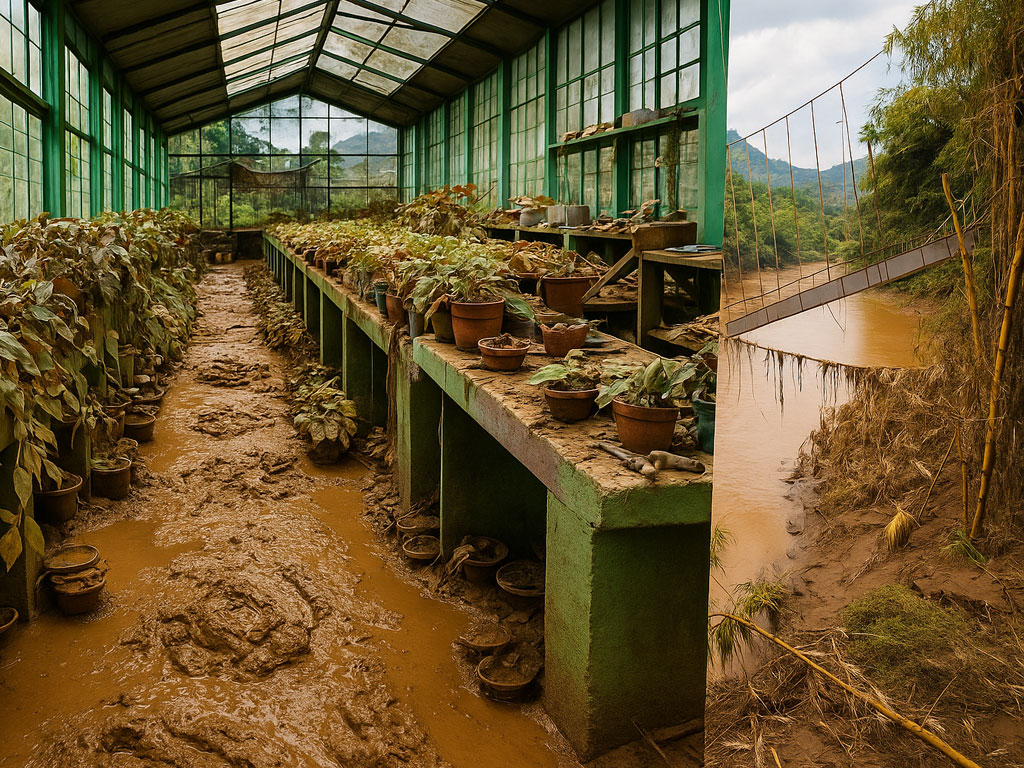
Sri Lanka’s iconic Royal Botanical Gardens at Peradeniya are facing massive restoration costs after floods swept through delicate plant collections, research facilities, and historic structures, leaving conservation teams racing against time to save rare species.
The total damage caused to the Royal Botanical Gardens, Peradeniya, following recent flooding has been estimated at over Rs. 120 million, according to garden authorities. Despite ongoing clean up and recovery work, the gardens have been reopened to the public, allowing visitors to witness both the resilience and vulnerability of this national treasure.
Officials confirmed that several sections of the gardens sustained serious damage. These include the suspension bridge, outdoor plant nursery, orchid nursery, leaf nursery, anthurium plant section, compost yard, and the floriculture research laboratory. The research laboratory plays a critical role in cultivating and treating infected tissue culture plants, making the damage particularly significant for long term conservation efforts.

Garden staff noted that several orchids housed in the damaged orchid nursery had been named in honour of foreign and local dignitaries. While large orchid specimens gifted by foreign dignitaries as endemic display plants were spared, many other orchid varieties were submerged in floodwaters and covered in mud.
Deputy Director of the Royal Botanic Gardens, Ruwini Gomes, said that extensive restoration work is required. “About Rs. 120 million will be needed to repair the suspension bridge, restore the plant nurseries, rehabilitate the floriculture research laboratory, and rebuild the compost yard,” she explained.
The gardens are surrounded by the Mahaweli River on three sides, making them particularly vulnerable during periods of heavy rainfall and flooding. “The plant nurseries, including the orchid nursery, were badly affected. The orchids were covered in mud. We are cleaning, treating, and replanting them,” Gomes said.
She cautioned that not all plants may survive. “Some orchids require very specific environmental conditions. Since those conditions have changed, certain species may not recover. We will need several weeks to assess the full extent of root rot and fungal infections among orchids, foliage plants, and anthuriums,” she added.
If losses occur, authorities plan to purchase replacement orchid plants from external sources to rebuild collections. Meanwhile, the suspension bridge suffered extensive structural damage, with the Government Factory estimating repair costs at approximately Rs. 70 million alone.
National Botanic Gardens Director General H.C.P. Jayaweera said efforts are underway to preserve as many plants as possible. “We are taking immediate steps to treat affected plants and keep them alive. Ornamental plants will be replanted once conditions stabilize,” he said.
Jayaweera acknowledged that orchid nurseries were the worst hit, noting that orchids are highly sensitive to environmental changes. “When conditions shift suddenly, plants become highly vulnerable to disease,” he explained.
While visitors are currently restricted from accessing the iconic suspension bridge due to safety concerns, officials warned that final repair costs may increase as assessments continue.