Sri Lanka’s power consumers face another shock as retirement payouts, cyclone losses, and mounting loans are quietly folded into electricity tariffs, raising urgent questions about fairness, accountability, and who truly pays for reform.
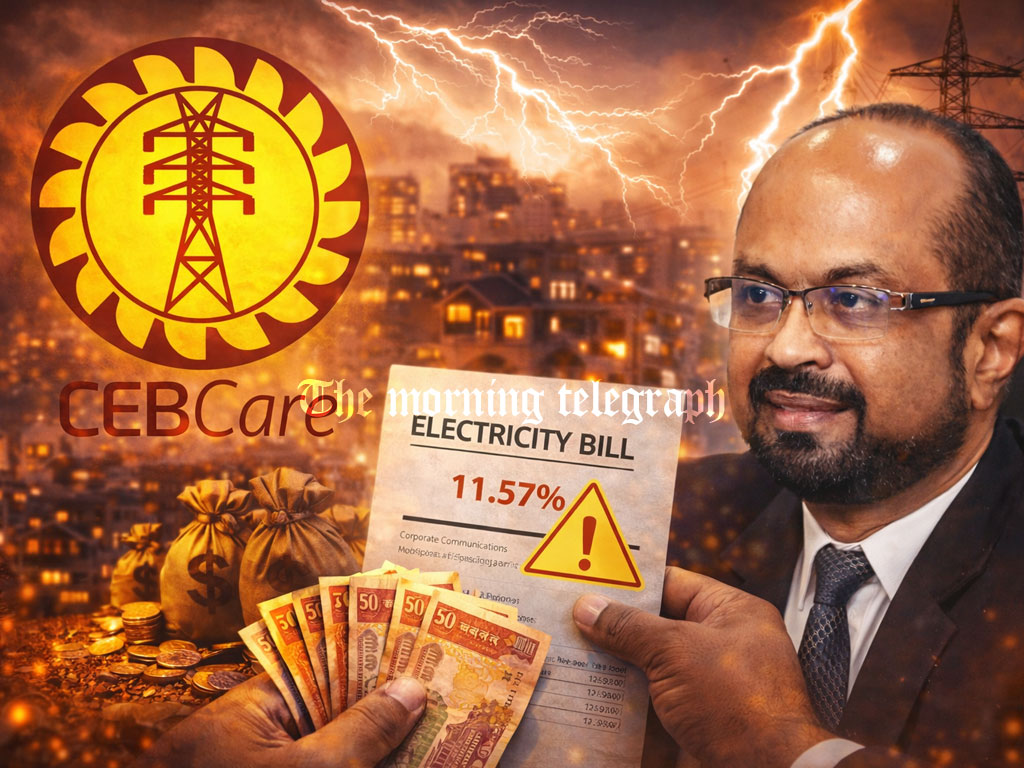
Sri Lanka’s electricity consumers are once again bracing for higher bills, as the Ceylon Electricity Board moves to impose an additional 11.57 percent tariff increase for the first three months of 2026. The proposal arrives against a politically charged backdrop, particularly for a National People’s Power government that once campaigned loudly on promises of lowering electricity tariffs before coming to power.

After assuming office, the reality proved more complicated. In early 2025, the CEB requested a tariff increase for the first quarter of the year, while the Public Utilities Commission moved to reduce domestic tariffs by 20 percent. This occurred even as Energy Minister Kumara Jayakody told Parliament on January 9, 2025 that rapid tariff reductions were not feasible.
By May 2025, the CEB claimed losses of Rs. 8 billion due to the earlier reductions and proposed an 18 percent hike. In June, the Public Utilities Commission approved a 15 percent increase, which remained in effect from June to December 2025.
Despite this adjustment, the CEB returned with another request, seeking a 6.8 percent increase. In October, regulators chose instead to maintain existing tariffs for the final three months of the year. Now, as 2026 approaches, the board is once again asking consumers to absorb an 11.57 percent rise.
A major factor behind the proposed increase is the cost of compensating electricity workers scheduled to retire voluntarily under structural reforms linked to the new Electricity Amendment Act passed last year. Nearly Rs. 11,500 million in compensation has been earmarked, and a portion of this cost is now being passed on to electricity consumers through tariffs.
According to the CEB, total expenditure for January, February, and March 2026 is projected at Rs. 137,016 million, while expected revenue stands at Rs. 113,161 million. With Rs. 10,761 million carried forward from last year, the remaining gap amounts to Rs. 13,094 million. The board argues that an 11.57 percent tariff increase is necessary to bridge this shortfall.
Financial expenses during this period include costs linked to the voluntary retirement scheme. Following a Cabinet decision on August 25, 2025, a voluntary pension program covering 2,158 employees was approved, with total compensation estimated at Rs. 11,554 million. The amount is structured as a five year loan, and the first quarter installment of Rs. 874.23 million has been included in financial expenses to be recovered from consumers.
Additional liabilities further complicate the picture. A payment of US $1.8 million, equivalent to Rs. 540 million, owed to the contractor of the Kitulgala Hydropower Project is due by February 2026. To soften the immediate impact, the CEB plans to spread this payment over six months. A separate loan installment of Rs. 2,725 million due in March 2026 is also planned to be repaid over six months. Despite these measures, both obligations are included in the first quarter’s financial expenses.
Electricity Users’ Association General Secretary Sanjeewa Dhammika has strongly criticized the decision to recover worker compensation through tariffs.
“The compensation paid to the electricity workers who voluntarily retire has been added to the electricity tariff this time. It is wrong to try to collect 874 million from the consumers there,” he said.
He argued that electricity tariffs should only recover the cost of supplying power, not unrelated financial obligations.
“The current bill and the bill that will be implemented in the future can only collect the cost of providing electricity from the public as electricity tariffs. If the compensation is going to be collected from the tariff, it is not the cost of providing electricity. Then that method is wrong,” he stressed.
Dhammika also warned that continued payments to power producers could significantly raise household electricity bills. He added that concessions previously extended to industrial users and low income earners may soon be withdrawn, placing further pressure on vulnerable groups and businesses.
Another unresolved issue is the financial fallout from Cyclone Ditva, which struck Sri Lanka at the end of 2025. The CEB estimates total losses of Rs. 20 billion, with Rs. 7,016 million attributed to the first quarter of 2026. While the board plans to seek concessional credit to cover these costs, it has cautioned that failure to secure financing may force recovery through tariffs in the second quarter of 2026. These cyclone related losses are not included in the current tariff proposal.
The Public Utilities Commission has confirmed receipt of the CEB’s proposal. Corporate Communications Director Jayanath Herath said the request is under review.
“We have now received the proposal to increase electricity tariffs by 11.57%. We are currently studying it. After that study, we will prepare our report on it and publish it. We will announce it in the future, invite public comments and take them into account, and a final decision regarding the tariffs is expected to be taken in accordance with the provisions of the Act.”
As Sri Lanka enters another year of economic strain, the debate over electricity tariffs has become a symbol of deeper questions about reform, responsibility, and who ultimately bears the cost of institutional change.